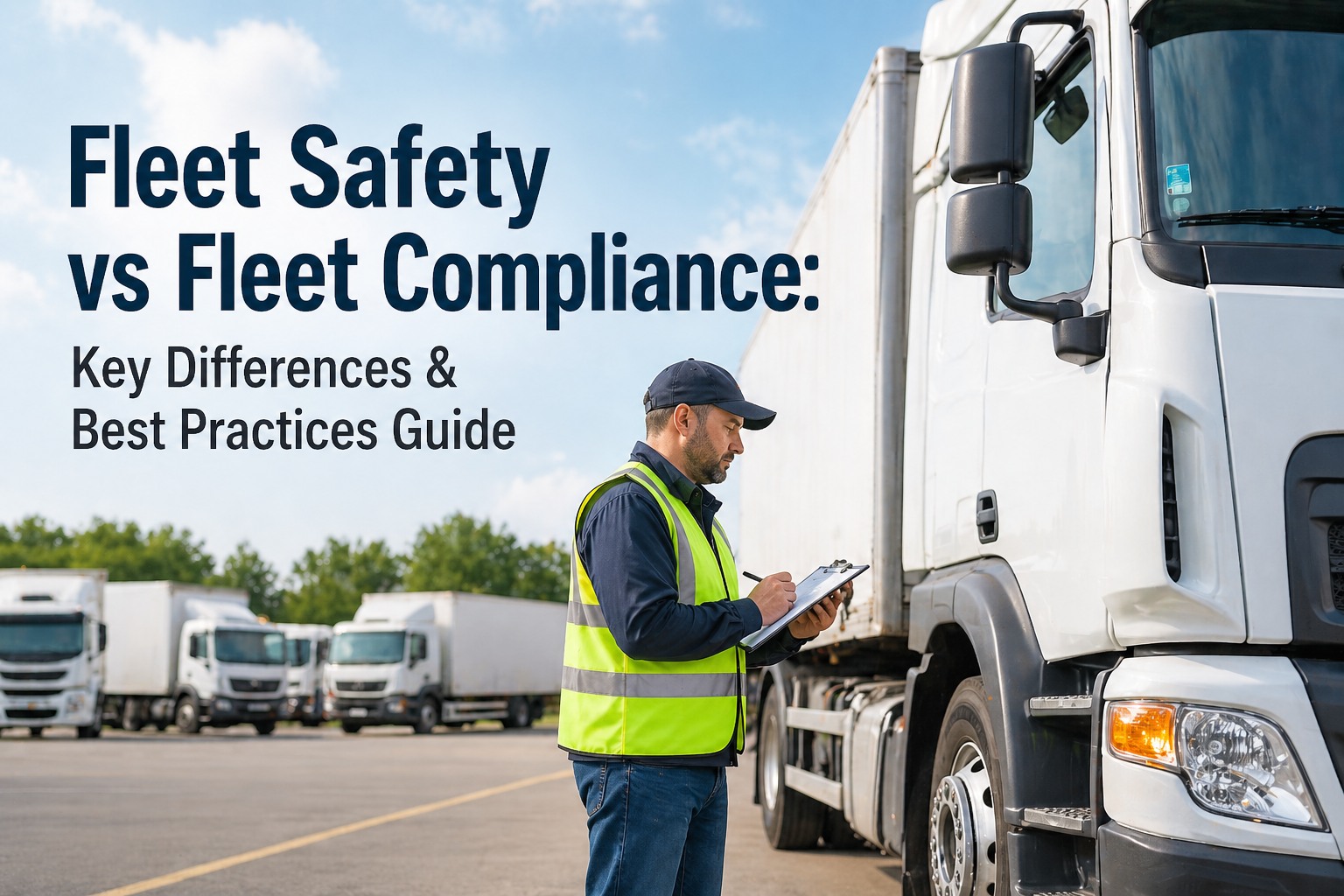
A fleet can be 100% compliant and still be unsafe. Every DVIR filed on time, every medical certificate current, every PM completed on schedule — and a truck still rolls out with brake adjustment drifting toward failure because the inspection was a checkbox exercise, not a genuine walk-around. Conversely, a fleet can have the best safety culture in the industry and still fail a DOT audit because documentation gaps make good practices invisible to auditors. Safety and compliance are not the same thing — and treating them as interchangeable creates dangerous blind spots. Compliance asks: "Did we meet the regulatory requirement?" Safety asks: "Is this vehicle actually safe to operate?" The fleets that achieve the best outcomes in 2026 — the lowest accident rates, the cleanest CSA scores, and the fewest nuclear verdict exposures — are the ones that understand where these two disciplines overlap, where they diverge, and how to build systems that serve both simultaneously. HVI's inspection and compliance platform bridges the gap — delivering genuine safety verification that also produces audit-ready compliance documentation as a byproduct.
Safety That Proves Itself on Paper
HVI delivers genuine safety inspections that automatically generate audit-ready compliance records. No tradeoff between doing it right and documenting it right.
Safety vs. Compliance: The Core Difference
Before diving into best practices, understand what each discipline actually focuses on — and where they create different outcomes.
Fleet Safety
Core question:
"Will this vehicle operate without causing harm?"
Focuses on actual vehicle condition, driver behaviour, risk prevention, and operational practices that protect lives — regardless of whether a regulation requires it.
Example: A driver notices unusual steering vibration that does not trigger any OOS criteria. Safety says: investigate now. The vehicle is not technically non-compliant — but it may be unsafe.
VS
Fleet Compliance
Core question:
"Have we met every regulatory requirement with proper documentation?"
Focuses on meeting FMCSA, DOT, OSHA, and state regulatory standards — with documentation that proves it during audits, roadside inspections, and legal proceedings.
Example: A DVIR was completed on time with all items checked. Compliance says: requirement met. But if the driver rushed through in 90 seconds without genuinely inspecting — the compliance record exists but safety verification did not.
Head-to-Head: Where They Differ
Understanding the specific differences between safety and compliance reveals why excelling at one without the other creates gaps.
Primary Goal
Prevent harm — accidents, injuries, fatalities
Meet regulations — pass audits, avoid fines
Measured By
Accident rate, near-misses, injury frequency
Audit pass rate, violation count, CSA score
Time Horizon
Continuous — real-time risk management
Point-in-time — audit, inspection, review dates
Driven By
Culture, training, leadership, accountability
Regulation, enforcement, documentation systems
Inspection Quality
Thorough — did the driver genuinely check?
Complete — was the form submitted on time?
Failure Consequence
Accidents, injuries, fatalities, nuclear verdicts
Fines, audit failures, OOS orders, rating downgrades
Cost of Failure
$27.5M avg nuclear verdict + human cost
$7,155 avg audit penalty, up to $125K+
Who Owns It
Everyone — drivers, managers, technicians, leadership
Safety department, compliance officer, fleet manager
Can Exist Without the Other?
Yes — but undocumented safety is invisible to auditors
Yes — but checkbox compliance does not verify safety
HVI eliminates the gap between safety and compliance — photo-verified inspections prove genuine safety checks while automatically generating the documentation that passes audits.
Schedule a demo to see how both work together on one platform.
The Danger Zones: Compliant but Unsafe vs. Safe but Non-Compliant
The worst fleet outcomes happen when safety and compliance are disconnected. These two danger zones explain why.
Compliant but Unsafe
Every DVIR filed. Every PM logged. Every credential current. But inspections are pencil-whipped — completed in 90 seconds without a genuine walk-around. The defect that a real inspection would have caught goes undetected. The truck rolls out. The brake fails. The crash investigation finds a clean compliance record — and an attorney who will argue the carrier created a "culture of checkbox compliance" that prioritised documentation over actual safety.
Result: $27.5M average nuclear verdict. Clean compliance records make the negligence argument worse — not better — because they prove the carrier had the tools but chose not to use them genuinely.
Safe but Non-Compliant
Excellent maintenance culture. Experienced drivers who genuinely check their vehicles. Technicians who fix everything properly. But documentation is inconsistent — DVIRs are verbal, repairs are logged on paper that never reaches the office, medical certificates expire without tracking, and the Clearinghouse query is 4 months overdue. The DOT auditor sees no evidence that good practices exist.
Result: $7,155 average audit penalty. Conditional safety rating. Insurance premium increase. Good practices that cannot be proven are treated as if they never happened.
Best Practices That Serve Both Safety and Compliance
The strongest fleet programs do not treat safety and compliance as separate initiatives — they build systems where safety actions automatically produce compliance documentation. Sign up free for HVI and implement these best practices from day one.
01
Replace Checkbox DVIRs with Guided Photo-Verified Inspections
Safety benefit: Drivers genuinely inspect every component because the app guides the walk-around sequence and requires photos at critical checkpoints. Pencil whipping becomes physically impossible.
Compliance benefit: Every inspection generates a timestamped, GPS-verified, photo-evidenced DVIR stored in the cloud — audit-ready and searchable. The 2026 CSA "Driver Observed" category directly scores this quality.
02
Automate the Defect-to-Repair Chain
Safety benefit: Defects are routed to maintenance instantly with photo evidence and severity classification. Safety-critical items trigger immediate alerts. No vehicle operates with a known unrepaired defect.
Compliance benefit: The complete defect → work order → repair → certification chain is documented automatically — the exact chain FMCSA auditors verify under 49 CFR 396.11 and 396.13.
03
Enforce the 3-Signature DVIR Chain Digitally
Safety benefit: No vehicle returns to service until the mechanic certifies the repair and the next driver acknowledges it. The vehicle is physically blocked from dispatch until all three signatures are captured.
Compliance benefit: The 3-signature requirement is the most commonly broken compliance chain on paper fleets. Digital enforcement eliminates this violation category entirely.
04
Score Inspection Quality — Not Just Completion
Safety benefit: AI-scored inspection quality (time, completeness, photo quality, consistency) identifies drivers who rush through walk-arounds. Targeted coaching improves actual inspection thoroughness — not just submission rates.
Compliance benefit: The 2026 CSA "Driver Observed" BASIC directly scores the quality of defects drivers should catch. Monitoring inspection quality metrics keeps this score healthy.
05
Track Credentials Automatically with Escalation
Safety benefit: No driver operates without valid medical certification, CDL, or Clearinghouse clearance. Dispatch-restricted at expiration — not at the next audit or roadside inspection.
Compliance benefit: Expired medical certificates are 35% of all audit violations. Automated 60/30/7-day alerts with escalation eliminate the single most common audit finding.
06
Build Legal Defence into Daily Operations
Safety benefit: Comprehensive daily inspection records prove the carrier actively managed vehicle safety — not just checked boxes. In the event of an incident, records demonstrate systematic effort.
Compliance benefit: In nuclear verdict litigation, plaintiff attorneys examine inspection records first. GPS-verified, photo-documented, AI-scored inspection records are the strongest defence evidence a carrier can produce.
Every best practice above is built into HVI's inspection workflow — safety verification that automatically produces compliance documentation.
Start free today, or
schedule a demo to see all 6 best practices running on your vehicle types.
Safety and Compliance Are Not the Same — But They Should Be Connected
The fleet that treats compliance as the goal will pass audits but miss defects. The fleet that treats safety as the goal will prevent accidents but fail audits. The fleet that connects both — where every safety action produces a compliance record, and every compliance record verifies genuine safety — achieves the outcomes that matter: the lowest accident rates, the best CSA scores, the cleanest audits, and the strongest legal defence position. HVI is built for this connection: guided photo-verified inspections that prove genuine safety checks, automated defect-to-repair chains that satisfy both operational safety and regulatory documentation, 3-signature DVIR enforcement that protects both the vehicle and the compliance record, and AI quality scoring that ensures inspections are thorough — not just completed. Sign up free and build a fleet program where safety and compliance reinforce each other from day one.
Where Safety and Compliance Meet
Photo-verified safety inspections. Audit-ready compliance records. AI quality scoring. 3-signature enforcement. Legal defence documentation. All on one platform — trusted by 25,000+ users.
Frequently Asked Questions
Q: What is the difference between fleet safety and fleet compliance?
Fleet safety focuses on whether a vehicle is actually safe to operate — genuine inspection quality, real defect detection, effective maintenance, and driver behaviour that prevents accidents. Fleet compliance focuses on whether regulatory requirements are met with proper documentation — DVIRs filed, PMs logged, credentials current, audit records ready. A fleet can be compliant without being safe (checkbox inspections) or safe without being compliant (good practices, poor documentation). The strongest programs connect both.
Q: Can a fleet be compliant but still unsafe?
Yes — this is the most dangerous gap. When drivers complete DVIRs in 90 seconds without genuinely walking around the vehicle, the compliance record exists but the safety verification did not happen. The truck operates with undetected defects. If a crash occurs, plaintiff attorneys argue the carrier created a "culture of checkbox compliance" — making clean compliance records evidence of negligence rather than defence.
HVI prevents this with photo-required checkpoints and AI inspection quality scoring.
Q: How does the 2026 CSA overhaul affect the safety vs. compliance balance?
The February 2026 CSA overhaul created a "Driver Observed" category that separately scores defects drivers should have caught during walk-arounds. This directly connects safety inspection quality to compliance scoring — making pencil-whipped inspections visible on your carrier profile for the first time. OOS violations now carry 2x severity weight. The overhaul effectively forces fleets to align safety and compliance.
Schedule a demo to see CSA integration.
Q: What does HVI do differently to connect safety and compliance?
HVI makes every safety action automatically produce a compliance record. Guided photo-verified inspections verify genuine safety checks while generating timestamped, GPS-verified DVIRs. Defect-to-repair automation ensures both immediate safety response and complete 49 CFR 396.11/396.13 documentation. AI quality scoring measures inspection thoroughness — not just completion. The 3-signature chain is enforced digitally, protecting both the vehicle and the compliance record simultaneously.
Q: What are the best practices for improving both safety and compliance?
Six practices that serve both: (1) replace checkbox DVIRs with guided photo-verified inspections, (2) automate defect-to-repair chains so nothing falls through cracks, (3) enforce the 3-signature DVIR chain digitally, (4) score inspection quality — not just completion, (5) track credentials automatically with dispatch restriction at expiration, (6) build legal defence into daily operations with GPS-verified, AI-scored records. HVI implements all six from day one.
Start free.