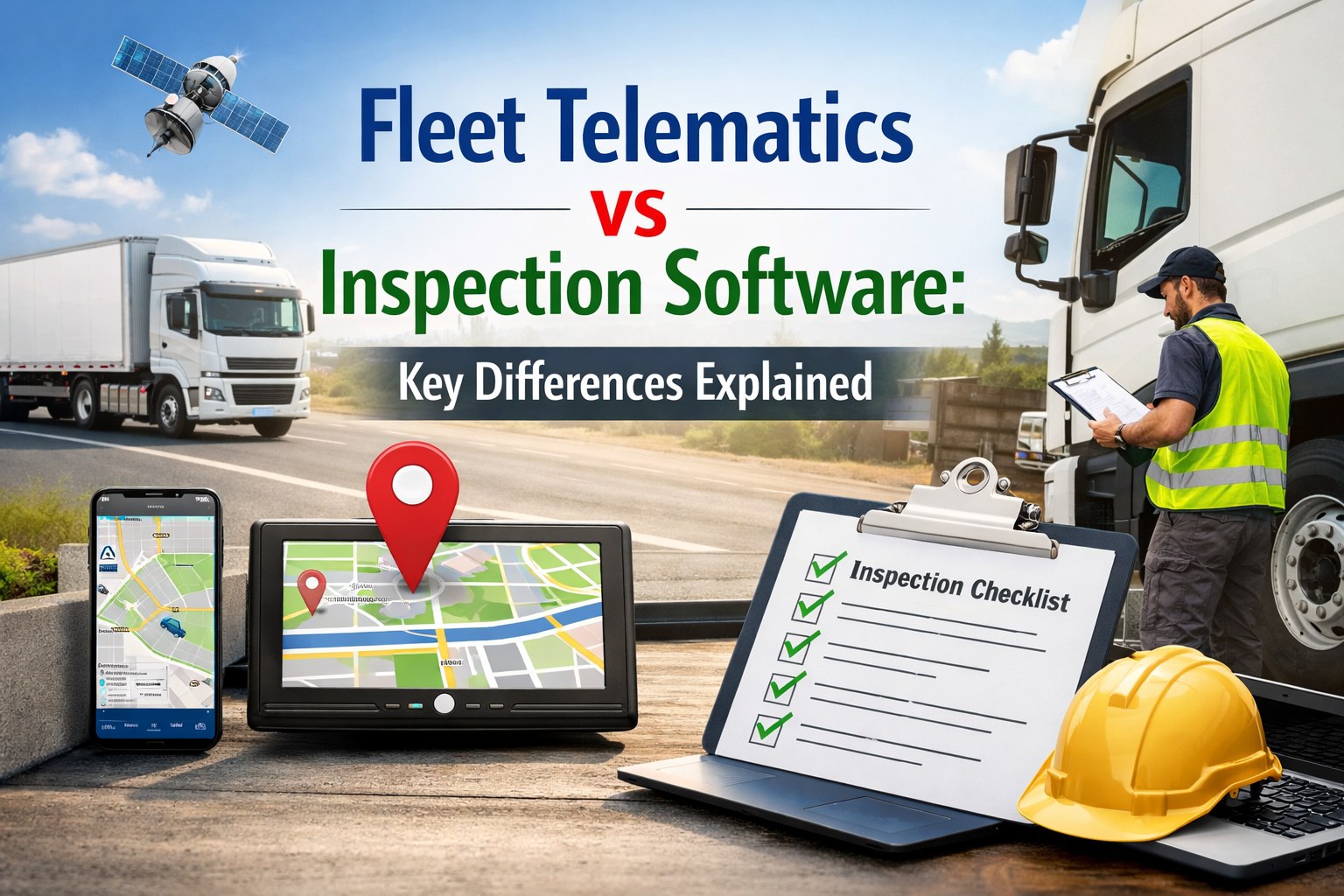
Choosing the wrong fleet logbook software costs more than the subscription fee — it creates compliance gaps that trigger FMCSA violations, maintenance blind spots that lead to breakdowns, and data silos that make every audit a scramble. With over 200 platforms on the market in 2026, fleet operators need a comparison that evaluates what actually matters for heavy vehicle operations: inspection depth, maintenance integration,mcompliance automation, mobile usability, and total cost of ownership. This guide compares the five fleet logbook solutions most commonly evaluated by heavy vehicle fleets — ranked by how well they handle the inspection-to-maintenance chain that determines whether your software investment produces ROI or just produces another subscription invoice. Whether you run 10 trucks or 500+ mixed assets, the right platform should eliminate paper, connect every record, and keep your fleet audit-ready around the clock.
What Heavy Vehicle Fleets Actually Need from Logbook Software
Before comparing platforms, you need to know which capabilities separate fleet logbook software that works for heavy vehicles from tools designed for light-duty or general-purpose fleets. These six criteria drive the evaluation.
01
Vehicle-Specific Inspection Templates
Generic one-size-fits-all checklists miss critical items. Heavy vehicle software must provide templates for Class 8 tractors, trailers, buses, cranes, forklifts, and specialty equipment — each with the correct inspection items per vehicle type and regulation.
02
Inspection-to-Maintenance Chain
The defining feature: defect found during inspection auto-generates a work order with photos, routes it to maintenance, tracks repair, certifies completion, and updates the vehicle record. If this chain is broken, you have paper problems in digital clothing.
03
FMCSA Compliance Built In
DVIR 3-signature chain enforcement, annual DOT inspection tracking with 90-day lookahead, maintenance record retention per 49 CFR 396.3, and eDVIR authorization (effective March 2026). Compliance must be enforced by the platform — not left to user discipline.
04
Mobile-First with Offline Capability
Drivers and mechanics work in cabs, job sites, and shop floors — not at desks. The mobile app must be the primary interface, not a stripped-down companion. Full offline functionality with auto-sync is non-negotiable for heavy vehicle operations.
05
PM Scheduling with Multi-Trigger Logic
Heavy vehicles need PM scheduled by mileage, engine hours, calendar, or whichever-comes-first — with different triggers for different vehicle types. Road vehicles run on mileage; equipment runs on hours; seasonal fleet runs on calendar.
06
Fleet Analytics & Audit Exports
Dashboards showing vehicle availability, cost-per-mile, planned-vs-reactive ratio, PM completion rate, and defect trends. Plus instant audit exports — FMCSA offsite audits sometimes give 48 hours notice. Your software must produce records in minutes, not days.
The Top 5 Fleet Logbook Solutions Compared
Each platform is evaluated across the six criteria above, with specific attention to how it handles heavy vehicle inspection and maintenance workflows. Schedule a demo of HVI to see how our platform compares with your specific fleet requirements.
HVI provides the inspection and maintenance depth that telematics platforms handle as add-ons. Many fleets pair HVI with their existing ELD/telematics provider for complete coverage.
Schedule a demo to see HVI alongside your current tools. Or
start your free trial.
Side-by-Side Feature Matrix
This matrix compares the five platforms across the features that matter most for heavy vehicle fleet logbook operations. Sign up free to test HVI's features against your current workflow.
Vehicle-specific inspection templates
Yes (37–70 items)
Basic
Basic
Basic
Add-on
3-signature DVIR chain
Enforced
No
Partial
Partial
No
Defect auto-generates work order
Automatic
Yes
Manual
Manual
Add-on
Multi-trigger PM (mi/hrs/cal)
All 3 + first
All 3
Mileage + cal
Basic
Mileage + cal
Offline mobile inspections
Full offline
Limited
Limited
Limited
No
OSHA/ASME B30 templates
Built in
No
No
No
No
Proprietary hardware required
None
None
Required
Required
Required
Built for heavy vehicles
Purpose-built
General fleet
General fleet
Carrier-focused
Data platform
Free trial available
Yes
Yes
Demo only
Demo only
Demo only
Which Platform Fits Your Fleet?
The right platform depends on your fleet's primary operational challenge. Use this decision framework to identify where to start — then test with real vehicles and real data before committing to a contract.
If your primary challenge is...
Inspection quality, DVIR compliance, and the defect-to-repair chain for heavy vehicles
Choose: HVI
Purpose-built for heavy vehicle inspection and maintenance. Vehicle-specific templates, 3-signature DVIR enforcement, auto-generated work orders, multi-regulation compliance. No hardware required.
Start free today.
If your primary challenge is...
Broad maintenance management with vendor and expense tracking
Choose: Fleetio
Good all-around fleet maintenance platform. Affordable entry point for small to mid-size fleets. Strong when outsourcing to external repair shops. Consider pairing with HVI for deep inspection coverage.
If your primary challenge is...
Real-time GPS tracking, AI dashcams, and connected fleet visibility
Choose: Samsara
Enterprise telematics platform with comprehensive data visualization. Strong for large logistics operations. Requires 3-year contract and proprietary hardware. Pair with HVI for inspection depth.
If your primary challenge is...
ELD compliance, HOS tracking, and CSA score management
Choose: Motive
Compliance-first ELD platform with integrated driver coaching. Best for carriers where HOS is the top operational concern. Pair with HVI for maintenance and inspection management beyond ELD basics.
If your primary challenge is...
Deep data analytics, custom API integrations, and predictive maintenance at scale
Choose: Geotab
Powerful data platform with extensive customization. Best for data-mature fleets (Level 4) with technical resources. Requires development investment to build inspection workflows that HVI provides out of the box.
Most heavy vehicle fleets need deep inspection and maintenance management first — then add telematics, ELD, or analytics as secondary layers. HVI delivers the inspection-to-maintenance chain that every other function depends on.
Book a demo to see HVI with your vehicle types. Or
start free.
Start with the Inspection Chain — Everything Else Follows
Fleet logbook software comparisons often focus on feature counts, but the platform that produces the best ROI for heavy vehicle fleets is the one that connects every inspection to every work order to every compliance record — automatically, without manual handoffs. That is the inspection-to-maintenance chain, and it is what separates software that transforms your operation from software that digitizes your existing problems. HVI provides this chain purpose-built for heavy vehicles, with the vehicle-specific templates, multi-regulation compliance, and mobile-first design that generic platforms handle as afterthoughts. Sign up free and see the difference in your first week.
See Why Heavy Vehicle Fleets Choose HVI
Purpose-built inspection and maintenance management. Vehicle-specific templates. 3-signature DVIR enforcement. Auto-generated work orders. Trusted by 25,000+ users worldwide.
Frequently Asked Questions
Q: Why is HVI ranked #1 for heavy vehicle fleets?
HVI was designed from the ground up for heavy vehicle operations — not adapted from a generic CMMS or ELD. It provides vehicle-type-specific templates (37–70+ items per vehicle type), enforced 3-signature DVIR chains, automatic defect-to-work-order routing, multi-trigger PM scheduling, and multi-regulation compliance (FMCSA, OSHA, ASME B30) on one platform. No other solution on this list matches HVI's depth for heavy vehicle inspection and maintenance.
Q: Can I use HVI alongside my existing ELD or telematics system?
Yes — HVI complements ELD and telematics platforms. It handles the inspection, DVIR, maintenance, and compliance documentation that ELD systems do not cover. Many fleets run HVI alongside Samsara, Motive, Geotab, or other telematics providers for complete operational coverage.
Book a demo to see how HVI integrates with your current tools.
Q: What does HVI cost compared to these other platforms?
HVI offers a free trial with no hardware investment required — it runs on any iOS or Android smartphone. Platforms like Samsara, Motive, and Geotab require proprietary hardware ($100–$400+ per vehicle) plus multi-year contracts. Fleetio and HVI are the most accessible on this list, but HVI provides deeper heavy vehicle inspection capability.
Try HVI free.
Q: How quickly can I switch to HVI from my current system?
Most fleets complete the transition in 2–4 weeks. Week 1–2 covers vehicle data import and template configuration. Week 2–3 is driver training (one 30-minute session) and pilot with 5–10 vehicles. Week 3–4 is full rollout. Most drivers master the app within 2–3 inspections — faster than their previous paper or digital workflow.
Q: What if I need features that HVI doesn't offer, like route optimization or ELD tracking?
HVI is focused on inspection and maintenance depth — the foundation that every other fleet function depends on. For route optimization, GPS tracking, or ELD/HOS compliance, pair HVI with a telematics provider (Samsara, Geotab) or ELD platform (Motive). The combination delivers better results than any single all-in-one platform trying to do everything at surface level.