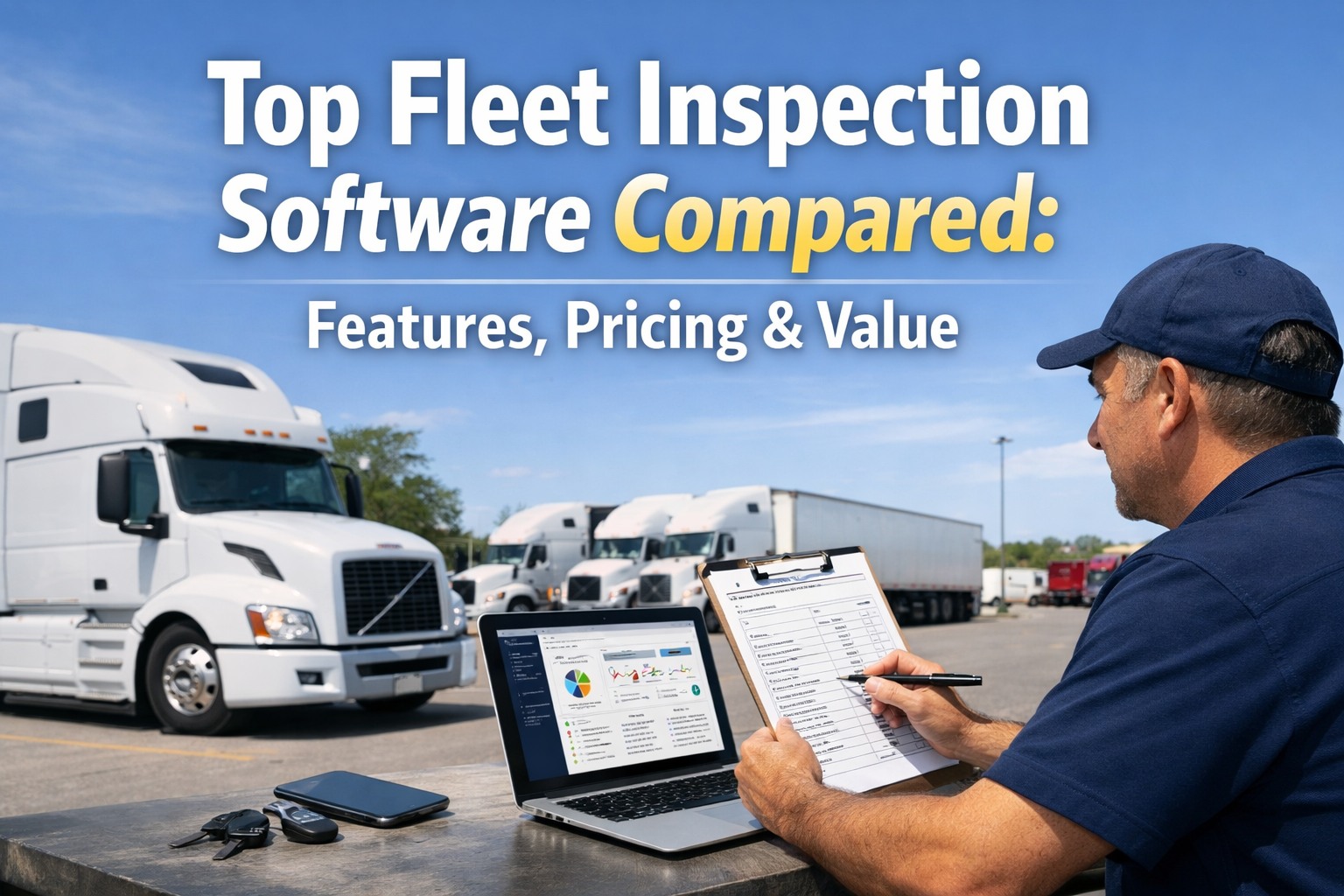
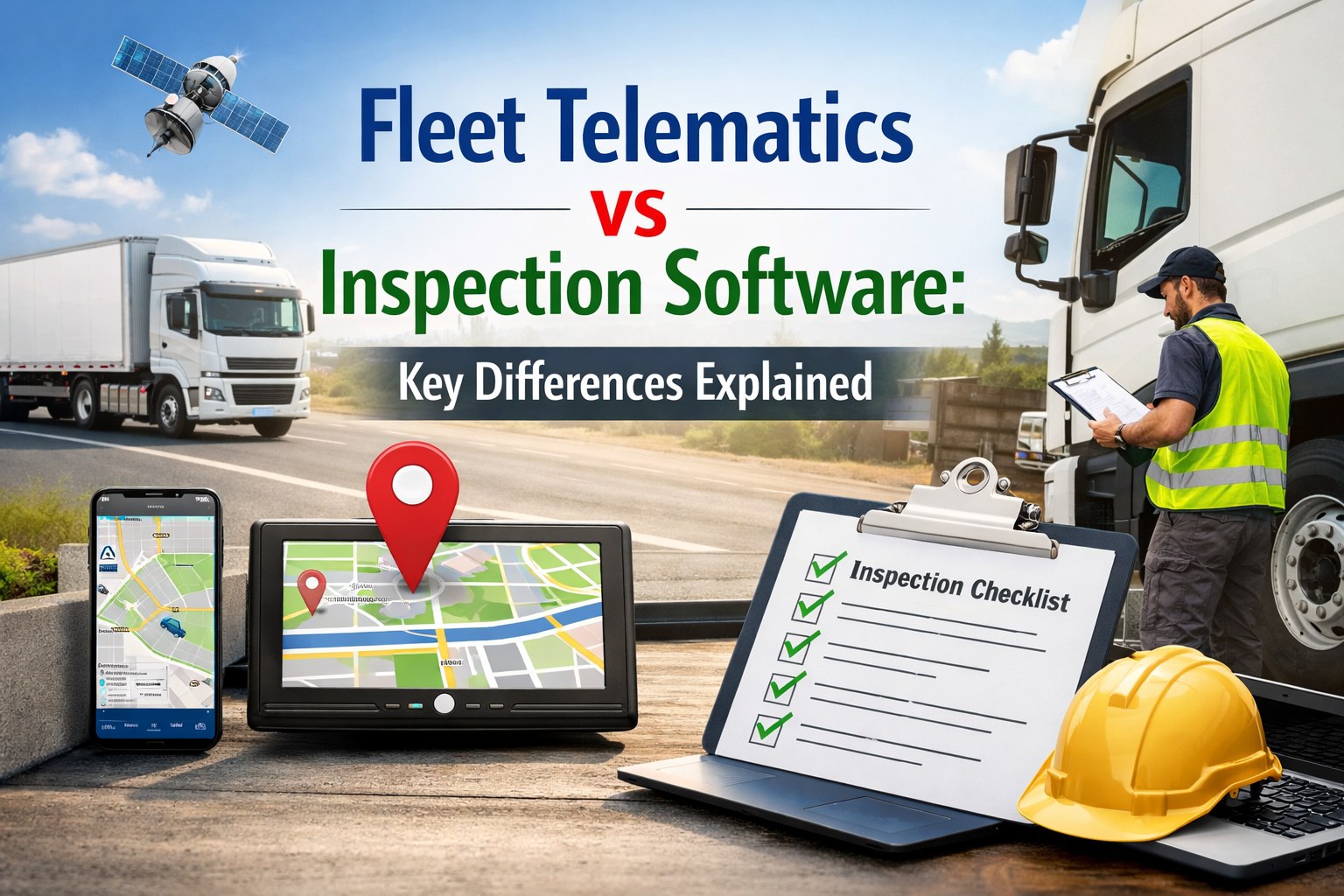
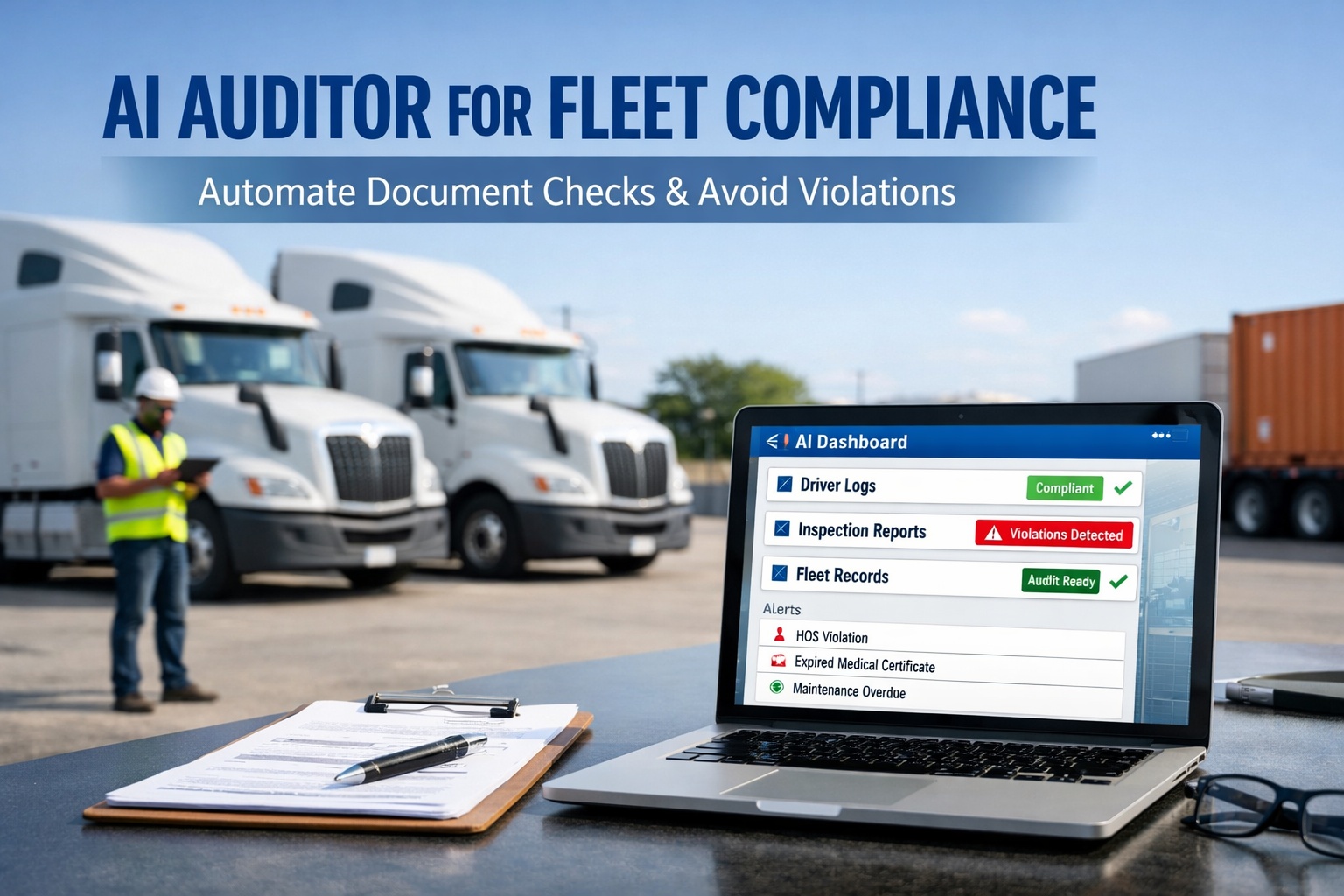
The fleet inspection software market hit $1.32 billion in 2024 and is growing at 12.6% CAGR — driven by FMCSA's February 2026 final rule explicitly authorizing eDVIRs, the new CSA "Driver Observed" scoring category that makes your inspection quality directly visible on your carrier profile, and the simple reality that 73% of paper DVIRs never reach the office. Every fleet needs digital inspections. The question is which platform delivers the best combination of compliance, usability, maintenance integration, and value at your fleet size. This comparison evaluates the top fleet inspection platforms in 2026 across the features that actually matter — guided walk-arounds, defect-to-repair automation, offline capability, 3-signature DVIR enforcement, AI defect detection, pricing transparency, and driver adoption — so you can choose with data instead of demos. HVI is included in this comparison because it was purpose-built for heavy vehicle inspection and consistently leads on compliance depth, maintenance integration, and value per vehicle.
The 6 Criteria That Actually Matter
Before comparing platforms, understand what separates a compliance checkbox app from an operational tool that reduces violations, prevents breakdowns, and survives DOT audits.
01
FMCSA 3-Signature Enforcement
Does the app enforce driver pre-trip → post-trip defect declaration → mechanic repair certification? If any signature is optional, your DVIR chain has a compliance gap the 2026 CSA scoring will expose.
02
Defect-to-Work-Order Automation
When a driver flags a defect, does the system auto-create a prioritised work order with photos, severity, and parts requirements — or does someone need to manually re-enter the information?
03
Offline Capability
Inspections happen at truck stops, rural yards, and job sites with no signal. If the app requires connectivity, your drivers either skip inspections or produce incomplete records in dead zones.
04
Driver Adoption UX
If drivers need more than 10 minutes or find the app confusing, completion rates drop. Large tap targets, photo capture instead of typing, guided walk-around order, and under-10-minute completion are non-negotiable.
05
CSA Score Integration
The 2026 "Driver Observed" BASIC scores items drivers should catch during walk-arounds. Does the platform map DVIR data to this category — or leave your inspection quality invisible?
06
Pricing Transparency
Per-vehicle pricing with no minimums, no hardware lock-in, and no multi-year contracts. Hidden costs (hardware, implementation fees, per-user charges) inflate the true cost 2–5x above the published rate.
Platform Comparison: Features & Pricing
Five platforms evaluated across inspection-specific capabilities. Data from published pricing, feature documentation, and verified user reviews as of 2026.
Starting Price
Free trial, low per-vehicle
$5/veh/mo (Essential)
$4/veh/mo
~$25–35/veh/mo + hardware
~$25–45/veh/mo + hardware
Hardware Required
No — smartphone only
No
No
Yes — proprietary gateway
Yes — proprietary device
Guided Walk-Around
Yes — photo-required steps
Yes — customisable forms
Yes — mobile-first
Basic checklist
Basic checklist
3-Signature DVIR Chain
Enforced — vehicle blocked
Supported
Supported
Partial
Partial
Defect-to-Work-Order
Auto — with parts + severity
Auto — Pro plan required
Manual trigger
Partial — via CMMS add-on
Partial — via integration
Offline Inspections
Full offline + auto-sync
Yes — Fleetio Go
Yes
Yes
Yes
AI Defect Detection
Yes — 163+ components
No
No
AI dashcam (separate)
AI dashcam (separate)
PM Schedule Management
Multi-trigger (mi/hrs/cal)
Yes — all tiers
Basic
Mileage-based only
Mileage-based only
CSA "Driver Observed" Mapping
Yes — directly mapped
No
No
Via CSA module
Via CSA module
Heavy Equipment Support
Yes — OSHA + ASME B30
Limited
Yes
No — trucks only
No — trucks only
Contract Required
No — month-to-month
Annual billing
Annual billing
Multi-year + hardware
Multi-year + hardware
Platform Profiles: Who Each Platform Fits Best
Every platform has a sweet spot. Here is an honest assessment of where each one delivers the most value.
HVI
Best for: Heavy vehicle fleets needing inspection + maintenance + compliance depth
Purpose-built for heavy vehicles — trucks, trailers, cranes, excavators, loaders. The only platform that covers FMCSA DVIRs, OSHA equipment inspections, and ASME B30 crane checklists on one app. Strongest on defect-to-repair automation, 3-signature enforcement, AI defect detection (163+ components), and CSA "Driver Observed" score mapping. No hardware required, no multi-year contracts. 25,000+ users.
Start free.
Fleetio
Best for: Mid-size fleets wanting an all-in-one fleet management tool
Strong general-purpose fleet management — maintenance, fuel tracking, parts inventory, and inspections in one platform. Intuitive interface with solid mobile app (Fleetio Go). Work order automation requires Pro plan ($8/veh/mo). No AI defect detection. Good for fleets that want one tool covering everything at a mid-range price.
Whip Around
Best for: Fleets that prioritise driver-friendly mobile inspections
Mobile-first inspection platform with a clean driver interface. Quick DVIR completion with photo and video capture. Good for fleets where driver adoption is the primary concern. Weaker on maintenance workflow integration — work orders require manual trigger. Basic PM scheduling.
Samsara
Best for: Large fleets wanting integrated telematics + inspections
Comprehensive telematics platform with inspection as one module among many — GPS, ELD, dashcams, driver behaviour, and DVIRs. Strong for fleets that want everything from one vendor. Requires proprietary hardware ($99–$200 upfront per vehicle). Premium pricing ($25–35/veh/mo). Multi-year contracts standard. DVIR is a checklist add-on, not a guided workflow.
Motive
Best for: Large logistics operations needing full telematics suite
AI-powered fleet platform with strong ELD, dashcam, and compliance features. DVIR module with photo evidence. Requires proprietary hardware. Custom enterprise pricing ($25–45/veh/mo). Best suited for large fleets that need the full telematics stack — GPS, video, compliance, and basic inspections — and can absorb the premium pricing.
The Hidden Costs Most Comparisons Miss
Published per-vehicle pricing is rarely the total cost. Here are the cost factors that inflate the actual price of fleet inspection software by 2–5x.
$99–$200
Hardware Per Vehicle
Samsara and Motive require proprietary OBD-II devices per vehicle. A 50-truck fleet pays $5,000–$10,000 upfront before the first inspection runs. HVI, Fleetio, and Whip Around require no hardware.
24–36 mo
Contract Lock-In
Enterprise platforms typically require 2–3 year contracts with early termination fees. If the platform underperforms, you pay the same amount regardless. HVI operates month-to-month.
$500–$2,000
Implementation / Onboarding
Some platforms charge for configuration, template setup, and training. HVI provides guided onboarding included in the subscription — setup completes in under a day.
Per-user fees
User-Based Pricing Add-ons
Some platforms charge per user on top of per-vehicle pricing — adding cost for every manager, dispatcher, and technician who needs dashboard access. HVI includes unlimited users.
Choose the Platform That Matches Your Operation
The best fleet inspection software is the one that your drivers actually use, that connects defects to repairs without manual hand-offs, that produces audit-ready documentation automatically, and that costs what it claims to cost — with no hardware surprises, no contract lock-in, and no per-user add-ons. For heavy vehicle fleets that need the deepest inspection compliance, the strongest maintenance integration, and the most transparent pricing, HVI consistently delivers the highest value. It covers FMCSA DVIRs, OSHA equipment inspections, and ASME B30 crane checklists on one platform — with AI defect detection, 3-signature chain enforcement, CSA "Driver Observed" mapping, and month-to-month flexibility that enterprise platforms cannot match. Start free today and see why 25,000+ users chose HVI — or schedule a comparison demo to see it run alongside your current tool.
Try HVI Free — No Hardware, No Contracts
Guided DVIRs. AI defect detection. 3-signature enforcement. Defect-to-repair automation. CSA score integration. Multi-regulation coverage. Trusted by 25,000+ users worldwide.
Frequently Asked Questions
Q: Which inspection software is best for small fleets under 25 vehicles?
For small fleets, look for: free trial or free tier, no hardware requirements, no minimum vehicle counts, and per-vehicle pricing under $5/month. Avoid enterprise platforms (Samsara, Motive) — their hardware costs and contract requirements make them cost-prohibitive for small operations. HVI offers a free trial with no minimums and full feature access from day one.
Start free.
Q: Do I need to replace my telematics to use inspection software?
No. Dedicated inspection platforms (HVI, Fleetio, Whip Around) work alongside your existing telematics — they handle the inspection, maintenance, and compliance layer that telematics was not built for. If you use Samsara or Motive, their inspection modules are built in — but offer less depth than dedicated inspection platforms.
Schedule a demo to see HVI running alongside your telematics.
Q: What makes HVI different from Fleetio or Whip Around?
HVI was purpose-built for heavy vehicle inspection — covering FMCSA DVIRs, OSHA equipment inspections, and ASME B30 crane checklists on one platform. Key differentiators: AI defect detection across 163+ components (95–99% accuracy), enforced 3-signature DVIR chain (vehicle blocked until complete), direct CSA "Driver Observed" score mapping, and multi-trigger PM scheduling. Fleetio is a strong general-purpose fleet tool; Whip Around is a strong mobile-first inspection app — neither matches HVI's heavy vehicle inspection depth.
Q: How long does it take to switch from paper to digital inspections?
Most fleets complete the transition in 2–4 weeks: configure templates per vehicle type (day 1), map checklist items to walk-around order (day 1–2), set defect routing rules (day 2), train drivers in a single 25-minute session (day 3–5), and pilot with one terminal before fleet-wide rollout. 95%+ driver adoption within 30 days is the documented norm across platforms.
Q: Is eDVIR legally compliant in 2026?
Yes — unambiguously. FMCSA published a final rule on February 19, 2026 (Docket FMCSA-2025-0115, effective March 23, 2026) explicitly authorizing electronic DVIRs under 49 CFR 396.11 and 396.13. Electronic signatures are legally binding under the E-SIGN Act. Digital records are preferred during FMCSA desktop audits because they are searchable, timestamped, and tamper-evident. Paper DVIRs remain legal but are now an operational and regulatory disadvantage.