Fleet managers hear "inspection" and "audit" constantly — and often use them interchangeably. That confusion is costly. In 2025, FMCSA auditors found an average of six violations per audit, even on targeted focused reviews. Only 7% of motor carriers pass DOT audits without a single violation — the remaining 93% face fines, out-of-service orders, or worse. Meanwhile, approximately 2.5 to 3.5 million roadside inspections of commercial motor vehicles are conducted each year in North America, with 22.6% of vehicles placed out of service during the 2025 CVSA International Roadcheck. These are fundamentally different events with different triggers, different processes, different consequences, and different preparation requirements — yet most fleets prepare for them with the same approach. That's like studying for a math test and a history test with the same flashcards.
Understanding the distinction between inspections and audits is critical because each exposes different vulnerabilities and demands different defenses. A fleet that aces every roadside inspection can still fail a compliance audit because inspections check vehicle condition while audits check your systems, records, and management processes. Conversely, a fleet with immaculate records can still accumulate roadside violations if vehicles aren't properly maintained. In 2026, FMCSA's shift to data-driven continuous safety ratings, on-site focused audits at their highest level in five years, and stricter Drug and Alcohol Clearinghouse enforcement make both inspection readiness and audit preparedness essential — not one or the other, but both working together as complementary layers of compliance defense.
Inspection vs. Audit: The Fundamental Distinction
"Is this vehicle safe to operate right now?"
Focus: Physical condition of vehicles and driver credentials at a single point in time
When: Daily (DVIRs), annually (DOT annual), randomly (roadside), and during CVSA events
Who conducts: Drivers (DVIRs), certified inspectors (annual), CVSA-certified enforcement officers (roadside)
Duration: 5-10 minutes (DVIR) to 45-60 minutes (Level I roadside)
Outcome: Pass/fail for individual vehicle. Violations added to carrier's SMS/CSA scores. OOS orders for critical defects.
"Does this carrier have safety systems that work?"
Focus: Carrier's safety management systems, recordkeeping, and regulatory compliance across all operations
When: New entrant (months 9-12), triggered by CSA data, complaints, crashes, or random selection
Who conducts: FMCSA-certified auditors or state DOT investigators
Duration: Hours to days. On-site focused reviews target 1-2 specific areas; comprehensive reviews cover all operations.
Outcome: Safety rating (Satisfactory/Conditional/Unsatisfactory). Corrective action plans. Fines up to $19,277/violation. Operating authority at risk.
What Is a Fleet Inspection? Types, Levels, and What's at Stake
Fleet inspections are point-in-time evaluations of vehicle condition and driver compliance. They range from the daily driver vehicle inspection report (DVIR) required before and after every trip, to comprehensive roadside inspections conducted by certified enforcement officers. Each inspection type serves a different purpose — but they all share one characteristic: they evaluate what's happening right now, not what your records say should be happening.
What It Is
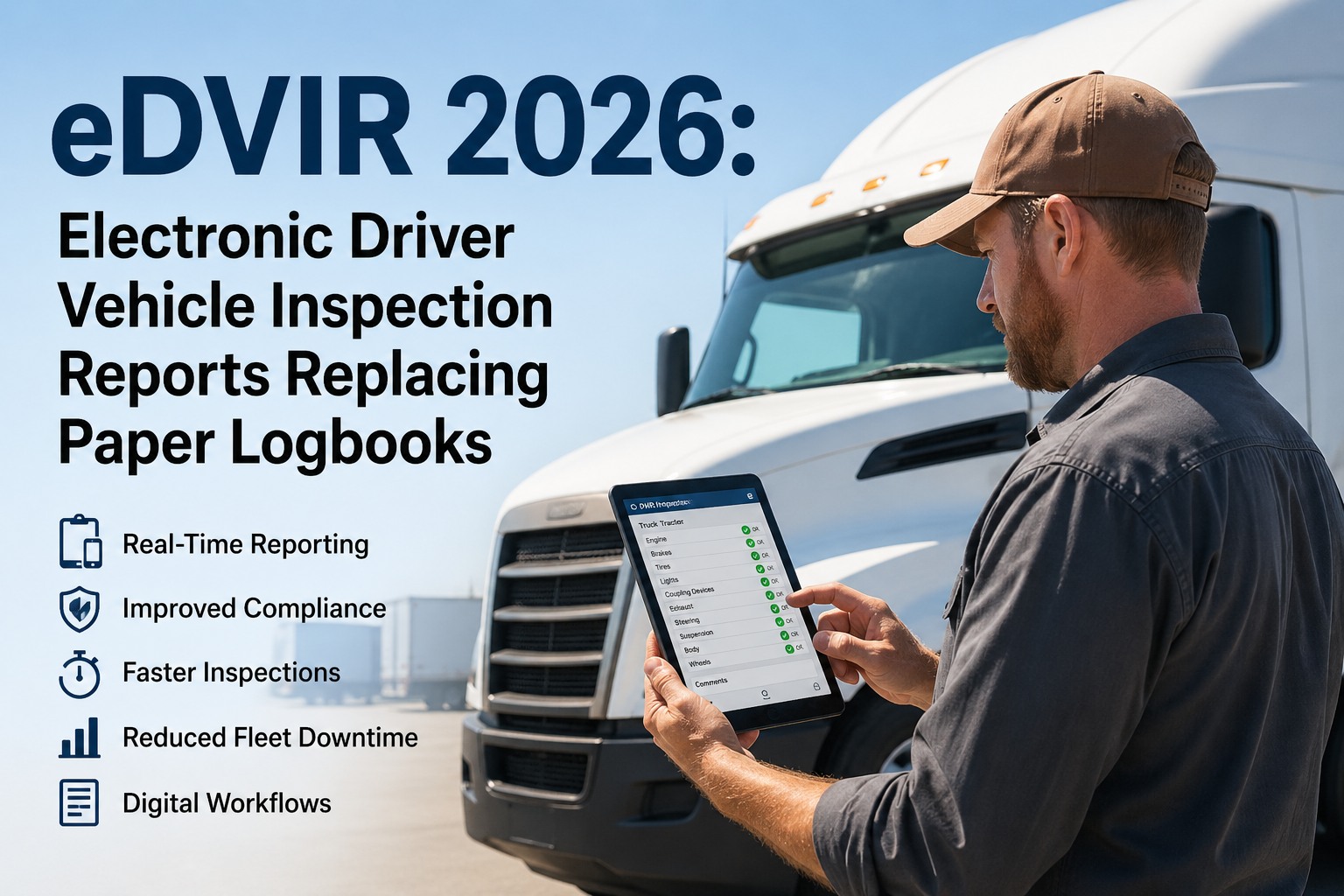
Federal requirement (49 CFR 396.11 & 396.13) for drivers to inspect their vehicle before operating (pre-trip) and at the end of each day's work (post-trip). FMCSA estimates DVIRs help prevent approximately 14,000 accidents annually through early defect identification. The DVIR must list any defect or deficiency that could affect safe operation or result in a mechanical breakdown.
What's Checked
Brakes, coupling devices, lighting, tires, wheels, windshield, mirrors, horn, steering, suspension, frame, exhaust, emergency equipment. If previous DVIR noted deficiencies, driver must review and sign acknowledgment that repairs were made before operating.
Consequences
Missing DVIRs are the #1 citation in FMCSA audits. Each missing DVIR is a separate violation. Retention requirement: minimum 3 months. Pattern of incomplete DVIRs triggers FMCSA investigation. Poorly executed DVIRs lead to missed defects that become roadside violations and CSA score damage.
What It Is
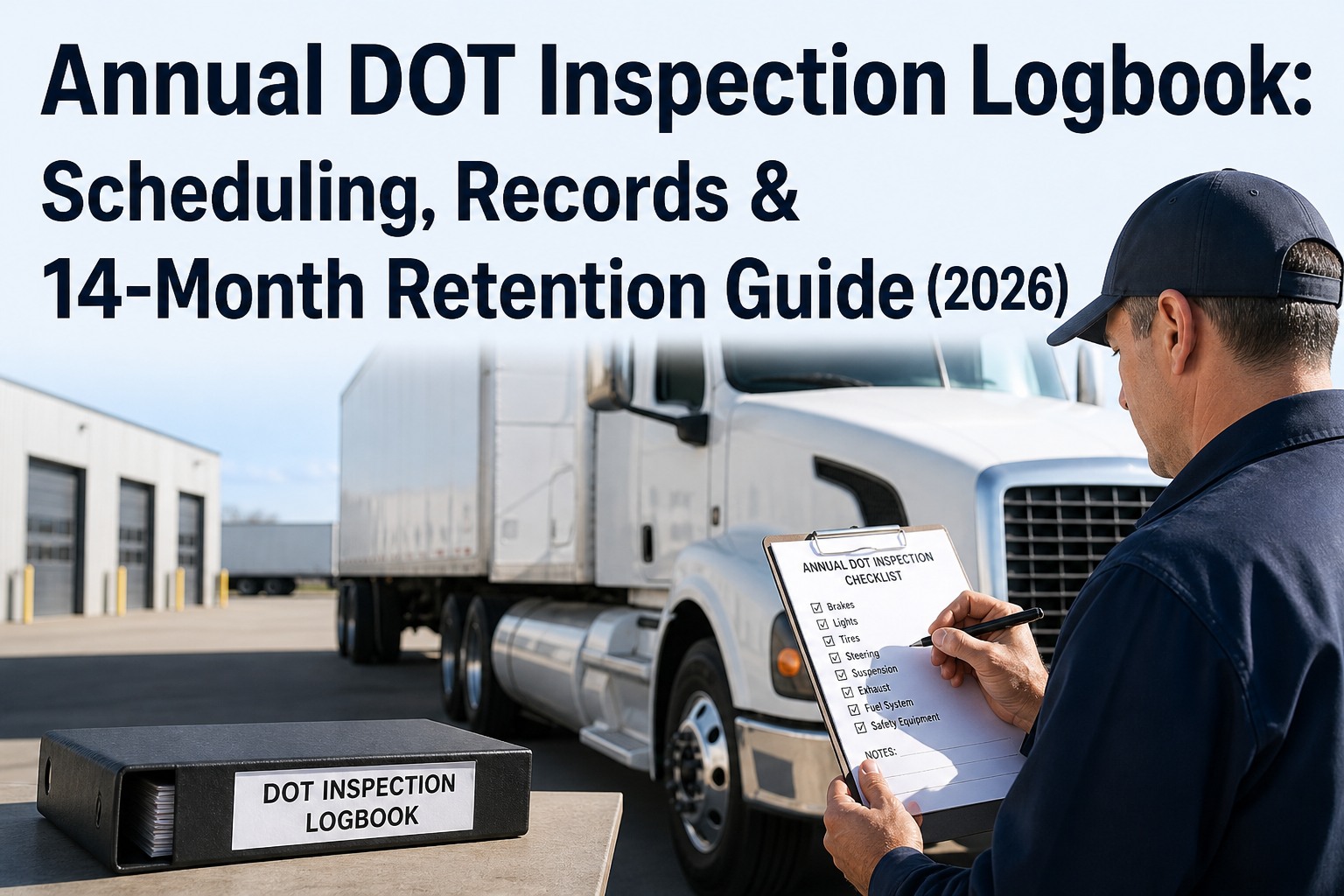
Required at least once every 12 months per 49 CFR 396.17. Must be performed by a qualified inspector following Appendix A or Appendix G standards. The inspection certificate (valid for 12 months from last day of inspection month) must be carried on the vehicle and a copy maintained at the carrier's principal place of business.
What's Checked
Comprehensive evaluation of 14 component categories: brake system, coupling devices, exhaust system, fuel system, lighting, safe loading, steering mechanism, suspension, frame, tires, wheels/rims, windshield glazing, emergency equipment, and electrical systems.
Consequences
Operating without current annual inspection: $19,277 maximum fine per violation. Certificate must be retained for 14 months. During audits, investigators verify annual inspection records exist for every vehicle. Missing or expired inspections are high-severity findings that can trigger conditional or unsatisfactory safety ratings.
What It Is
Unannounced inspections by CVSA-certified enforcement officers at weigh stations, roadside stops, or roving patrols. 2.5-3.5 million conducted annually in North America. Eight inspection levels, from the comprehensive 37-step Level I (most common) to the wireless Level VIII electronic screening. Passing Level I/V/VI earns a CVSA decal valid for 3 months.
Key Levels
Level I: Full 37-step driver + vehicle inspection (45-60 min). Most common and thorough. Level II: Walk-around — everything visible without going under vehicle. Level III: Driver-only — credentials, medical card, HOS, drug/alcohol compliance. Level IV: Special — one-time focus area (e.g., Brake Safety Week). Level V: Vehicle-only — without driver present, often at terminals.
Consequences
Violations feed directly into carrier's CSA/SMS BASIC scores. Out-of-service orders for critical violations — vehicle/driver cannot operate until corrected. 2025 Roadcheck: 22.6% of inspected vehicles placed OOS. Carrier must certify all violations corrected within 15 days. Repeat violations increase intervention probability and trigger focused audits.
What Is a Compliance Audit? Types, Triggers, and What Investigators Actually Look For
A compliance audit evaluates your safety management systems — not a single vehicle at a single moment, but your entire operation over time. Auditors examine whether you have the policies, processes, records, and oversight necessary to operate safely and comply with federal regulations. In 2025, FMCSA conducted on-site focused audits at their highest level in five years, averaging six violations per audit. The shift from broad comprehensive reviews to targeted focused audits means investigators arrive knowing exactly what they're looking for — and they're finding it.
When
Months 9-12 after activating USDOT authority (sometimes later due to state backlogs). Required during the 18-month provisional period. Conducted by phone/online or in-person depending on state.
Scope
Review of basic safety management controls across all major compliance areas: CDL requirements, driver qualifications, HOS/ELD, drug and alcohol testing, inspection/repair/maintenance (Parts 393 & 396), hazmat (if applicable), financial responsibility, accident register.
Stakes
Pass or fail. Failing triggers corrective action plan (CAP) — if not resolved within 30 days, provisional authority is suspended and then revoked. No drug/alcohol testing program = automatic fail. Refusing the audit = immediate suspension. Passing earns permanent Certificate of Registration after the 18-month period.
When
Triggered by poor CSA/SMS scores, serious crashes, complaints, or random selection. Most in-depth form of FMCSA investigation. Becoming less common as FMCSA shifts to focused reviews — but still used for carriers with systemic problems.
Scope
Full examination of all regulatory areas: DQ files for every driver, 6 months of HOS records, complete maintenance records, drug and alcohol program, insurance, accident register, hazmat procedures. Investigators may interview drivers and review vehicles on-site.
Stakes
Results in a formal safety rating: Satisfactory, Conditional, or Unsatisfactory. Conditional rating requires corrective action; Unsatisfactory can lead to operating authority revocation. Fines up to $19,277 per violation. Shippers and insurers screen safety ratings — Conditional or Unsatisfactory ratings mean lost contracts and premium increases.
When
Triggered by specific CSA BASIC scores exceeding intervention thresholds, pattern of specific violation types during roadside inspections, or crash data. Projected to reach nearly 6,000 by end of 2025 fiscal year — highest in five years.
Scope
Examines only 1-2 specific compliance areas where problems were flagged. Examples: HOS/ELD compliance only, Clearinghouse procedures only, vehicle maintenance records only. Narrower scope but deeper investigation of the targeted area. Auditors arrive knowing exactly what they're looking for.
Stakes
Average of six violations per focused audit in 2025. Violations documented in FMCSA record, impacting CSA scores and increasing risk of comprehensive review. Can result in civil penalties and corrective action orders. Multiple focused reviews may escalate to full compliance review.
What Triggers an FMCSA Audit? The 6 Red Flags
1
CSA BASIC Scores Above Thresholds
Any BASIC score exceeding the 65th percentile for general carriers (80th for HM/passenger). Multiple BASICs above threshold = highest priority. Vehicle Maintenance and Unsafe Driving BASICs are most heavily scrutinized.
2
Crash Rate Above Peer Average
Carriers with crash rates significantly above peer group average, particularly fatal or injury crashes, are prioritized for investigation regardless of other scores.
3
Repeat Roadside Violations
Pattern of the same violation type across multiple roadside inspections signals a systemic problem that inspections alone can't fix. FMCSA escalates to an audit to examine the root cause.
4
Complaints
Safety complaints from drivers, the public, or other carriers — particularly regarding vehicle condition, HOS violations, or drug/alcohol concerns. FMCSA investigates complaint-triggered reviews at higher priority.
5
Clearinghouse Violations
Failure to conduct required pre-employment or annual Clearinghouse queries. Allowing drivers in "prohibited" status to operate. Penalties up to $5,833 per occurrence. Now one of the most enforcement-intensive compliance areas.
6
New Entrant Status
All new carriers must pass a Safety Audit within the 18-month provisional period. Enhanced monitoring during this period means any safety data anomalies trigger faster investigation.
Build audit-ready records from day one. Start your free HVI trial — GPS-verified, timestamped, photo-documented inspections that create the defensible records auditors want to see. Or book a demo to see audit-ready documentation in action.
How Inspections Support Audit Readiness: The Connection Most Fleets Miss
Here's what most fleets get wrong: they treat inspections and audits as separate compliance activities managed by different people at different times. In reality, your daily inspection program is the engine that drives audit readiness. Every DVIR creates an audit record. Every defect report generates a work order that demonstrates your repair process. Every inspection completion rate data point feeds the compliance story auditors evaluate. The connection between inspections and audits isn't incidental — it's structural.
How Daily Inspections Feed Audit Readiness: 5 Direct Links
Inspection Activity
Driver completes DVIR with GPS verification, timestamp, and photo documentation
▶
Audit Evidence Created
49 CFR 396.11 & 396.13 compliance: documented proof that inspections occurred when and where required. Immutable digital records with audit trail retrievable in seconds — vs. scrambling through filing cabinets for 48 hours.
Inspection Activity
Defect reported, work order auto-generated, repair completed, driver notified
▶
Audit Evidence Created
Complete defect-to-resolution chain with timestamps at every step. Demonstrates the systematic inspection, repair, and maintenance program auditors evaluate under 49 CFR Part 396. No gaps between defect discovery and repair.
Inspection Activity
Quality scoring tracks individual driver inspection performance over time
▶
Audit Evidence Created
Driver coaching documentation demonstrates proactive safety management — not just compliance, but continuous improvement. During litigation, this evidence demonstrates due diligence that resonates with juries.
Inspection Activity
Defect trend analysis identifies recurring component failures across fleet
▶
Audit Evidence Created
Systematic maintenance approach evidence. Shows the carrier doesn't just fix what breaks — they identify patterns, address root causes, and prevent future failures. This is the hallmark of a "Satisfactory" safety rating.
Inspection Activity
Internal quality scores correlated with roadside outcomes, reviewed weekly by leadership
▶
Audit Evidence Created
Management oversight evidence: leadership actively monitors safety data, reviews outcomes, and makes decisions based on inspection analytics. This demonstrates the safety management controls auditors are specifically looking for.
Preparation Strategies: Your Dual-Track Readiness Plan
Effective preparation isn't about cramming for one event — it's about building systems that keep you perpetually ready for both inspections and audits. The best fleets don't distinguish between "inspection mode" and "audit mode" because their daily operations create audit-ready documentation automatically. Here's the dual-track approach that covers both.
Dual-Track Preparation Framework
Always ready for roadside, annual, and CVSA events
Pre-Trip Excellence
Digital DVIRs with guided checklists, photo requirements at key checkpoints (brakes, tires, coupling devices, lights), and GPS/timestamp verification. Target: 97%+ completion rate. 5-10 minutes per inspection. Zero pencil-whipping tolerance.
Defect Response Speed
Auto-generated work orders for every defect. Safety-critical: vehicle grounded immediately. Standard: repair within 72 hours. Driver notification when repair completes. Close the loop every time — this is the single most important factor in sustained driver engagement.
Annual Inspection Currency
Automated tracking of annual inspection dates. 60-day advance alerts for upcoming expirations. No vehicle operates with an expired inspection certificate. Copies on every vehicle and at the principal place of business.
Roadside Preparation
Driver training on roadside inspection process — what to expect, what documents to have ready, how to conduct themselves. Regular review of common roadside violations (brakes, tires, lights). Cross-reference internal defect data with roadside outcomes. Share roadside results fleet-wide for continuous improvement.
PM Compliance
Preventive maintenance schedule based on OEM recommendations, adjusted for operating conditions. PM compliance rate target: 95%+. Scheduled vs. unscheduled maintenance ratio target: 80/20. Automated PM scheduling by miles, time, or engine hours — whichever triggers first.
Always ready for new entrant, focused, or comprehensive reviews
DVIR Records Integrity
Every DVIR retained minimum 3 months (recommended 12+ months). Digital records with immutable timestamps, GPS coordinates, and photo evidence. Retrievable in under 60 seconds for any vehicle on any date. Complete chain: driver report → work order → repair → sign-off.
DQ File Completeness
Every CDL driver has a complete Driver Qualification File accessible within 48 hours. Missing or incomplete DQ files account for nearly 12% of all FMCSA violations. Post-2026: verify medical certifications via MVR (no more paper MECs for CDL drivers). DQ files retained 3 years after driver departure.
Clearinghouse Compliance
Pre-employment full queries before any driver operates. Annual limited queries for all active CDL drivers. No drivers in "prohibited" status operating. Violations reported within required timeframes. Document return-to-duty processes completely. States now revoke CDLs for prohibited Clearinghouse status.
Maintenance Records System
Complete maintenance history for every vehicle: annual inspections, work orders, parts records, PM completions. Records demonstrate systematic inspection, repair, and maintenance per 49 CFR Part 396. Evidence of qualified inspector certifications. Retained per regulatory minimums (14 months for annual inspections, 1 year + 6 months for maintenance).
Safety Management Evidence
Leadership review documentation: weekly meeting notes with inspection analytics discussion. Driver coaching logs tied to quality scorecard data. Corrective action records showing how identified problems were resolved. Continuous improvement evidence — this is what separates "Satisfactory" from "Conditional" ratings.
HVI builds both tracks simultaneously — inspection-ready vehicles and audit-ready records from a single platform. Start your free trial to build dual-track readiness today. Or book a demo to see how inspection data creates audit documentation automatically.
The Audit Readiness Checklist: 6 Compliance Areas Investigators Examine
When FMCSA auditors arrive — whether for a new entrant safety audit, focused review, or comprehensive compliance review — they evaluate specific regulatory areas with specific documentation requirements. This checklist covers the six core areas, what investigators look for in each, and the records you need to produce.
Records Required
Application for employment. Motor Vehicle Record (MVR) from each state where driver held license (past 3 years). Road test certificate or equivalent. Medical certification verified via state MVR (post-Jan 2026). Annual MVR review. Prior employer verification (past 3 years). Driver's written certification of violations. Annual review of driving record.
Common Failures
Expired medical certifications. Missing prior employment verification. No annual MVR review documentation. Incomplete applications. DQ file inaccessible within 48 hours. Accounts for nearly 12% of all FMCSA violations. Retained 3 years after driver leaves.
Records Required
ELD records for all applicable drivers. Supporting documents: bills of lading, fuel receipts, toll records. 6 months of records readily available. Backup paper log procedures documented. ELD device on FMCSA's registered list (check regularly — dozens removed in 2025). Device transfer capability via web service or local data transfer.
Common Failures
Using unregistered ELD after 60-day grace period. Insufficient supporting documents. False log entries (10% of all driver OOS violations in 2025 Roadcheck). No malfunction protocol. No 24-48 hour device replacement plan. Edits not transparent. FMCSA now cross-checks ELD data for fraud detection.
Records Required
DVIRs (minimum 3 months). Annual inspection certificates for every vehicle (14 months). Systematic maintenance program documentation. Repair records with dates, description, signed by qualified person. Inspector qualification records. Evidence that defects reported on DVIRs were addressed before vehicle operation.
Common Failures
Missing DVIRs (#1 audit citation). No evidence of defect correction after DVIR reports. Expired annual inspections. No systematic maintenance program. Incomplete repair records. Unable to demonstrate inspection frequency meets regulatory standards. No qualified inspector documentation.
Records Required
Clearinghouse registration and query documentation. Pre-employment full queries for every driver. Annual limited queries for all active CDL drivers. Random testing pool enrollment (50% drug, 10% alcohol rate expected for 2026). SAP evaluation and return-to-duty documentation. Reasonable suspicion training records for supervisors.
Common Failures
No Clearinghouse enrollment = automatic new entrant audit fail. Missing pre-employment queries. Drivers in "prohibited" status allowed to operate. Incomplete return-to-duty documentation. Penalties up to $5,833 per occurrence. States now revoking CDLs for prohibited status — creating cascade failures for carriers.
Records Required
Proof of minimum insurance levels: $750,000 for general freight, $1M for oil/hazmat, $5M for certain hazmat classes. Current insurance filing (Form BMC-91 or BMC-34). Evidence of financial responsibility continuously maintained. Cargo insurance if applicable.
Common Failures
Insurance lapse (even brief lapses can trigger authority revocation). Incorrect filing amounts. Policy doesn't cover all vehicles/operations. Broker surety bonds now $75K minimum effective January 2026.
Records Required
Accident register documenting all DOT-reportable accidents. Records retained 3 years. Details: date, location, driver name, number of injuries/fatalities, hazmat released. Copies of accident reports. Drug/alcohol post-accident testing documentation where required.
Common Failures
Incomplete accident register. Missing post-accident testing documentation. Failure to screen crash-involved drivers for impairment. Not understanding DOT-reportable accident thresholds. Post-crash inspections not correlated with maintenance records.
Common Misconceptions: 7 Myths That Leave Fleets Exposed
Misconceptions about inspections and audits aren't just academic — they create real compliance gaps that cost real money. These seven myths are the most common, and each one leaves fleets vulnerable to violations, fines, and safety rating downgrades.
✗
"If we pass roadside inspections, we'll pass an audit."
✓
Roadside inspections check vehicle condition at one moment. Audits examine your systems, records, and management processes over time. A fleet with perfect vehicles but missing DQ files, incomplete DVIRs, and no Clearinghouse queries will fail an audit. Inspections and audits test different things.
✗
"Audits only happen to new carriers or bad carriers."
✓
Focused audits are at a five-year high and triggered by data patterns that any carrier can develop. A spike in one BASIC score, a complaint from a single driver, or a single serious crash can trigger investigation. 93% of carriers audited receive at least one violation. Random selection is also possible.
✗
"We have 48 hours to produce records during an audit."
✓
While the 48-hour rule applies to remote DQ file access, focused audits are increasingly on-site and expect immediate access to records. If an auditor arrives and you need days to compile maintenance records from multiple systems, that itself signals a systemic compliance problem. Digital records retrievable in seconds demonstrate the organized system auditors want to see.
✗
"DVIRs are just a formality — auditors don't really check them."
✓
Missing DVIRs are the #1 citation in FMCSA audits. Each missing DVIR is a separate violation. Auditors cross-reference DVIR records with vehicle dispatch records — if a vehicle was dispatched but has no DVIR for that date, that's a documented violation. FMCSA estimates DVIRs prevent approximately 14,000 accidents annually.
✗
"Annual inspections and roadside inspections are the same thing."
✓
Annual inspections are scheduled, comprehensive, facility-based evaluations valid for 12 months. Roadside inspections are random, varying in scope (Levels I-VIII), and result in pass/fail with immediate consequences. A passing roadside inspection does not replace the annual inspection requirement. Both are required and serve different regulatory purposes.
✗
"A CVSA decal means we won't be inspected for 3 months."
✓
A CVSA decal reduces the likelihood of reinspection for that vehicle, but doesn't guarantee it. Vehicles can still be inspected if a violation is visible, during Level IV special events (like Brake Safety Week), or for Level VII jurisdictional inspections. The decal applies to the vehicle only — the driver can still be selected for a Level III driver-only inspection.
✗
"We can prepare for an audit when we're notified one is coming."
✓
Focused audits in 2025-2026 arrive with less warning and more preparation by the auditor. By the time you're notified, the auditor already knows what they're looking for based on your CSA data. Scrambling to compile records after notification doesn't fix the underlying system gaps that triggered the audit. Audit readiness must be built into daily operations, not bolted on at notification.
Stop treating inspections and audits as separate problems. Start your free HVI trial — one platform that makes your fleet inspection-ready and audit-ready simultaneously. Or book a demo to see how daily inspection workflows create perpetual audit readiness.
Inspections and Audits Are Two Sides of the Same Coin
Inspections ask: "Is this vehicle safe right now?" Audits ask: "Does this carrier operate safely over time?" The fleet that answers both questions well — through rigorous daily inspections feeding organized, accessible records reviewed regularly by leadership — doesn't fear either event. Roadside inspections become opportunities to demonstrate vehicle condition. Audits become opportunities to showcase systematic safety management. In 2026, with FMCSA's data-driven continuous oversight, focused audits at five-year highs, and stricter Clearinghouse enforcement, the separation between "inspection readiness" and "audit readiness" is disappearing. What remains is operational readiness — the state of a fleet that runs well because it's built well.
Build a Fleet That's Inspection-Ready and Audit-Ready — Every Day
HVI creates both from a single platform: digital DVIRs with GPS verification and photo documentation for inspection readiness, plus organized, retrievable, audit-ready records with complete defect-to-repair chains. 50+ automated report types, compliance dashboards, and one-click audit documentation.
Frequently Asked Questions
Q: What's the difference between a DOT inspection and a DOT audit?
A DOT inspection evaluates vehicle condition and driver compliance at a specific moment — either through daily DVIRs, annual vehicle inspections, or roadside CVSA inspections. A DOT audit evaluates your carrier's safety management systems, recordkeeping, and regulatory compliance across your entire operation over time. Inspections check vehicles; audits check systems. You need to pass both, and your daily inspection program is the foundation that makes audit readiness possible.
Start your free HVI trial to build both simultaneously.
Q: What triggers an FMCSA audit or compliance review?
Six primary triggers: CSA BASIC scores exceeding intervention thresholds (65th percentile for general carriers), crash rates above peer average, patterns of repeat roadside violations, safety complaints, Clearinghouse violations, and new entrant status. FMCSA is increasingly using focused audits — targeted reviews of 1-2 specific areas — rather than broad comprehensive reviews. In 2025, focused audits are at their highest level in five years, averaging six violations found per audit.
Book a demo to see how HVI monitors your audit risk indicators.
Q: How long do we need to keep inspection and maintenance records?
DVIRs: minimum 3 months (recommended 12+ months for legal protection). Annual inspection records: 14 months. Maintenance records: 1 year plus 6 months. ELD/HOS records: 6 months. DQ files: 3 years after driver departure. Drug/alcohol records: 5 years. Best practice: retain all records digitally for 3-5 years — storage costs are minimal and the legal protection is significant. Digital records retrievable in seconds beat filing cabinets that take hours to search.
Start free — HVI retains all records digitally with automatic compliance tracking.
Q: What are the most common audit violations?
The top violations by frequency: missing or incomplete DVIRs (#1 citation), incomplete Driver Qualification files (12% of all violations), no Clearinghouse queries, expired medical certifications, no systematic maintenance program, missing annual inspection certificates, and inadequate drug/alcohol testing documentation. The common thread: not that fleets don't do the work, but that they can't prove they did. Digital documentation with immutable audit trails eliminates the "records gap" that causes most audit failures.
Q: How do inspection results affect our CSA scores and audit likelihood?
Every roadside inspection violation is added to your carrier's Safety Measurement System (SMS) account and factors into your CSA BASIC scores. Higher scores increase your percentile ranking, and exceeding intervention thresholds (65th percentile for most BASICs) triggers FMCSA investigation. Under the 2025-2026 SMS updates, violation groupings are simplified and new prioritization methods focus on high-risk carriers. Better inspection outcomes directly reduce audit risk — and better audit outcomes demonstrate the systems that prevent future inspection failures.
Schedule a demo to see CSA score monitoring built into your inspection dashboard.