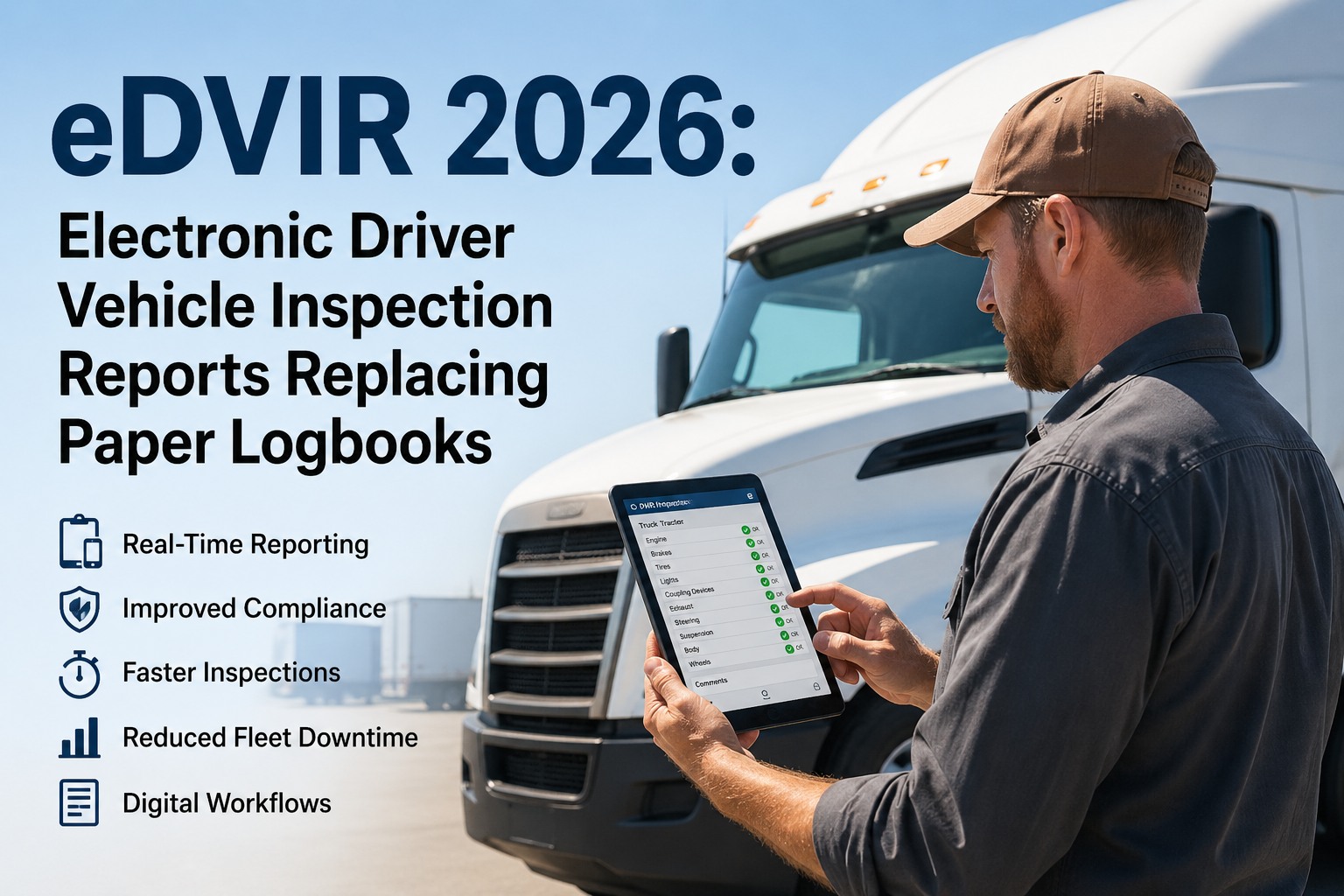
On March 23, 2026, FMCSA Final Rule FMCSA-2025-0115 made it official: electronic Driver Vehicle Inspection Reports are explicitly authorised under 49 CFR 396.11 and 396.13. The legal ambiguity that kept some fleets clinging to carbon-copy forms is gone. Paper DVIRs are not illegal — but they are now an operational and regulatory disadvantage in every measurable dimension. 73% of paper DVIRs never reach the maintenance office. Handwritten defect descriptions average 4 words — too vague for technicians to diagnose remotely. Paper forms have no timestamp, no GPS verification, no photo evidence, and no mechanism to enforce the 3-signature repair chain that FMCSA requires. The 2026 CSA overhaul makes this worse: the new "Driver Observed" BASIC category separately scores defects drivers should have caught during walk-arounds — and pencil-whipped paper DVIRs produce the lowest-quality inspection data in this newly visible scoring category. eDVIRs solve every one of these problems: guided walk-arounds with photo verification, instant defect routing, enforced 3-signature chains, timestamped audit-ready records, and inspection quality data that keeps your CSA scores healthy. HVI's eDVIR platform delivers this transition — setup takes under 10 minutes, drivers are proficient in 25 minutes, and your first electronic inspection can be running today.
Paper DVIRs Are Now a Competitive Disadvantage
FMCSA-2025-0115 explicitly authorises eDVIRs. The 2026 CSA "Driver Observed" category scores your inspection quality. Make the switch — setup takes 10 minutes.
Paper vs. eDVIR: The Full Comparison
Every dimension that matters — speed, accuracy, compliance strength, and cost — favours electronic inspection reports.
Completion Time
15–25 min (handwriting slows process)
5–10 min (guided taps + photo capture)
Defect Description Quality
4-word average — too vague to diagnose
Photo evidence + structured severity + GPS
Reaches Maintenance
27% of forms (73% never arrive)
100% — instant digital delivery
3-Signature Chain
Broken 40–60% of the time
Enforced — vehicle blocked until complete
Timestamp Verification
Handwritten date — questionable integrity
System timestamp + GPS coordinates
Pencil Whipping Detection
Impossible to detect
AI quality scoring flags rushed inspections
Defect-to-Work-Order
Manual re-entry — days of delay
Auto-generated with parts + severity — instant
Audit Retrieval
Days of filing cabinet search
Under 5 minutes — one-click export
Offline Capability
Works anywhere (it is paper)
Full offline mode — syncs on reconnect
CSA "Driver Observed" Impact
Lowest-quality data in scored category
Photo-verified data improves score
Legal Standing (2026)
Legal but operationally disadvantaged
Explicitly authorised — FMCSA-2025-0115
Every row in this table favours eDVIR — with one exception: paper works offline by default. HVI's eDVIR matches this with full offline mode and auto-sync.
Schedule a demo to see eDVIR in action. Or
sign up free — first inspection running in under 10 minutes.
The 2026 Regulatory Timeline That Forced the Shift
Three regulatory changes in early 2026 made the paper-to-digital transition urgent rather than optional.
Jan 10, 2026
Paper Medical Certificate Waiver Expires
CDL drivers must now have medical certification verified through MVR — not a paper card. Fleets already managing one paper-to-digital transition are now managing two simultaneously. The operational case for fully digital compliance accelerates.
Feb 2026
CSA "Driver Observed" Category Goes Live
Vehicle Maintenance splits into two BASICs: "Standard" (shop-detectable defects) and "Driver Observed" (defects drivers should catch during walk-arounds). Your daily DVIR quality now directly affects your CSA scores in a newly visible category. Paper DVIRs produce the weakest data for this scoring.
Mar 23, 2026
eDVIR Final Rule Effective
FMCSA-2025-0115 explicitly authorises electronic DVIRs under 49 CFR 396.11 and 396.13. Removes all remaining legal ambiguity. Also removes spare fuse and liquid-burning flare requirements. Digital inspection documentation is now unambiguously compliant and actively preferred during offsite audits.
What an eDVIR System Actually Does
An eDVIR is not a PDF of a paper form — it is an automated inspection workflow that connects the driver's walk-around to the maintenance shop and the compliance record. Start free with HVI and see the full workflow on your first vehicles today.
Guided Walk-Around Sequence
Step-by-step checklist that mirrors the DOT inspection order — front to rear, exterior to interior. Photo-required checkpoints at brakes, tyres, lights, coupling. Prevents skipping items and eliminates the "check all pass" pattern.
Photo-Verified Defect Reporting
When a driver flags a defect, the app requires a photo with severity classification. Maintenance receives a visual reference — not a 4-word handwritten description. Technicians can diagnose before the vehicle reaches the shop.
Instant Defect-to-Work-Order
Defects auto-generate prioritised work orders with photo evidence, parts requirements, and severity routing. Safety-critical items (brakes, steering, tyres) trigger immediate alerts. No manual re-entry. No lost forms.
Enforced 3-Signature Chain
Driver reports defect (signature 1). Mechanic certifies repair (signature 2). Next driver acknowledges before operating (signature 3). Vehicle is dispatch-restricted until all three are captured with digital identity verification.
AI Inspection Quality Scoring
Every inspection is scored on time taken, completeness, photo quality, and consistency. Rushed or pencil-whipped inspections flagged for coaching. Directly maps to the 2026 CSA "Driver Observed" scoring category.
Audit-Ready Cloud Storage
Every eDVIR stored with timestamp, GPS coordinates, driver identity, vehicle ID, and photo evidence. Searchable by any parameter. Complete audit packages exportable in under 5 minutes for any date range — years of records accessible instantly.
The Transition: Paper to eDVIR in 5 Steps
Switching from paper DVIRs to electronic is faster than most fleet managers expect. Schedule a demo and we will walk through the transition plan for your fleet size.
Day 1
Platform Setup
Sign up, configure vehicle templates per type (tractor, trailer, equipment), import vehicle and driver data. HVI provides pre-built FMCSA-compliant templates — customise or use as-is. Under 2 hours for most fleets.
Day 2–3
Driver Training
25-minute guided session per driver group. Drivers install the app on their existing smartphones, complete a practice inspection, and are proficient. 95%+ adoption within 30 days regardless of age or tech comfort.
Day 3–5
Parallel Run
Run both paper and eDVIR simultaneously for 2–3 days. Verify that digital records capture everything the paper form did — plus photos, timestamps, and GPS that paper cannot. Builds driver confidence before paper is removed.
Week 2
Paper Elimination
Remove paper forms from vehicles. All inspections now digital. Monitor completion rates and quality scores daily. Address any driver questions or workflow adjustments immediately.
Week 3–4
Full Optimisation
Configure defect routing rules, alert thresholds, and department-level dashboards. Enable cross-terminal benchmarking. First audit-ready export test. By week 4, the system is fully operational and your fleet is paperless.
The Paper Era Is Over. The Question Is How Fast You Move.
FMCSA-2025-0115 eliminated the last legal question. The 2026 CSA "Driver Observed" category created the first scoring consequence. And the 73% of paper DVIRs that never reach the maintenance office represent an operational failure that no fleet can justify in an era where a smartphone and 10 minutes of setup deliver timestamped, photo-verified, GPS-located, AI-scored inspection records that auto-generate work orders and enforce the 3-signature chain your auditor will ask about. Every day you run paper DVIRs in 2026 is a day you are choosing worse compliance data, weaker audit records, slower defect resolution, and higher CSA exposure — when the alternative is free to try and takes 25 minutes to learn. Start free today — or schedule a demo and see why 25,000+ users already made the switch.
Switch to eDVIR Today — Free to Start
Guided walk-arounds. Photo verification. 3-signature enforcement. AI quality scoring. Audit-ready records. FMCSA-2025-0115 compliant. Trusted by 25,000+ users.
Frequently Asked Questions
Q: Are electronic DVIRs legally compliant in 2026?
Yes — explicitly. FMCSA Final Rule Docket FMCSA-2025-0115, published February 19, 2026 and effective March 23, 2026, authorises electronic DVIRs under 49 CFR 396.11 and 396.13. Digital records that capture vehicle identification, defects found (or "no defects" certification), driver signature, and repair verification are fully compliant. Electronic signatures are legally binding under the E-SIGN Act. Paper DVIRs remain legal but carry operational disadvantages.
Q: Do eDVIRs work without internet?
Yes. HVI's mobile app completes full inspections — including photos, defect reports, severity classification, and digital signatures — entirely offline. All data syncs automatically when the device reconnects to cellular or Wi-Fi. This is critical for truck stops, rural yards, and customer sites where paper's only remaining advantage (works anywhere) is matched by offline-capable eDVIR.
Start free and test offline mode.
Q: How long does the paper-to-eDVIR transition take?
Most fleets complete the transition in under 2 weeks: platform setup (day 1), driver training in 25-minute sessions (days 2–3), parallel run (days 3–5), paper elimination (week 2), and full optimisation (weeks 3–4). 95%+ driver adoption within 30 days is the documented norm regardless of driver age or tech comfort.
Schedule a demo to see the transition plan.
Q: What does the CSA "Driver Observed" category mean for DVIRs?
The February 2026 CSA overhaul split Vehicle Maintenance into two categories: "Standard" (defects found by shop mechanics) and "Driver Observed" (defects drivers should have caught during walk-arounds). Your daily DVIR quality now directly affects your CSA score in a separately visible category. Paper DVIRs — with no photo evidence, no quality scoring, and high pencil-whipping rates — produce the weakest data for this category. eDVIRs with photo verification and AI quality scoring produce the strongest.
Q: What ROI does eDVIR deliver over paper?
Documented outcomes: 67% faster inspection completion (5–10 min vs 15–25 min), 40% fewer compliance violations within 12 months, $8,500 per vehicle in annual maintenance savings (from faster defect resolution and avoided breakdowns), 12+ hours per week of admin time eliminated, and audit preparation reduced from days to minutes. Most fleets see full ROI within 60 days of deployment.
Start free today.