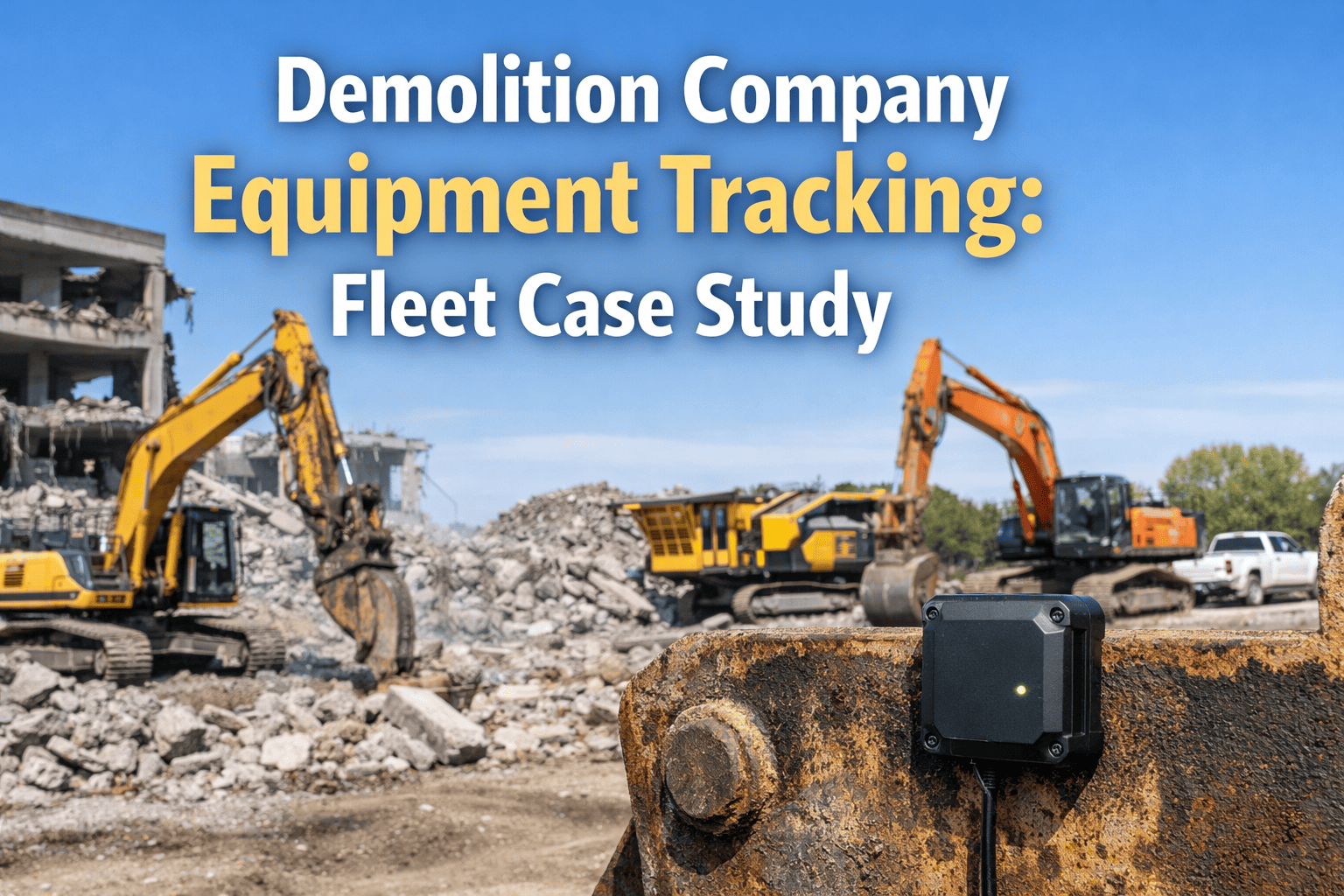
A general contractor operating 156 assets — excavators, loaders, dozers, skid steers, haul trucks, aerial lifts, generators, compressors, light towers, and support vehicles — across 20 active job sites had no centralized visibility into where equipment was, what condition it was in, or whether maintenance was being performed. Each job site superintendent managed "their" equipment independently, creating 20 isolated equipment management silos. The result: $214,000 in unnecessary equipment rental spend in a single year because available owned assets at one site weren't visible to project managers at another. PM compliance averaged 54% fleet-wide — but ranged from 88% at the best-managed site to 23% at the worst. 11 pieces of equipment couldn't be physically located during a fleet audit, eventually found idle at completed or inactive job sites. The fleet was generating zero consolidated data — no utilization reports, no fleet-wide maintenance history, no equipment health visibility. After implementing a centralized fleet management platform with mobile inspections, GPS-integrated asset tracking, and unified PM scheduling across all 20 sites, the contractor achieved real-time visibility into every asset, improved fleet-wide PM compliance from 54% to 84%, prevented $200,000+ in unnecessary equipment transfers and rentals, and recovered 14 "lost" assets that were sitting idle at inactive locations. Construction fleet managers, equipment coordinators, and general contractor operations directors searching for a framework to manage multi-site equipment operations will find actionable data on how centralized fleet platforms solve the visibility, maintenance, and coordination challenges that fragment when equipment is spread across dozens of active projects.
Fleet Profile & The Multi-Site Coordination Problem
General contractors don't operate a fleet from one location — they operate many mini-fleets scattered across active job sites, each with its own superintendent, its own equipment needs, and its own maintenance habits. Without centralized visibility, every site becomes an island. Equipment gets stranded, maintenance quality varies wildly, and the fleet office makes allocation decisions based on phone calls and spreadsheets instead of real-time data. This contractor's 20 active sites spanned highway construction, commercial building, site development, and utility installation — each with different equipment mixes, different utilization patterns, and different maintenance requirements. Schedule a consultation to assess your multi-site fleet operations, or start your free trial to see centralized fleet management in action.
Asset Distribution Across Job Sites
The Five Visibility Gaps That Cost $1.2M Annually
The cost of operating without centralized fleet visibility isn't one large, obvious expense — it's five separate problems that compound into a seven-figure annual drain. Each gap is invisible when you're managing site-by-site, but becomes starkly clear when you aggregate the data across all 20 locations.
Equipment Location Unknown
No GPS tracking. No centralized asset register updated in real time. When the fleet audit asked "where is unit EX-14?" the answer required 6 phone calls across 4 sites — and the machine was eventually found idle at a project that had been completed 3 weeks earlier. 11 assets total were "lost" during the audit.
Unnecessary Rental Spend
Project managers rented equipment because they couldn't confirm whether owned assets were available at other sites. In 73% of rental instances, an equivalent owned machine was idle within 30 miles — but the PM at the requesting site had no way to know that. Average rental cost per unnecessary transaction: $4,700.
PM Compliance Variance
Fleet-wide PM compliance: 54%. But the range was 23% to 88% across sites — meaning some superintendents ran disciplined programs while others barely tracked maintenance at all. The 8 lowest-compliance sites generated 78% of all unplanned repair costs. Without centralized PM data, the fleet office couldn't identify or address underperformers.
Failed Equipment Transfers
Equipment transfers between sites averaged 4.2 days from request to arrival. 31% of transfers arrived with the equipment in a different condition than expected — needing repairs before it could be put to work. 14% of transfers were cancelled after the equipment was already in transit because the receiving site's needs changed. No system existed to match equipment availability with project demand in real time.
Zero Fleet-Wide Data
No consolidated utilization reports. No fleet-wide cost-per-hour data. No equipment health scoring. The fleet office made buy/rent/sell decisions based on superintendent opinions and outdated spreadsheets. The most expensive fleet decisions — whether to buy a new excavator, extend a rental, or retire aging equipment — were made with no data.
Managing Multiple Sites Without Centralized Fleet Data?
If your equipment allocation decisions are based on phone calls and spreadsheets, you're paying a visibility tax on every project.
The Solution: Centralized Dashboard + Mobile Inspections + GPS Integration
The implementation connected all 20 job sites into a single fleet management platform — replacing phone calls with real-time data, replacing paper inspection forms with mobile digital checklists, and replacing calendar-based PM guesswork with engine-hour-triggered maintenance scheduling visible from any location. The rollout followed a phased approach recommended by industry best practices: start with GPS tracking at the highest-value sites, then expand inspections and PM scheduling fleet-wide. Try the platform that unifies multi-site construction fleets.
Asset Registry + GPS Deployment
Every asset tagged, photographed, and registered with current location, condition rating, and maintenance history. GPS trackers deployed on all 78 heavy equipment units and 22 support vehicles. Non-powered assets (generators, compressors, light towers) tagged with QR-based check-in/check-out system. Result: Complete asset map within 72 hours of deployment.
Mobile Inspection Rollout Across All 20 Sites
Paper inspection forms replaced with mobile digital checklists — equipment-class-specific templates for heavy machines, aerial lifts, support equipment, and vehicles. Operators complete pre-shift inspections on tablets or phones with mandatory photos. Defects route directly to the fleet maintenance queue with GPS-tagged location, severity rating, and machine ID. Superintendent dashboard shows site-level inspection completion rates in real time.
Unified PM Scheduling With Engine-Hour Triggers
Calendar-based PM schedules replaced with engine-hour triggers for powered equipment and usage-based intervals for non-powered assets. OEM service intervals loaded as baselines, adjusted for operating conditions per site. Fleet office gains consolidated PM compliance view — every machine, every site, one dashboard. Automated alerts notify both the site superintendent and the fleet office when any unit approaches a service threshold.
Fleet-Wide Analytics + Transfer Coordination
Utilization dashboards go live: hours used vs. hours available per asset, per site, per equipment class. Equipment transfer requests route through the platform — showing the requesting site what's available fleet-wide, the machine's current condition (from latest inspection), and estimated transfer time. Rental decisions require platform verification that no owned equivalent is available. Monthly fleet reviews use actual data instead of anecdotal reports.
Results: Visibility, Compliance & Cost Recovery
The transformation happened in layers. GPS tracking provided immediate asset visibility within the first week. Inspection completion rates climbed over 60 days as operators adopted the mobile platform. PM compliance improved steadily as the engine-hour-based scheduling replaced calendar-based guesswork. And the financial impact accelerated as data-driven transfer and rental decisions replaced phone-call coordination. Explore the HVI Learning Center for more on building multi-site fleet management programs.
12-Month Multi-Site Fleet Management Results
| Metric | Before | After (12 months) | Change |
|---|---|---|---|
| Assets with real-time location tracking | 0% | 100% | Full visibility |
| Fleet-wide PM compliance | 54% | 84% | +30 pts |
| PM compliance range across sites | 23% - 88% | 71% - 94% | Gap narrowed 78% |
| Annual unnecessary rental spend | $214,000 | $47,000 | -78% |
| Equipment transfer cycle time | 4.2 days | 1.4 days | -67% |
| Failed/cancelled transfers | 31% | 7% | -77% |
| "Lost" or unlocatable assets | 11 | 0 | Eliminated |
| Inspection completion rate | 28% | 89% | +61 pts |
| Fleet utilization rate | 41% | 64% | +23 pts |
| Unplanned repair costs | $340,000/yr | $178,000/yr | -48% |
PM Compliance By Site Type: Before vs. After
Year 1 ROI: Multi-Site Fleet Centralization
How HVI Powers Multi-Site Construction Fleet Management
Managing one site is coordination. Managing 20 is a systems problem. HVI provides the centralized infrastructure that turns disconnected job sites into a unified fleet operation — giving the fleet office, site superintendents, and maintenance teams a single source of truth for every asset across every project.
Centralized Fleet Dashboard
Every asset — heavy equipment, support gear, vehicles, and non-powered assets — visible on one screen. Filter by site, equipment class, status, or maintenance state. See what's active, idle, in transit, or down for service across all locations simultaneously.
GPS-Integrated Asset Tracking
Real-time equipment location across all job sites. Geofencing alerts when assets leave designated areas. Breadcrumb trails showing movement history. Instant answers to "where is unit X?" — no phone calls, no guesswork.
Mobile Inspection Platform
Equipment-class-specific digital checklists deployed to every site simultaneously. Operators complete pre-shift inspections on mobile devices with mandatory photos and GPS stamps. Defects auto-route to maintenance with machine ID, location, and severity. Site superintendents see their completion rates; fleet office sees all 20 sites.
Unified PM Scheduling
Engine-hour-based PM triggers for all powered equipment. Usage-based intervals for non-powered assets. Fleet office sees consolidated PM compliance across every site. Automated alerts to both site supervisors and central fleet management when any machine approaches service thresholds.
Smart Equipment Transfer System
When a site needs equipment, the platform shows available owned assets fleet-wide — with current location, condition (from latest inspection), engine hours, and estimated transfer time. Eliminate unnecessary rentals by confirming available inventory before approving external spend.
Fleet-Wide Utilization Analytics
Consolidated utilization data across all sites and equipment classes. Identify underused assets for redeployment. Compare site-level performance. Provide the data foundation for fleet rightsizing, buy/rent/sell decisions, and capital planning based on actual operational metrics.
Ready to See Every Asset Across Every Job Site?
Stop managing 20 disconnected equipment silos. Connect your multi-site fleet into a centralized platform with real-time visibility, unified inspections, and consolidated PM scheduling.
Free 14-day trial. No credit card required. Deploy to your first site in 72 hours.