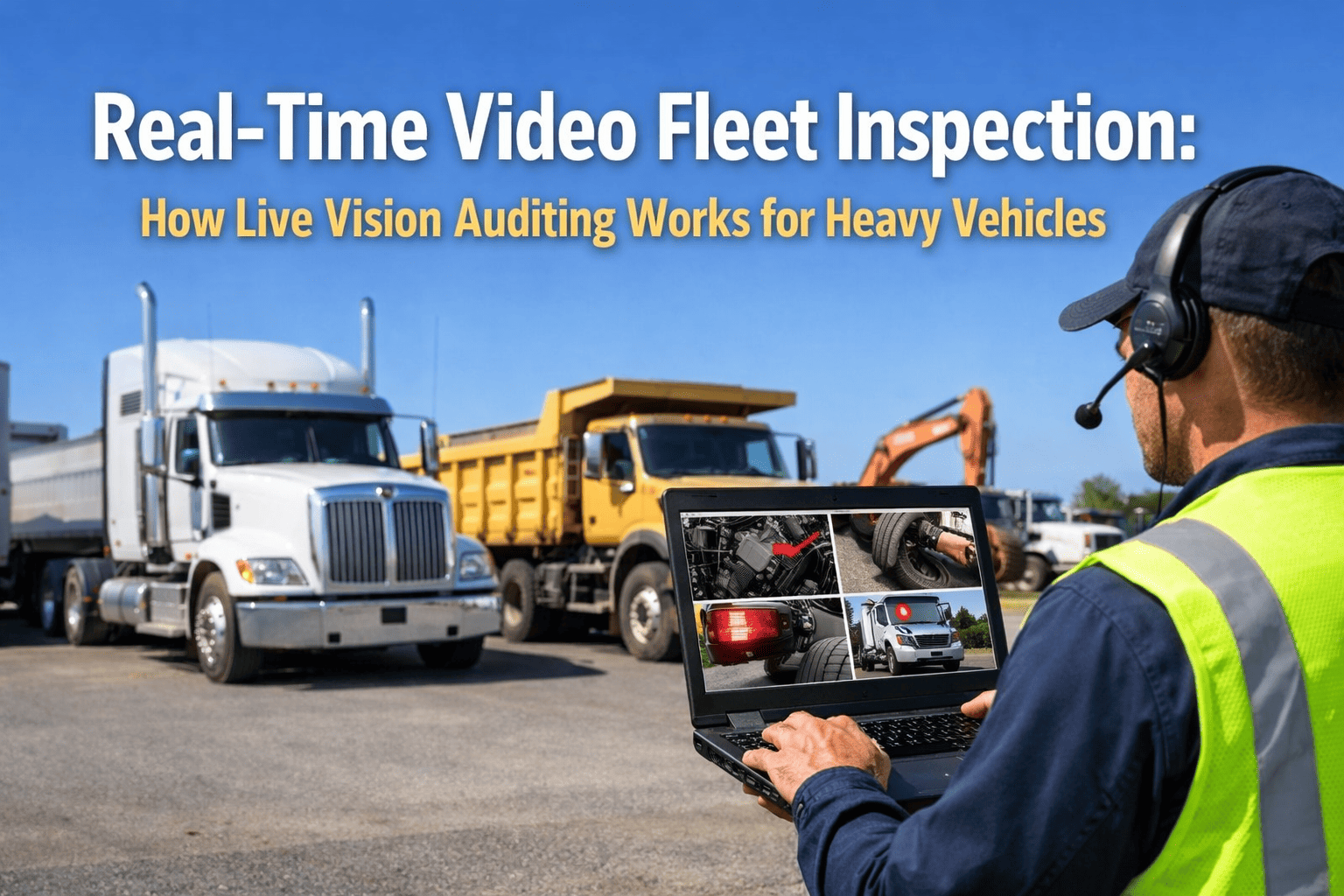
A driver walks around a Class 8 tractor at 5:45 AM, taps through a checklist in 3 minutes, and reports "all clear." Six hours later, that truck is pulled at roadside for a brake defect visible to anyone who actually looked. This gap — between inspections performed and inspections that actually detect problems — is the single biggest failure point in fleet safety. Real-time video fleet inspection closes this gap by adding visual verification to every walk-around: the driver's smartphone camera captures each inspection point, AI analyzes the footage for defects the human eye misses, and fleet managers can observe the entire process live from any location. For heavy vehicles — Class 8 tractors, trailers, cranes, buses, construction equipment — where a missed defect does not just cause a breakdown but can cause a fatal accident, video-verified inspection is the difference between a safety program that looks good on paper and one that actually keeps vehicles safe on the road.
The Four Layers of Real-Time Video Inspection
Real-time video fleet inspection is not a single technology — it is four distinct capabilities working as one system. Each layer adds verification that the previous one cannot provide alone.
Layer 1
Guided Video Walk-Around
What it does: The HVI app directs the driver through a vehicle-specific inspection sequence — left side, right side, front, rear, underbody, tires, lights, coupling — with the camera capturing every checkpoint. The guided workflow ensures nothing is skipped, regardless of time pressure or fatigue.
Why it matters for heavy vehicles: A Class 8 tractor has 37+ inspection items. A crane has 70 items across 7 systems. Without guided sequencing, drivers skip areas they perceive as low-risk — exactly where undetected defects accumulate.
Layer 2
AI Defect Detection
What it does: Computer vision AI analyzes every photo and video frame in real time — detecting tire wear patterns, brake component condition, fluid leaks, structural cracks, lighting failures, corrosion progression, and cargo securement issues. Trained on 30+ million images, the AI achieves 95–99% detection accuracy.
Why it matters for heavy vehicles: Manual inspection catches 70–80% of defects. AI catches 95–99%. That 20–30% gap is where roadside violations, breakdowns, and accidents live. For a 50-truck fleet, closing that gap prevents an estimated 14–20 missed defects per month.
Layer 3
Live Remote Observation
What it does: Fleet managers, safety directors, or compliance officers observe inspections in real time via live video stream — from anywhere, on any device. They can watch multiple inspections across multiple locations simultaneously, flag concerns, and provide voice coaching to drivers during the walk-around.
Why it matters for heavy vehicles: Multi-site operations cannot have a safety director at every yard. Live observation lets one manager verify inspection quality across 10 terminals without travel — catching procedural problems before they become compliance gaps.
Layer 4
Evidence Chain & Auto-Routing
What it does: Every inspection generates a tamper-proof evidence package: timestamped video recording, AI-flagged defect photos with severity classification, GPS-verified location, digital signatures, and the complete 3-signature DVIR chain. Defects auto-generate work orders with video evidence routed directly to maintenance.
Why it matters for heavy vehicles: In accident lawsuits, plaintiff attorneys examine inspection records. Video evidence proving systematic, thorough inspections creates defensible documentation that no paper checklist or static photo can match. One prevented lawsuit covers a decade of platform costs.
What AI Sees That Drivers Miss
AI defect detection is not a theoretical improvement — it catches specific, measurable categories of damage that human inspectors consistently miss, especially in poor lighting, adverse weather, and time-pressured pre-trip conditions. Start free and see AI detection on your own trucks within 10 minutes of setup.
Tire Wear Patterns
AI estimates tread depth from photos, flags tires approaching DOT minimum thresholds, and detects uneven wear indicating alignment or suspension issues — conditions invisible during a quick visual scan.
Human miss rate: 35–40%
Brake Component Condition
Detects pad thickness, rotor scoring, caliper leaks, and air brake chamber wear from inspection photos. Brake problems are present in nearly 30% of fatal large truck crashes — the highest-risk component category.
Human miss rate: 25–30%
Fluid Leaks
AI identifies oil, coolant, hydraulic fluid, and fuel leak patterns on the undercarriage and ground surface — including slow seeps that haven't yet left visible puddles but indicate developing seal failures.
Human miss rate: 40–50%
Frame Cracks & Weld Defects
Micro-fractures along frame rails and crossmembers detected through pattern analysis of surface irregularities invisible at walking speed. Corrosion progression tracked across inspections to predict structural integrity loss.
Human miss rate: 50–60%
Lighting & Reflector Failures
Lens cracks, seal deterioration, moisture intrusion, and reflectivity loss that pass a casual glance but fail roadside inspection. AI detects condensation patterns and micro-cracks that develop over weeks.
Human miss rate: 30–35%
Cargo Securement Issues
AI evaluates load positioning, strap tension indicators, blocking and bracing adequacy, and securement hardware condition. CVSA reported 18,108 cargo securement violations in 2025 — the top vehicle violation category.
Human miss rate: 20–25%
The Numbers: Video Inspection vs. Standard Inspection
Every metric that matters — detection accuracy, inspection speed, compliance rates, and cost avoidance — improves when video verification and AI are added to the inspection process.
Defect Detection Accuracy
Inspection Completion Speed
Preventable Breakdowns Avoided
Heavy Vehicle Types: What Video Inspection Covers
HVI provides vehicle-type-specific inspection templates — each with the correct items, the correct regulations, and AI trained on that specific equipment category. Schedule a demo with your actual vehicle types.
Class 8 Tractors
37+ inspection items
Full FMCSA DVIR with 3-signature chain. AI-guided video captures brakes, tires, coupling, frame, lights, and cab systems. eDVIR compliant per March 2026 rule.
Trailers
28+ inspection items
Landing gear, frame rails, cross-members, flooring, door hardware, reefer units, cargo securement points, and lighting circuits — each verified by video.
Cranes
70 items / 7 systems
OSHA 1926.1412 and ASME B30 compliant templates. Boom, rigging, hydraulics, outriggers, load indicators, and structural inspections — all video-documented.
Buses & Transit
40+ inspection items
Passenger safety systems, wheelchair lifts, emergency exits, ADA compliance items, brake and suspension — with public accountability documentation.
Construction Equipment
Variable by equipment
Excavators, loaders, dozers, pavers — hours-based PM triggers. OSHA pre-shift requirements. AI detects hydraulic leaks, undercarriage wear, and structural fatigue.
Forklifts & Specialty
OSHA 1910.178 compliant
Mast, forks, hydraulics, propane systems, and operator restraints. Pre-shift and periodic inspection schedules enforced through the platform.
Video Changes What "Inspected" Actually Means
A paper checkmark proves someone held a pen. A digital tap proves someone touched a screen. Video proves someone actually walked around a 70-foot tractor-trailer, looked at every component the checklist requires, and documented what they found with evidence that holds up in audits, lawsuits, and roadside encounters. For heavy vehicles — where 80% of equipment failures show warning signs 30–90 days before breakdown — real-time video inspection with AI detection is not an upgrade to your safety program. It is the safety program. HVI provides this capability purpose-built for heavy vehicle operations, with the templates, the compliance enforcement, and the inspection-to-maintenance chain that makes every video-verified defect become a resolved repair. Sign up free and see what video-verified inspections look like on your fleet.
See Real-Time Video Inspection on Your Vehicles
AI defect detection. Live remote auditing. Video-verified DVIRs. All on one platform purpose-built for heavy vehicle fleets — trusted by 25,000+ users worldwide.
Frequently Asked Questions
Q: How accurate is AI video defect detection on heavy vehicles?
AI-powered inspection systems achieve 95–99% defect detection accuracy, compared to 70–80% for manual inspection. The AI is trained on 30+ million real-world images and recognizes 163+ vehicle components across 21+ damage types. It catches developing defects — micro-cracks, slow leaks, gradual wear patterns — that human inspectors consistently miss during time-pressured walk-arounds.
Q: What equipment do drivers need for video inspections?
Any standard iOS or Android smartphone. No proprietary cameras, dash cams, or specialized hardware required. The HVI app guides drivers through the video inspection using their existing device. Setup takes under 10 minutes, and most drivers master the workflow within 2–3 inspections.
Try it free on your team's existing phones.
Q: Does video inspection work offline at remote job sites?
Yes. HVI works fully offline — drivers complete video-recorded inspections, capture photos, apply signatures, and generate DVIRs without internet connectivity. Data syncs automatically when signal returns. Live streaming requires connectivity, but the complete inspection workflow, AI analysis, and evidence chain function offline. No inspection is ever lost.
Q: Is video-verified DVIR documentation FMCSA compliant?
Yes — and it exceeds FMCSA requirements. FMCSA's February 2026 final rule (effective March 23, 2026) explicitly authorizes eDVIRs with digital signatures. HVI enforces the complete 3-signature DVIR chain, adds photo and video evidence, GPS verification, and AI-verified defect documentation that surpasses the minimum standard.
Book a demo to see FMCSA compliance in action.
Q: How does video inspection connect to maintenance?
Every defect identified — whether by the driver, the AI, or a remote auditor — auto-generates a work order in HVI's maintenance module with video evidence, severity classification, and complete vehicle history. Mechanics receive verified, visual defect data instead of vague written descriptions. The defect-to-repair loop closes in minutes, not hours or days.