Every dollar spent on preventive maintenance saves $4-8 in emergency repairs, towing, and downtime costs. Fleets with structured PM programs see 30-40% fewer unplanned breakdowns, 20% longer vehicle lifespans, and measurably lower cost per mile. Yet 70% of fleet managers still operate reactively — fixing trucks after they break instead of preventing failures before they happen. The gap between knowing PM matters and executing a PM program that actually delivers results comes down to five things: tiered service schedules matched to your duty cycle, trigger-based scheduling that adapts to real usage, inspection-to-maintenance integration that closes the loop on defect resolution, KPIs that measure what matters, and digital tools that enforce consistency at scale. This guide covers all five — with the specific intervals, checklists, metrics, and implementation strategy you need to cut fleet maintenance costs by 30% or more.
Why Preventive Maintenance Pays for Itself
Preventive maintenance isn't an expense — it's the single highest-ROI activity in fleet operations. The math is unambiguous: planned maintenance done on schedule costs a fraction of the emergency repairs, towing, lost revenue, and compliance penalties that result from skipping it. Here's what the numbers show.
$4-$8
Saved per $1 spent on PM
Emergency repairs cost 4-8x more than the same work done during scheduled service — factoring in premium labor rates, expedited parts, towing, and revenue loss from downtime.
30-40%
Fewer unplanned breakdowns
Fleets with comprehensive PM programs reduce unexpected failures by 30-40%. One fleet manager reported cutting downed vehicles by 20-30% after implementing structured PM schedules.
85%
Reduction in unexpected failures
Fleets using standardized PM checklists with digital enforcement reduce unexpected component failures by up to 85% compared to reactive maintenance operations.
20%
Longer vehicle lifespan
Consistent PM extends average vehicle lifespan by 15-20%. One operation pushed UTVs from 25-30K miles to 45-50K miles — a completely different fleet replacement cycle.
Reactive vs. Preventive: The Real Cost Comparison
Reactive Maintenance
$500 brake pad → $15,000 emergency repair
$150/hr emergency labor vs. $85/hr scheduled
$600-$1,200 per tow to nearest shop
$760+/day revenue loss per downed truck
$7,155 average FMCSA audit penalty per violation
vs
Preventive Maintenance
$500 brake pad replaced at scheduled PM
Standard shop rate, planned labor scheduling
$0 towing — repair happens in your shop
$0 revenue loss — truck returns same day
Clean audit record — documented PM history
PM Service Classes: A, B, C, and D
Most fleets organize preventive maintenance into four tiers — Class A through D — representing increasing scope and decreasing frequency. Each tier builds on the previous one: a Class B includes everything in Class A plus additional items, Class C includes everything in B, and so on. The exact mileage intervals depend on your duty cycle, but the tier structure ensures that basic safety checks happen frequently while comprehensive overhauls happen on longer cycles.
A
Safety Inspection
Every 5,000-15,000 miles
What's Included
Oil and filter change
Tire pressure and tread depth check
Brake adjustment inspection
All fluid levels (coolant, power steering, windshield, DEF)
Belt and hose visual inspection
Lights and signals functional test
Air system check (leaks, governor, dryer)
B
Intermediate Service
Every 15,000-30,000 miles
Everything in Class A, plus:
Fuel filter replacement
Air filter inspection / replacement
Coolant system test (concentration, pH)
Steering and suspension inspection
Wheel bearing inspection
Exhaust system review
Battery and charging system test
C
Comprehensive Service
Every 50,000-60,000 miles or annually
Everything in Class B, plus:
Transmission service (fluid, filter, adjustment)
Differential fluid change
Comprehensive brake overhaul (drums, linings, hardware)
Full electrical system test
DOT annual inspection items (Appendix A)
Emission system service (DPF regeneration/cleaning)
Alignment check and correction
D
Major Overhaul
Every 100,000+ miles or as needed
Everything in Class C, plus:
Engine top-end or complete overhaul
Transmission rebuild or replacement
Axle and differential rebuild
Complete wiring harness inspection
Frame inspection for cracks and fatigue
Fifth wheel rebuild (tractors)
Full cab refurbishment as needed
HVI provides customizable digital PM templates for Class A, B, C, and D services — with automated scheduling, photo-verified checklists, and direct work order generation.
Book a demo to see PM templates customized for your fleet. Or
start free.
PM Scheduling: Triggers and Methods
A PM schedule is only as good as its triggering mechanism. Schedule PM too early and you waste labor and parts. Schedule too late and you're back to reactive maintenance. The best programs use multiple triggers — whichever comes first — and adjust intervals based on real-world data from your own fleet rather than generic industry defaults.
Mileage-Based
When: Odometer reaches interval threshold
Best for: Line-haul, consistent-use vehicles
Most accurate for vehicles with consistent daily mileage. Integrate with telematics for automatic odometer tracking — no manual reading errors.
Engine Hours
When: Hour meter reaches interval threshold
Best for: PTO-heavy, idle-heavy, and off-road equipment
Better than mileage for vehicles that idle heavily (bucket trucks, reefers, cement mixers) or operate off-road (construction equipment). 1 engine hour ≈ 25-33 miles for conversion.
Calendar Time
When: Calendar interval reached regardless of usage
Best for: Low-mileage, seasonal, or reserve vehicles
Catches vehicles that sit without accumulating miles — fluids degrade, seals dry, batteries discharge. Typical: every 90 days or 6 months maximum regardless of mileage.
Condition-Based
When: Inspection findings or sensor data trigger service
Best for: Supplement to interval-based scheduling
Oil analysis results, brake lining measurements, tire tread depth trends, and DVIR defect patterns trigger service outside normal intervals. The most advanced trigger — requires data infrastructure.
Duty Cycle Adjustment
Line Haul
Standard intervals
Consistent highway miles, moderate engine stress, predictable wear
Regional / P&D
-15-20% interval
Stop-and-go increases brake, tire, and transmission wear significantly
Construction / Off-road
-25-40% interval
Dust, vibration, and extreme loads accelerate all component wear
Mountain / Heavy Haul
-20-30% interval
Grades stress brakes, transmission, cooling, and engine significantly more
Inspection-to-Maintenance Integration
The best PM programs don't treat daily inspections and scheduled maintenance as separate activities — they integrate them into a continuous loop where inspection findings drive maintenance actions. When a driver notes a developing issue on a DVIR, that finding should flow directly into the maintenance queue without a phone call, email, or lost paper form. This closed loop is what separates fleets that prevent failures from those that find them too late.
1
Driver Inspection (DVIR)
Driver finds developing issue during pre-trip or post-trip — brake noise, low tire, fluid leak, light out. Documents in digital inspection with photo and description.
2
Automatic Defect Routing
Digital inspection system immediately routes defect to maintenance queue. Critical defects flag the vehicle until resolved. Non-critical defects bundle into next scheduled PM.
3
Work Order Generation
Maintenance manager creates or auto-generates work order from defect. Parts checked against inventory. Labor scheduled. If bundling into next PM, defect attaches to that PM work order.
4
Repair and Certification
Technician completes repair, documents work performed, parts used, and time spent. Signs off on DVIR defect per §396.11 chain-of-custody requirements. Vehicle released.
5
Next Driver Verification
Next driver reviews previous DVIR, confirms repair, signs acknowledgment. If digital, this is enforced — driver cannot start trip without reviewing and signing. Loop complete.
HVI connects driver inspections directly to maintenance work orders — defects flow from DVIR to shop queue to repair certification to next-driver verification in one platform.
Book a demo to see the closed-loop workflow. Or
start free.
PM KPIs: Measure What Matters
You can't improve what you don't measure. These five KPIs separate high-performing maintenance operations from those constantly fighting fires. Track them weekly, review them monthly, and use the data to adjust intervals, identify problem vehicles, and justify PM investment to leadership.
PM Compliance Rate
Target: 95%+
Services completed on time / Services due = PM Compliance %
The single most important maintenance metric. High compliance means your team services assets before failures happen. Below 85% means your schedule is aspirational, not operational. Track by vehicle, location, and technician to find bottlenecks.
Fleet Uptime
Target: 95%+
Hours available / Total scheduled hours = Uptime %
Every hour a truck sits idle is lost revenue. Improving uptime requires reliable PM execution and fast repair turnaround. If uptime is below 92%, your PM program has gaps — either missed services causing breakdowns or PM taking too long.
Planned vs. Unplanned Ratio
Target: 80:20
Planned work orders / Total work orders = Planned %
A high ratio signals control and predictability. World-class fleets achieve 85%+ planned work. If unplanned exceeds 30%, your PM intervals may be too long or your checklists aren't catching developing issues.
Cost Per Mile (Maintenance)
Benchmark: $0.15-$0.22/mi
Total maintenance spend / Total fleet miles = CPM
The ultimate efficiency metric. Track by vehicle to identify units costing more than replacement would. Rising CPM on a specific vehicle signals it's approaching end of useful life — schedule Class D evaluation or plan replacement.
Mean Time Between Failures
Target: Increasing trend
Total operating hours / Number of failures = MTBF
Measures reliability improvement over time. MTBF should increase as your PM program matures. Declining MTBF on specific vehicles or components signals interval adjustment needed or systemic failure pattern.
FMCSA Compliance Requirements
Preventive maintenance isn't optional — it's federally mandated under 49 CFR Part 396. In 2025, focused FMCSA audits hit their highest level in five years, with auditors averaging six violations per carrier and penalties averaging $7,155 per violation. Your PM program must meet these regulatory requirements to survive an audit.
49 CFR 396.3
Systematic Inspection, Repair, and Maintenance
Every motor carrier must have a systematic inspection, repair, and maintenance program for all CMVs. "Systematic" means documented, scheduled, and consistent — not ad hoc. Auditors look for written procedures, evidence of scheduled services, and proof that the program is followed.
49 CFR 396.11
Driver Vehicle Inspection Reports (DVIRs)
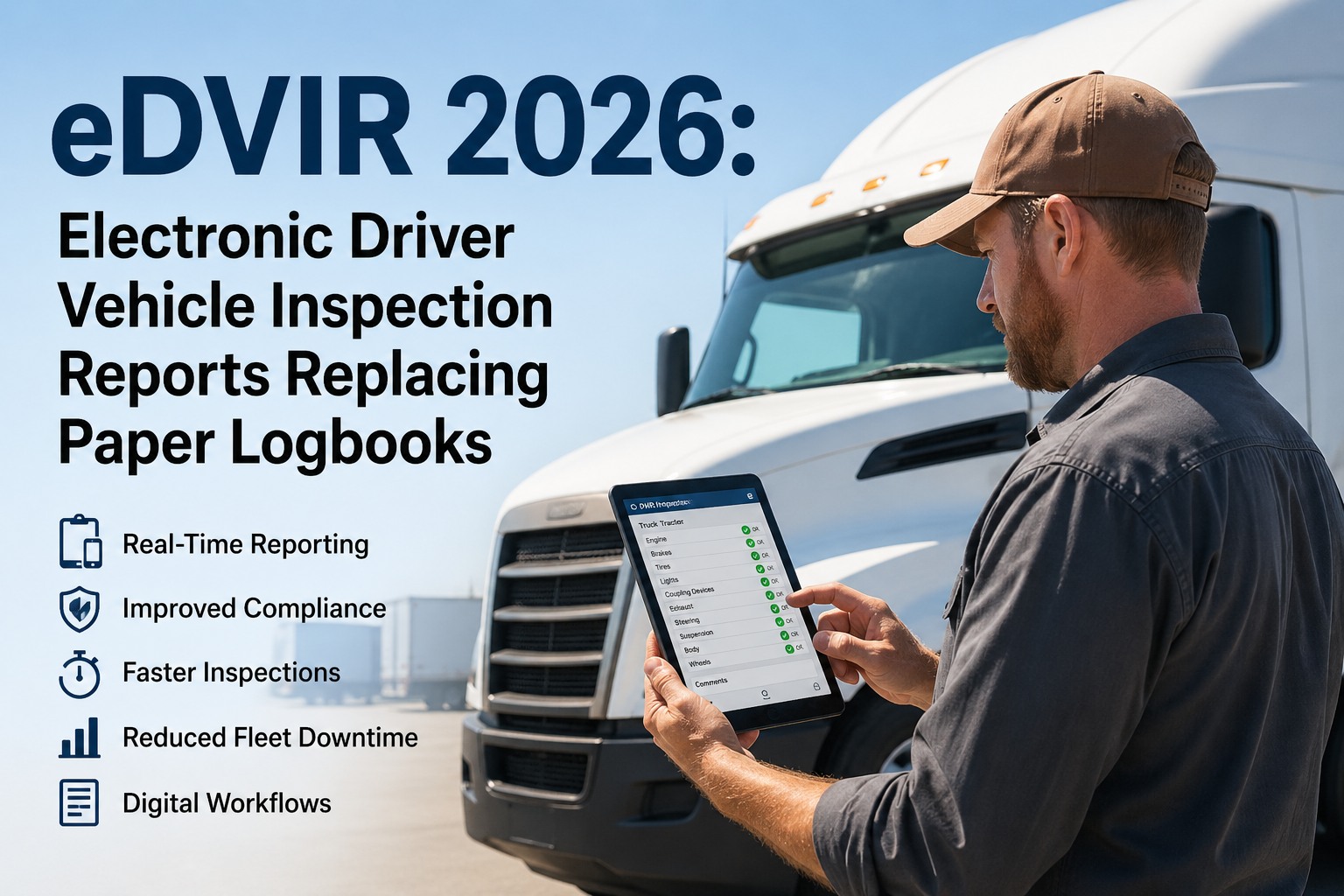
Drivers must complete DVIRs at end of each day's work when defects are found. Carrier must certify repairs. Next driver must review and sign. eDVIRs officially authorized effective March 23, 2026 (FMCSA-2025-0115). Retain 3 months minimum.
49 CFR 396.17
Annual Periodic Inspection
Every CMV must undergo inspection by a qualified inspector at least every 12 months covering all Appendix A items. Report retained 14 months. Copy must be carried in vehicle. Combine with Class C PM for efficiency.
49 CFR 396.3(b)
Maintenance Records
Carriers must maintain records of inspections, repairs, and maintenance for each vehicle. Records must include identification, description of work, date, and odometer. Retain for 1 year plus 6 months (DOT recommends 3 years for litigation protection).
CSA Vehicle Maintenance Split: Standard + Driver Observed
The February 2026 CSA overhaul splits Vehicle Maintenance into two compliance categories. "Standard" covers shop-detected issues; "Driver Observed" covers violations drivers should catch during walk-around (lights, tires, visible leaks). Your PM program now affects
two separate CSA categories — making both scheduled maintenance quality and daily inspection thoroughness critical.
Book a demo to see how HVI tracks both categories.
eDVIR Final Rule: Effective March 23, 2026
FMCSA's final rule (Docket FMCSA-2025-0115, published February 19, 2026) explicitly authorizes electronic DVIR creation, maintenance, and signature. Digital DVIRs that flow directly into PM work orders are now unambiguously compliant — and significantly more effective than paper at closing the inspection-to-maintenance loop.
FMCSA Audit Intensity at 5-Year High
In 2025, FMCSA focused compliance reviews increased, with auditors averaging 6 violations per carrier and penalties averaging $7,155 per violation. Only 7% of carriers pass clean. The Vehicle Maintenance BASIC (now two categories) is consistently the highest-volume violation area. A documented, digital PM program with audit-ready records is the strongest defense.
12-Month CSA Window: Clean Record Resets Score
The 2026 CSA scoring uses a 12-month violation window (down from 24). Fleets that fix their PM program and go 12 months clean see their Vehicle Maintenance percentile reset entirely. This creates a clear, achievable path from poor scores to clean compliance — if the PM program delivers consistent, documented results starting now.
PM Is the Foundation. Everything Else Builds on It.
Every fleet improvement — better CSA scores, lower insurance premiums, longer vehicle lifecycles, higher resale values, fewer DOT audit findings, reduced litigation exposure — starts with consistent preventive maintenance. The fleets that achieve 95%+ PM compliance don't have better trucks or bigger budgets. They have structured programs with clear tiers, data-driven scheduling, closed-loop inspection integration, KPIs that track execution, and digital tools that enforce consistency across every vehicle, every technician, every day.
Build a PM Program That Cuts Costs 30%
HVI integrates inspections, PM scheduling, work orders, and compliance tracking in one platform. Customizable Class A-D templates, automated mileage/time-based triggers, defect-to-work-order routing, and real-time KPI dashboards — from 5 trucks to 500.
Frequently Asked Questions
Q: What are the Class A, B, C, and D PM services?
Class A is a basic safety inspection (oil change, brakes, tires, fluids) every 5,000-15,000 miles. Class B adds engine diagnostics, filters, steering, and suspension every 15,000-30,000 miles. Class C includes transmission service, brake overhaul, DOT annual inspection items, and alignment every 50,000-60,000 miles. Class D covers major overhauls (engine, transmission, axle rebuilds) every 100,000+ miles. Each tier includes all items from the previous tier.
Q: What PM compliance rate should fleets target?
World-class fleets target 95%+ PM compliance (services completed on time vs. services due). Below 85% indicates the schedule isn't being followed consistently, which typically correlates with higher breakdown rates and increased maintenance CPM. Track compliance by vehicle, location, and technician to identify specific gaps.
HVI's dashboard shows real-time PM compliance across your fleet.
Q: Should PM intervals be based on mileage, time, or engine hours?
Use whichever trigger comes first. Highway trucks benefit most from mileage-based scheduling. Equipment with high idle time (bucket trucks, reefers, construction) should use engine hours (1 hour ≈ 25-33 miles). Low-usage or seasonal vehicles need calendar-based triggers (every 90 days minimum) because fluids and seals degrade regardless of usage. The best programs use all three and service whichever trigger fires first.
Q: How much does preventive maintenance actually save?
Every $1 spent on PM saves $4-8 in emergency repairs, towing, and downtime. Fleets with structured PM programs see 30-40% fewer unplanned breakdowns and 20% longer vehicle lifespans. One operation reduced downed vehicles by 20-30% and extended vehicle mileage by 15-20,000 miles simply by implementing consistent PM schedules. For a 50-truck fleet, this translates to $150,000-$400,000 in annual savings from avoided breakdowns, reduced emergency costs, and extended lifecycle.
Book a demo to see ROI projections for your fleet.
Q: What maintenance records does FMCSA require?
Under 49 CFR 396.3, carriers must document all inspections, repairs, and maintenance for each vehicle — including vehicle identification, description of work performed, date, and odometer reading. DVIRs retained 3 months, annual inspection reports 14 months, and general maintenance records 1 year plus 6 months minimum. Digital record-keeping systems with automatic retention satisfy all requirements and make audit retrieval instant.
Q: How does the 2026 CSA overhaul affect preventive maintenance?
Vehicle Maintenance is now split into two compliance categories: standard and "Driver Observed." OOS violations receive severity weight 2 (vs. 1 for non-OOS). The violation window shortened to 12 months — meaning a clean year resets your score. Multiple violations in the same group during one inspection count as only one. Net effect: PM quality matters more than ever, but recovery from bad scores is faster than before.