The fleet management app market in 2026 includes over 200 platforms — from GPS-only trackers to full maintenance management systems to telematics-heavy enterprise suites. Most comparison guides rank platforms by feature count or user reviews, which tells you very little about whether a specific app will actually solve your operational problems. The right fleet management app depends on what your fleet needs most: if your primary challenge is missed inspections and compliance gaps, a telematics platform with bolt-on inspection forms won't fix it. If your problem is real-time vehicle location and driver behavior, a maintenance-first CMMS won't help either. This guide evaluates fleet management apps across eight operational categories — the categories that actually determine whether the software improves your operation or becomes another underused subscription. We compare the major platforms (HVI, Fleetio, Samsara, Verizon Connect, Motive, Whip Around, and Geotab) on what they do best, where they fall short, and which fleet types they serve — so you can match the platform to your actual problem, not a generic feature checklist.
Eight Categories That Actually Matter
Every fleet management app claims to do everything. In practice, each platform was built to solve a specific core problem and expanded outward from there. Understanding where each platform started — and therefore where its deepest capability lives — is more useful than comparing feature lists. These eight categories represent the operational functions that determine fleet performance.
1
Inspection & DVIR Management
The frontline of fleet safety and compliance. Digital DVIRs, equipment inspections, photo documentation, defect routing. Determines whether problems are caught before they become roadside failures or audit citations.
Measure: inspection completion rate, defect-to-repair time, compliance audit readiness
2
Preventive Maintenance Scheduling
Automated PM scheduling by mileage, engine hours, calendar, or whichever-comes-first. Multi-tier PM programs (A/B/C/D). The difference between 80:20 and 55:45 planned-to-reactive ratios.
Measure: PM completion rate, on-time percentage, planned-vs-reactive ratio
3
Work Order Management
Create, assign, track, and close every maintenance task. Labor time tracking, parts consumption, digital sign-off. The backbone of maintenance operations and cost visibility.
Measure: MTTR, backlog weeks, first-time fix rate, cost per work order
4
GPS & Real-Time Tracking
Vehicle location, route history, geofencing, idle time monitoring. Essential for dispatch, theft recovery, and utilization analysis. Requires hardware (OBD-II or hardwired).
Measure: utilization rate, idle time percentage, unauthorized use incidents
5
Telematics & Diagnostics
Engine fault codes (DTCs), real-time sensor data, predictive alerts. Moves maintenance from time-based to condition-based. Requires hardware integration.
Measure: predictive alert accuracy, false positive rate, unplanned downtime reduction
6
Driver Safety & Compliance
ELD/HOS compliance, driver behavior scoring, AI dashcams, coaching alerts. Critical for carriers subject to FMCSA hours-of-service regulations and CSA scoring.
Measure: CSA score, HOS violations, safety incident rate, coaching completion
7
Parts & Inventory
Track parts stock, link consumption to work orders, min/max reorder points, purchase orders. Prevents repairs from stalling on missing parts and captures cost data.
Measure: parts availability at repair, inventory turnover, stock-out incidents
8
Mobile Experience
App quality for drivers and technicians. Offline capability. Photo capture. Ease of adoption. If the mobile app is slow, confusing, or doesn't work offline, adoption drops and data quality collapses.
Measure: user adoption rate, inspection completion time, technician update frequency
Platform Comparison: Strengths and Limitations
Each platform below is evaluated on where it genuinely excels and where it falls short — based on core architecture, not marketing claims. No platform does everything equally well. The goal is matching your primary operational need to the platform built deepest in that area.
HVI combines deep inspection management with full maintenance operations — purpose-built for the heavy vehicle types that generic platforms handle as afterthoughts.
Book a demo to see HVI with your actual vehicle types. Or
start free.
Decision Matrix: Match Your Primary Need to the Right Platform
Use this matrix to identify which platform category best fits your fleet's primary operational challenge. Most fleets have one dominant need — start there, then evaluate secondary capabilities.
Heavy vehicle inspections, DVIR compliance, defect-to-repair chain, multi-regulation compliance
Inspection + Maintenance
Vehicle-type-specific templates, 3-signature DVIR chain, auto-WO from defects, OSHA/ASME compliance
HVI
General fleet maintenance for light/medium-duty vehicles with fuel tracking and outsourced repair
All-in-One Fleet Management
Broad coverage across maintenance, fuel, and vendor management. Good for fleets without in-house shops
Fleetio
Real-time vehicle location, route optimization, geofencing, dispatch
GPS + Tracking
Hardware + software built for location intelligence. Best if your core problem is knowing where vehicles are
Verizon Connect, Geotab
Predictive maintenance from sensor data, engine diagnostics, condition-based alerts
Telematics + IoT
Deep hardware integration with engine systems. Best for fleets at maintenance maturity Level 4 (Predictive)
Samsara, Geotab
ELD/HOS compliance, driver behavior monitoring, safety coaching
ELD + Safety
Compliance-first with integrated coaching. Best for carriers where FMCSA HOS and CSA scores are the top priority
Motive
Quick DVIR digitization with minimal implementation complexity
Inspection-Focused
Simple driver app, instant fault reporting, DOT compliance. Best as a first step from paper — may need additional tools for full maintenance management
Whip Around
Mobile App Requirements: The Make-or-Break Factor
The mobile app determines adoption. If drivers won't use the inspection app and mechanics won't update work orders on their phones, the platform produces zero useful data — regardless of how powerful the desktop dashboard is. These are the mobile capabilities that separate high-adoption apps from expensive shelfware.
Driver App Requirements
Offline capability: Full inspection completion without cellular signal. Auto-sync when connectivity returns. Critical for remote job sites, underground garages, and rural routes.
Guided checklists: Vehicle-type-specific inspection items with required fields. Prevents "pencil whipping" by enforcing completion of every item before submission.
Photo capture: In-app camera with automatic GPS coordinates and timestamp on every photo. Photos travel with the defect report to the mechanic's work order — no separate upload.
Two-tap defect reporting: Tap the defect item, select severity, snap a photo, submit. Under 30 seconds per defect. Any more friction = drivers skip reporting.
Prior inspection review: Next driver sees the previous DVIR and any repair certifications before trip. Completes the FMCSA acknowledgment chain digitally.
Sub-5-minute inspections: Complete DVIR in 5-10 minutes vs. 15-30 minutes paper. Speed + accuracy drives adoption. Track inspection duration to detect rushed completions.
Technician App Requirements
Work order queue: Assigned jobs sorted by priority. Defect details with photos, severity, and vehicle history visible before arriving at the vehicle.
Labor timer: One-tap start/stop or manual entry. Feeds wrench time calculations and cost-per-work-order without desktop data entry.
Parts selection: Search and link parts consumed to the work order directly from phone. Auto-deduct from inventory. Flag low stock.
Repair certification: Digital sign-off with signature. For DVIR-sourced work orders, certification flows back to the original inspection record automatically.
Before/after photos: Document repair evidence directly in the work order. Critical for warranty claims, audit trail, and quality verification.
No desktop required: Technicians should never need to go to a desktop to complete their workflow. Every action — view WO, log time, record parts, sign off — works on phone.
HVI's mobile app handles inspections, work orders, photo documentation, and repair certification with full offline capability — on iOS and Android, no specialized hardware.
Book a demo. Or
start free.
How to Evaluate: A Practical Selection Process
Skip the demo theater. Bring your actual data into the platform and test whether it handles your real workflow — not a polished demo scenario.
Step 1
Define Your Primary Problem
Identify the one operational problem costing you the most money or risk right now. Is it missed inspections? Reactive maintenance? No cost visibility? Compliance gaps? Driver safety? This determines which platform category to prioritize from the decision matrix above.
Step 2
Test with Real Data
Import a real vehicle record, a real work order, and real maintenance history into each platform you're evaluating. Run a real inspection on one of your actual vehicle types. If the platform can't handle your workflow with your data, it won't handle your fleet.
Step 3
Test the Mobile App in the Field
Give the mobile app to 2-3 drivers and 1-2 technicians for one week. Don't train them extensively — the app should be intuitive enough for adoption with minimal instruction. If they struggle, your entire fleet will struggle. Test offline mode in a low-signal area.
Step 4
Verify the Inspection-to-Repair Chain
Have a driver report a defect during an inspection. Track how that defect becomes a work order: Is it automatic or manual? Does the photo travel with it? Does the mechanic see severity before arriving? Does repair certification flow back to the DVIR? This chain determines your defect-to-repair time.
Step 5
Check Total Cost of Ownership
Ask for total cost — not just the subscription headline. Include: hardware requirements, implementation/onboarding fees, per-user vs. per-vehicle charges, contract length, auto-renewal terms, and integration costs. Platforms requiring proprietary hardware add significant cost that isn't reflected in the software subscription alone.
Platform Consolidation Accelerating
Fleets are replacing 3-5 separate tools (inspection app + ELD + GPS + CMMS + compliance tracker) with unified platforms. The fleet management software market reached $32.36 billion in 2025. Data silos between disconnected tools create the same problems as paper — information exists but doesn't flow.
Inspection-to-Maintenance Integration Becomes Baseline
Auto-generating work orders from inspection defects was a differentiator in 2024. By 2026, it's a minimum expectation. Platforms that still require manual work order creation from inspection findings are falling behind.
Book a demo.
eDVIR Authorization Opens the Door
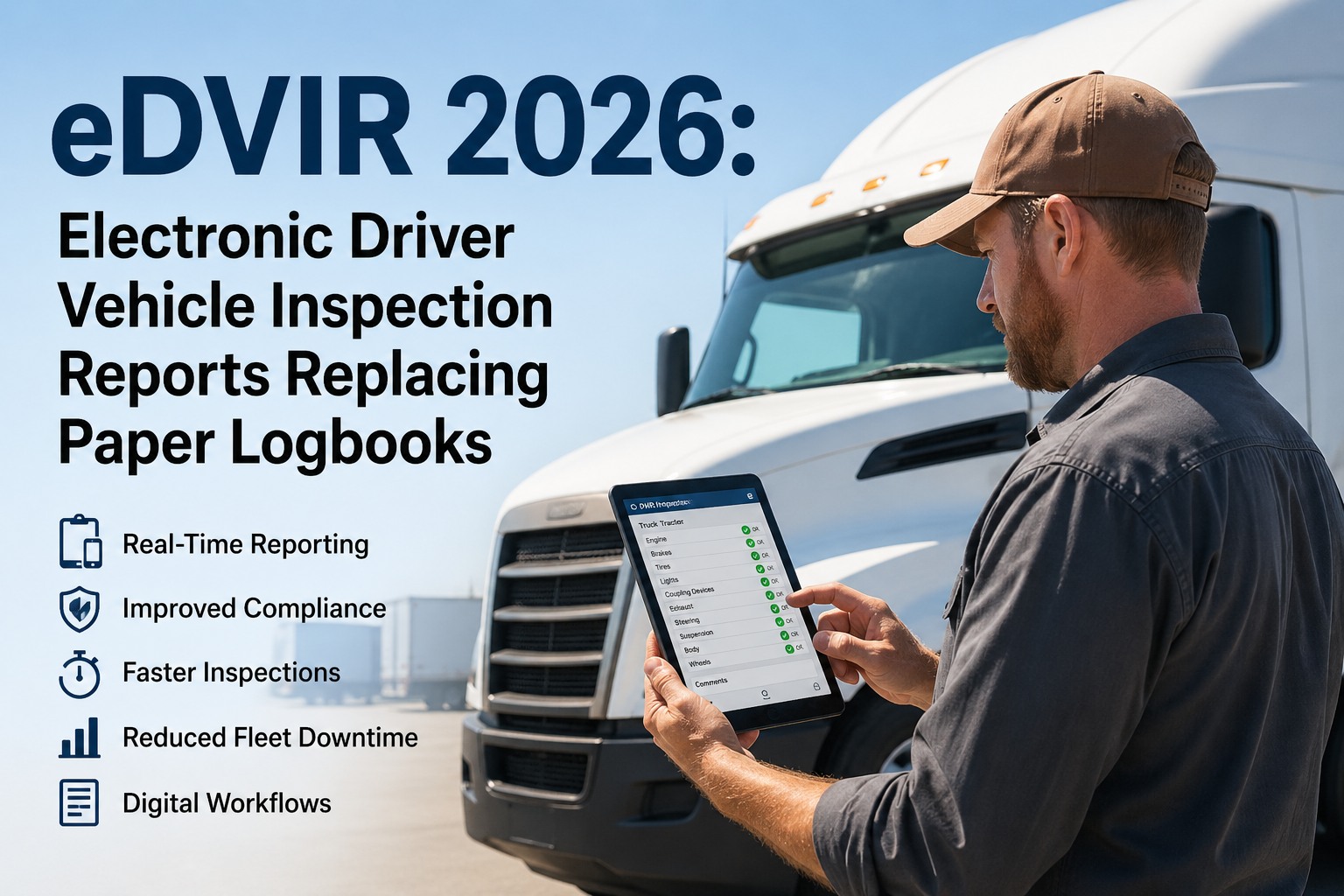
FMCSA's February 2026 final rule explicitly authorizing electronic DVIRs (effective March 23, 2026) eliminates the last regulatory argument for paper. Carriers still using paper DVIRs now face both operational and regulatory disadvantage as CSA's "Driver Observed" category makes DVIR quality visible in safety scores.
Mobile-First = Non-Negotiable
Fleet apps that require desktop for core workflows see 30-50% lower adoption than mobile-first platforms. In 2026, "mobile-friendly" isn't enough — the app must be mobile-FIRST with offline capability, meaning the phone is the primary interface and the desktop dashboard is the management overlay.
Match the Platform to the Problem
The best fleet management app is the one that solves your primary operational problem — not the one with the longest feature list. If your fleet runs heavy vehicles and your biggest challenges are inspection quality, maintenance compliance, and the defect-to-repair chain, HVI was built for exactly that. If you need telematics and IoT sensor data, look at Samsara or Geotab. If ELD compliance is your top priority, consider Motive. Start with the problem. Pick the platform built deepest in that area. Test with real data, real vehicles, and real users before committing.
Purpose-Built for Heavy Vehicle Operations
HVI connects inspections, PM scheduling, work orders, parts tracking, and fleet analytics on one mobile-first platform — with vehicle-type-specific templates for Class 8 trucks, trailers, cranes, forklifts, buses, and heavy equipment.
Frequently Asked Questions
Q: What's the difference between fleet tracking and fleet management apps?
Fleet tracking (GPS) focuses on vehicle location, route history, and driver behavior monitoring — answering "where is my vehicle right now?" Fleet management apps are broader platforms that include maintenance scheduling, work orders, inspections, parts inventory, and cost analytics — answering "what condition is my vehicle in, what does it need, and what does it cost?" Some platforms combine both; others specialize. Choose based on your primary need.
Q: Do I need a fleet CMMS or an ELD platform?
If your primary challenge is maintenance management (PM scheduling, work orders, cost tracking, inspections), you need a fleet CMMS. If your primary challenge is hours-of-service compliance and driver behavior, you need an ELD platform. Some fleets need both. In that case, choose the best platform for your primary need and verify it integrates with a strong tool for the secondary need. Trying to solve both with one mediocre platform usually means doing neither well.
Q: Why does HVI focus on heavy vehicles specifically?
Heavy vehicles have unique inspection requirements — a Class 8 tractor has 37+ inspection items, a crane has 70 items across 7 systems with ASME B30 compliance, forklifts need OSHA 1910.178 pre-shift checks. Generic platforms use one-size-fits-all inspection templates. HVI provides vehicle-type-specific checklists with the correct items, frequencies, and regulatory references for each equipment type.
Start free.
Q: What if I have both heavy vehicles and light-duty fleet?
HVI handles both — with the appropriate inspection template for each vehicle type. The advantage over light-duty-first platforms is that your heavy equipment gets the deep, regulation-specific inspection checklists it needs, while your light-duty vehicles get streamlined inspections appropriate for their requirements. One platform, correct templates for every asset type.
Q: How important is offline capability?
Critical for any fleet with vehicles at construction sites, underground facilities, rural routes, or remote locations. If a driver can't complete an inspection because there's no signal, they either skip it (compliance risk) or delay it (operational risk). Offline-capable apps complete the full inspection locally and sync when connectivity returns. Test this before committing to any platform.
Q: How do I measure if the app is actually working?
Track five metrics in the first 90 days: inspection completion rate (target 100% for CDL vehicles), defect-to-repair time (target under 4 hours for safety-critical), PM on-time completion (target 95%+), user adoption rate (target 90%+ active users), and planned-vs-reactive ratio (measure baseline, target 10% improvement in first quarter). If these aren't improving, the platform isn't being used properly.