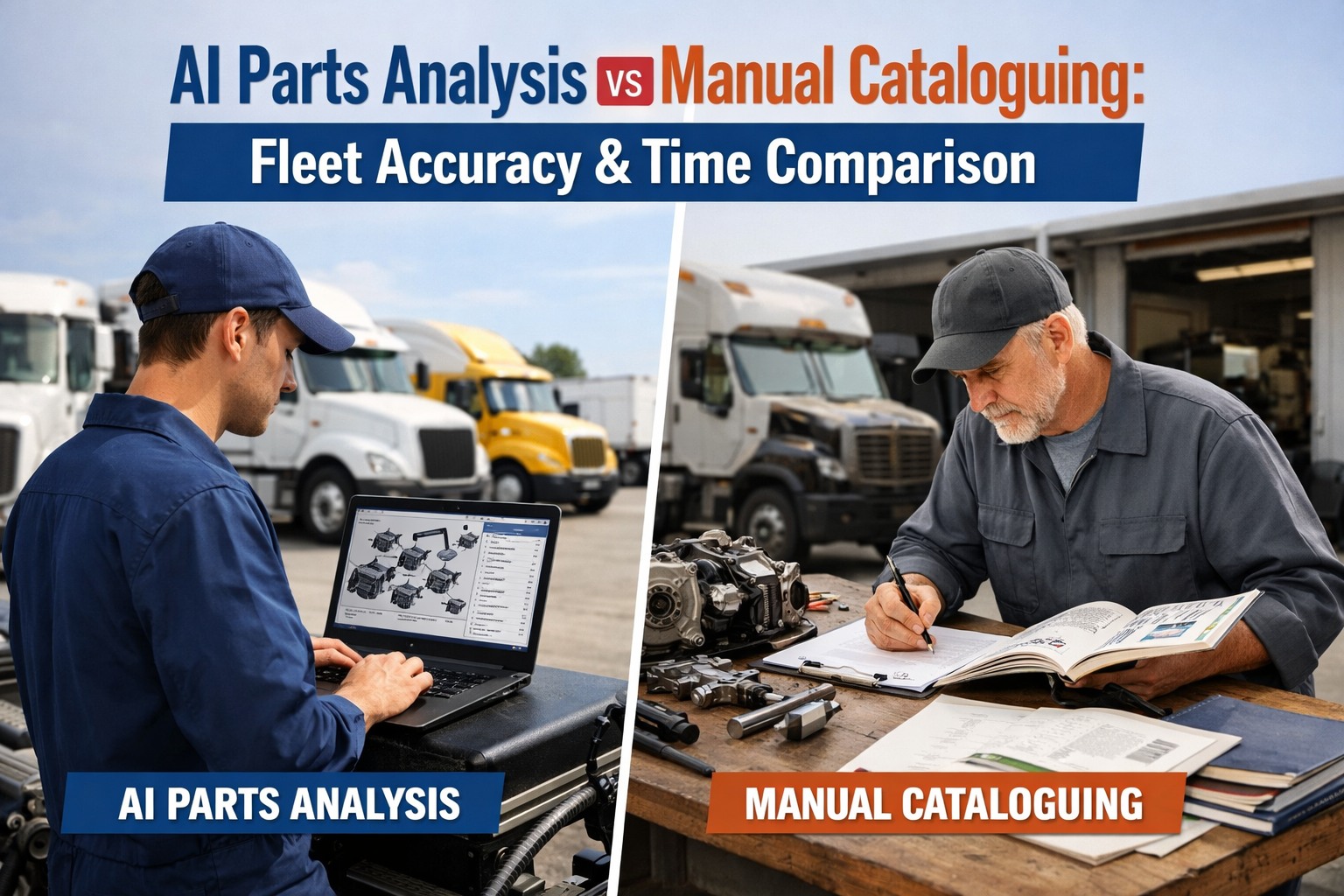
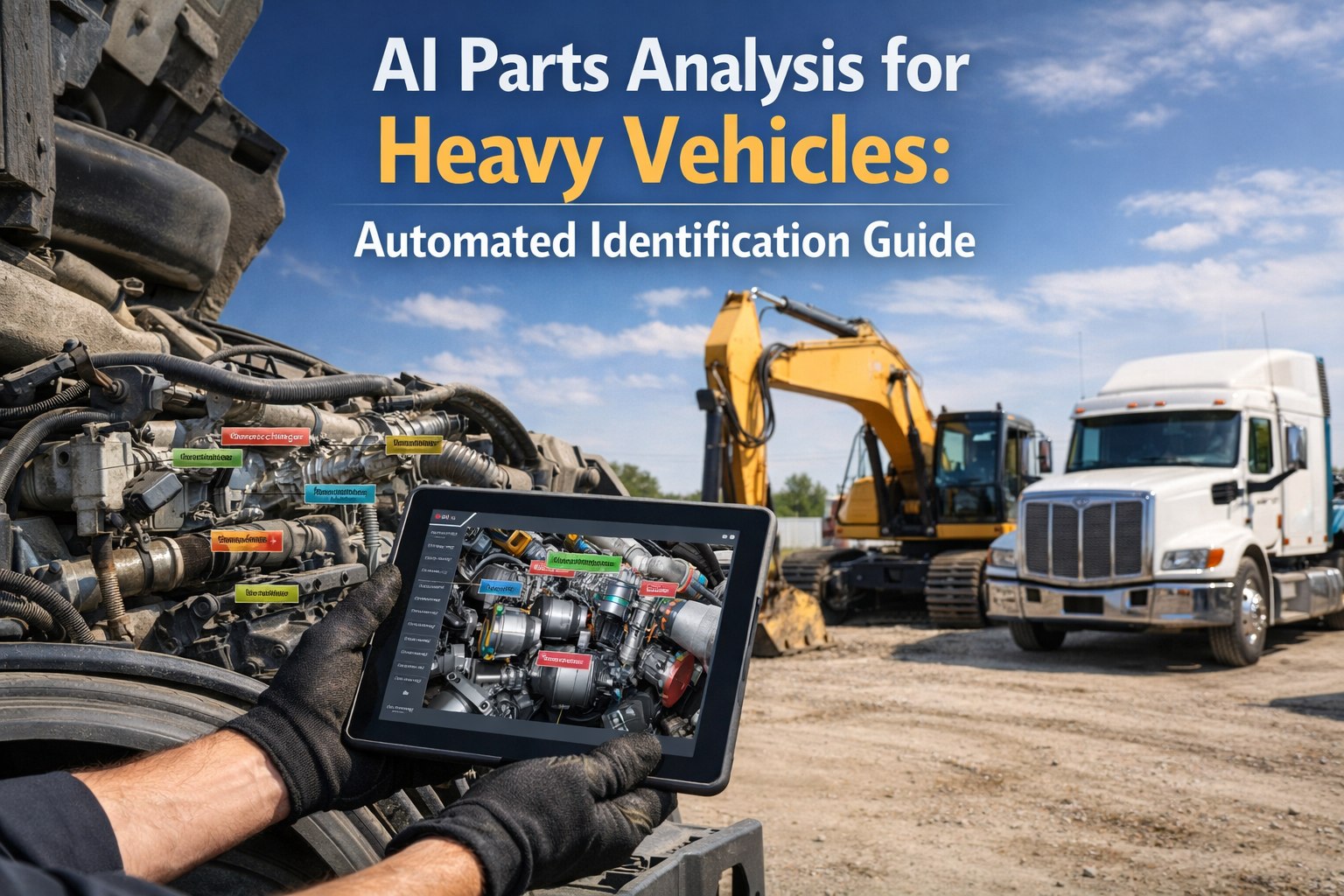
A technician needs a brake chamber for a 2019 Kenworth T680 — rear axle, driver side. In a manual cataloguing operation, this starts a 15–25 minute search: flip through a paper parts book (or scroll a PDF), cross-reference the VIN against a compatibility chart, call the parts supplier to confirm fitment, wait on hold, then hope the part number is correct. In an AI-powered operation, the technician photographs the component, and in under 60 seconds the system identifies it, confirms the exact spec for that vehicle, checks inventory, and attaches the correct part number to a work order. Same outcome. One takes 20 minutes and introduces human error at every step. The other takes 60 seconds with 95–99% accuracy. This is not a marginal improvement — it is a fundamental shift in how fleet maintenance handles parts identification, and the gap between fleets using AI and those still running manual catalogues is widening every quarter. HVI's AI parts analysis delivers the speed and accuracy side of this comparison — integrated with inspections, work orders, and inventory on one platform.
The Head-to-Head Comparison
Every dimension of parts identification — speed, accuracy, cost, scalability, and compliance documentation — favours AI. Here is what the comparison looks like across the metrics that matter to fleet operations.
Lookup Time per Part
15–25 minutes
Under 60 seconds
Identification Accuracy
70–80%
95–99%
Wrong-Part Order Rate
8–15% of orders
<2% of orders
Training Required
Months of experience
25-minute app onboarding
Knowledge Dependency
Lives in one person's head
Available to every technician
Cross-Reference Capability
Manual VIN lookup + supplier call
Automatic — photo + vehicle database
Inventory Integration
Separate system — checked manually
Live stock check per work order
Documentation Quality
Handwritten notes, often incomplete
Timestamped photo + part ID + audit trail
Scalability
Breaks at 50+ vehicles
Scales to 500+ with zero added staff
Annual Cost Impact
$3,200–$5,800 wasted per vehicle
$8,500 saved per vehicle
Why Manual Cataloguing Fails at Scale
Manual parts cataloguing works when you have 5 trucks, one experienced parts manager, and vehicles from a single manufacturer. It breaks the moment any of those conditions changes.
01
The Expert Leaves, the Knowledge Leaves
Manual cataloguing depends on institutional knowledge — the parts manager who "just knows" that a 2018 Peterbilt 579 needs a different alternator than a 2019. When that person retires, gets sick, or changes jobs, the knowledge walks out the door. AI retains every identification permanently.
02
Mixed Fleets Multiply Complexity
A fleet running Kenworth, Freightliner, Peterbilt, and Volvo — across multiple model years — has thousands of unique part specifications. No single person can hold this in memory. Paper catalogues become a maze. AI handles the entire matrix in real time from a single photo.
03
Supplier Catalogues Go Stale
Paper and PDF parts catalogues are outdated the moment they are printed — superseded part numbers, discontinued components, and manufacturer changes create a rolling accuracy problem. AI databases update continuously with current supplier data.
04
Night Shift Has No Support
The parts expert works day shift. The night crew identifies parts by guessing, calling colleagues at home, or ordering what "looks right." Wrong-part rates on second and third shifts are 2–3x higher than day shift — a gap AI eliminates entirely because it is always available.
If your fleet runs multiple makes, model years, or shift schedules — manual cataloguing is costing you more than you realize.
Schedule a fleet-specific consultation and we will calculate your actual wrong-part cost based on your maintenance records.
The Time Savings: Where 15 Minutes Becomes 60 Seconds
Time savings compound across every technician, every work order, every shift. Here is what it looks like at fleet scale.
Parts Lookups per Technician per Day
4–6 lookups x 20 min = 80–120 min/day
4–6 lookups x 1 min = 4–6 min/day
Time Saved per Technician per Day
75–115 minutes returned to wrench time
10-Technician Shop — Weekly Recovery
62–96 hours lost to manual lookup
3–5 hours total with AI
Annual Productivity Recovered (10 techs)
3,000–5,000 productive hours returned per year
The Accuracy Gap: Where Wrong Parts Cost Real Money
Accuracy is not an abstract quality metric — every wrong-part identification triggers a concrete financial cascade. Start free with HVI and measure your own fleet's accuracy improvement within 30 days.
$200–$1,200
Restocking Fee Per Wrong Part
$150–$400
Rush Shipping for Correct Part
$500–$2,000
Per Day Vehicle Downtime
1–3 hrs
Technician Labour Wasted
$850–$3,600
Total Cost Per Wrong-Part Event
At an 8–15% wrong-part rate on manual fleets versus <2% with AI — a 50-vehicle fleet doing 200 parts orders per month eliminates 12–26 wrong-part events monthly. At $850–$3,600 per event, that is $10,000–$93,000 in annual savings from accuracy improvement alone.
Want to know your fleet's actual wrong-part rate?
Schedule a free parts accuracy audit — we will review your last 90 days of maintenance data and show you exactly where misidentification is costing you money.
When Manual Still Makes Sense (and When It Does Not)
AI parts analysis is not necessary for every fleet. Here is an honest assessment of where each approach fits.
Manual Works When:
Fleet is under 10 vehicles, single make/model
One dedicated parts expert with no turnover risk
Single shift operation only
Parts supplier provides direct fitment support
AI Is Essential When:
Fleet exceeds 25+ vehicles or mixed makes/models
Multiple technicians need parts lookup capability
Multi-shift operation or remote field service
Wrong-part orders are a recurring cost problem
Work order backlog is growing due to parts delays
The Comparison Is Clear — the Question Is Timing
Manual parts cataloguing served fleet maintenance for decades. It no longer serves it well — not at the scale, complexity, and speed that modern fleet operations require. AI parts analysis is faster (60 seconds vs. 20 minutes), more accurate (95–99% vs. 70–80%), cheaper (saves $8,500/vehicle/year vs. costs $3,200–$5,800 in waste), and available to every technician on every shift without specialized training. The fleets making this transition now are compounding their advantage with every work order. Those waiting are compounding their wrong-part costs with every month. Start free with HVI today, or schedule a live comparison demo where we run AI analysis alongside your current process on the same vehicle.
See the Difference for Yourself
AI parts analysis vs. your current process — live, on your vehicles, during a 30-minute demo. 163+ component recognition. 95–99% accuracy. No hardware. Trusted by 25,000+ users.
Frequently Asked Questions
Q: How accurate is AI parts identification compared to an experienced parts manager?
AI achieves 95–99% identification accuracy across 163+ component types. Even experienced parts managers average 70–80% accuracy — higher on familiar vehicles, significantly lower on unfamiliar makes or model years. The critical difference is consistency: AI applies the same accuracy at 5 AM on a Sunday as it does at 10 AM on a Tuesday.
Schedule a demo to see accuracy on your specific vehicle types.
Q: Can AI handle older vehicles that are not in standard catalogues?
AI systems trained on 30+ million images cover vehicles across decades of production. For older or rare vehicles, the system uses visual matching against the component database rather than VIN-based lookup — identifying the part type and cross-referencing available replacements. Coverage improves over time as the AI learns from your fleet's specific equipment.
Q: What happens when AI is uncertain about an identification?
AI returns a confidence score with every identification. High-confidence results (95%+) proceed directly to work order creation. Lower-confidence results are flagged for human review with the AI's best matches displayed for the technician to confirm. This hybrid approach ensures no wrong part is ordered based on a low-confidence AI guess — you get the speed of AI with a human verification layer when needed.
Try it free.
Q: How long does the transition from manual to AI take?
Most fleets are running AI parts analysis within the first day of setup. The app works on existing smartphones with no hardware installation. Driver and technician training takes 25 minutes. Initial vehicle data import (VINs, make/model) takes 1–2 hours for a typical fleet. Full integration with work orders and inventory typically completes within the first week.
Q: What ROI can I expect from switching?
Most fleets see full ROI within 60 days. Documented savings include $8,500 per truck annually, 35% lower repair costs, and near-elimination of restocking fees and rush shipping charges. The first prevented wrong-part cascade (restocking + rush shipping + downtime at $850–$3,600 per event) typically covers several months of platform cost.
Schedule a free ROI assessment based on your fleet's actual maintenance data.