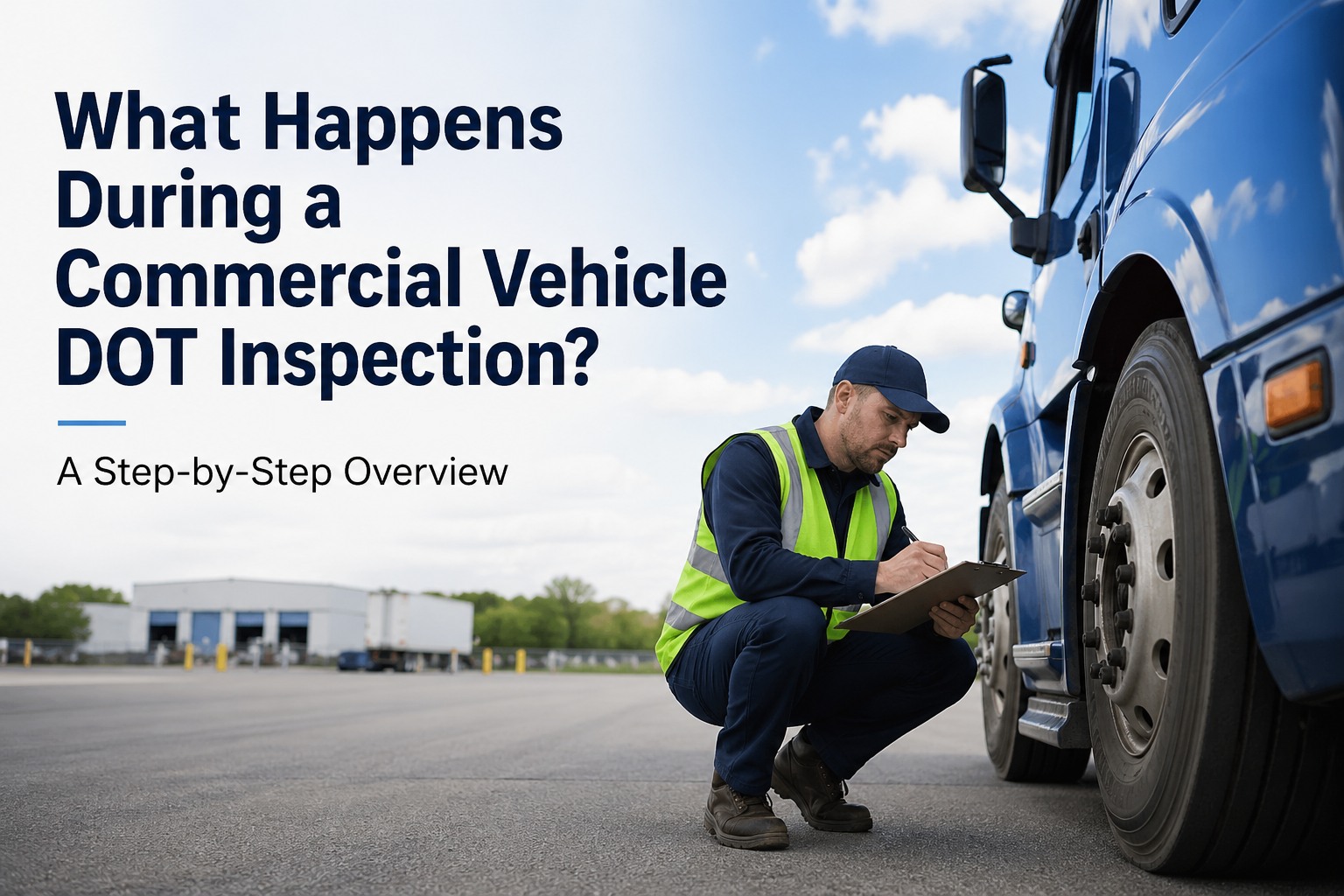
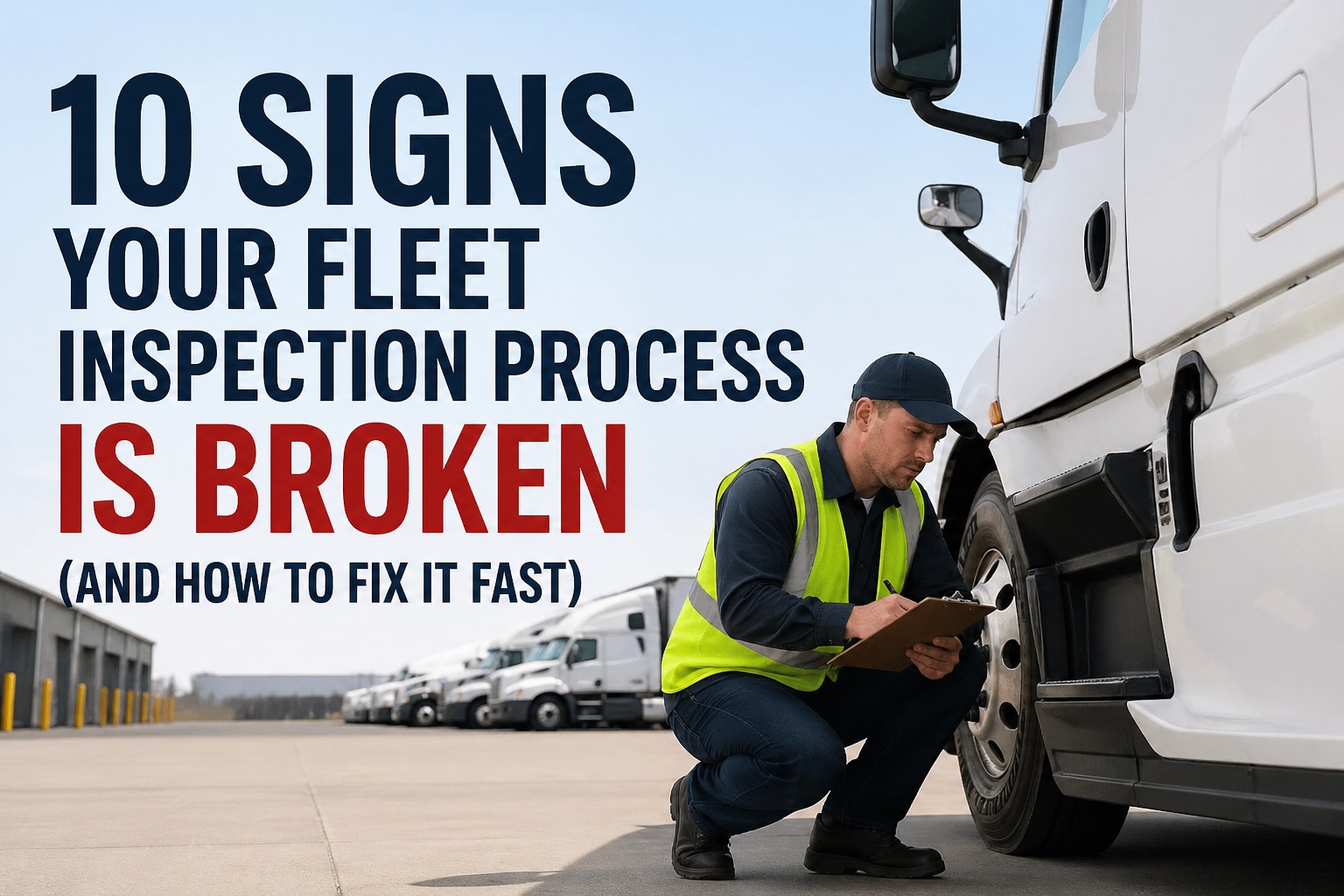
Approximately 4 million commercial motor vehicles are inspected roadside every year across North America — and during the 2025 International Roadcheck alone, 22.6% of vehicles inspected were placed out of service on the spot. Whether you are a driver approaching a weigh station for the first time or a fleet manager building a compliance program, understanding exactly what happens during a DOT inspection — step by step, item by item — is the foundation of passing one. The process follows a standardised CVSA protocol that is identical whether you are stopped in California, Texas, or North Carolina. Inspectors evaluate your credentials, your vehicle, and your cargo against a checklist that has not changed dramatically in years — which means the defects that fail trucks are entirely predictable and entirely preventable. This guide walks through the complete DOT inspection process: what triggers it, what happens at each stage, what inspectors check, and how your daily inspections connect directly to whether you pass or get parked. HVI's digital inspection platform prepares your fleet for exactly this — ensuring every vehicle that leaves your yard is inspection-ready before it reaches a weigh station.
Be Inspection-Ready Before the Weigh Station
HVI's guided digital inspections cover every item DOT inspectors check — so your trucks pass roadside because they were already verified at the yard.
The 8 CVSA Inspection Levels
Not every DOT inspection is the same. CVSA defines eight levels, each with different scope and depth. Level I and II account for the vast majority of roadside encounters.
Level I
Full 37-step driver + vehicle (includes under-vehicle)
45–60 min
Yes
Level II
Driver + walk-around vehicle (no under-vehicle)
20–30 min
No
Level III
Driver credentials and documents only
15–20 min
No
Level IV
Targeted single item (e.g., brakes during Brake Safety Week)
10–15 min
No
Level V
Vehicle-only (driver not present)
30–45 min
Yes
Level VI
Radioactive materials (enhanced Level I)
60+ min
Yes (nuclear)
Level VII
Jurisdictional-specific programs
Varies
No
Level VIII
Electronic / remote inspection (wireless)
Varies
No
The Level I Inspection: Step by Step
The Level I is the most comprehensive and most common DOT inspection. Here is exactly what happens — in the order the inspector performs it. Sign up free for HVI and your daily inspections will mirror this exact sequence.
Phase 1
Approach & Initial Observation
Before the inspection formally begins, the officer observes the vehicle during approach — looking for visible defects, fluid leaks, unsecured cargo, smoke from brakes, and tyre condition. Visible problems during approach can escalate a Level III into a full Level I immediately.
Phase 2
Driver Credentials Review
Inspector checks: valid CDL with correct endorsements, Medical Examiner's Certificate (now verified through MVR — paper waiver expired January 10, 2026), ELD/record of duty status, hours of service compliance, seat belt usage, Drug & Alcohol Clearinghouse status, Skill Performance Evaluation Certificate (if applicable), and signs of impairment. Any credential violation can result in an immediate driver OOS order.
Phase 3
Exterior Walk-Around
Starting at the front of the vehicle: headlamps, turn signals, windshield condition, wipers, mirrors. Moving along the sides: clearance markers, reflectors, tyre condition (tread depth, inflation, exposed cord), wheel fasteners, fuel tank mounting, exhaust system. Rear: tail lights, brake lights, turn signals, reflectors, mud flaps, licence plate illumination. Coupling area: fifth-wheel condition, locking mechanism, safety chains, kingpin, electrical connections.
Phase 4
Under-Vehicle Inspection
This is what separates Level I from Level II — the inspector goes underneath. They check: brake adjustment (pushrod travel on every axle), brake hose and tubing condition, air system leaks, brake drum and lining condition, steering components (tie rods, drag links, pitman arm), suspension (spring leaves, U-bolts, air bags), frame cracks, driveline condition, exhaust system routing and leaks.
Phase 5
Brake Performance Test
Inspector tests the air brake system: governor cut-in and cut-out pressure, air compressor build-up rate, low-pressure warning activation, tractor protection valve, trailer air supply, parking brake hold, and applied brake pushrod travel at each wheel. The 20% defective brake rule: if 2+ out of 10 brakes exceed pushrod travel limits, the vehicle is placed OOS.
Phase 6
Cargo Securement Check
Inspector verifies cargo is properly secured according to FMCSA cargo securement rules (49 CFR 393 Subpart I): adequate number of tie-downs based on cargo weight and length, proper working load limits, no cargo leaking/spilling/blowing/falling. Cargo securement is the 2026 International Roadcheck vehicle focus area.
Phase 7
Findings & Disposition
Inspector documents all findings and issues the inspection report. Three possible outcomes: clean pass (no violations — may receive CVSA decal valid for 3 months), violations cited but no OOS (driver can continue with documented defects), or OOS order (vehicle and/or driver restricted from movement until violations are corrected). Every violation is reported to FMCSA and affects your CSA scores.
HVI's guided inspection follows this exact 7-phase sequence — so your drivers verify everything a DOT inspector checks before the truck ever reaches a weigh station.
Schedule a demo to see the walk-around mapped to DOT inspection items.
What Fails Most Often — and How Daily Inspections Prevent It
The same defect categories top the violation list year after year — making them the most predictable and most preventable failures in any fleet. Start free with HVI and catch every one at the yard.
Brake Systems
29–30%
Daily pushrod travel check + air leak listen + ABS light verification. HVI photo-verifies brake condition at every walk-around.
Tyres & Wheels
21.4%
Tread depth gauge (not visual estimate) + inflation check + inner dual inspection. HVI AI estimates tread depth from photos.
Lighting
Top 3
Full perimeter walk with all lights on + brake light check (someone presses pedal). HVI requires 4+ angle photos with lights activated.
Cargo Securement
2026 focus
Tie-down count, WLL verification, load shift check at every stop. HVI's cargo checklist matches FMCSA 49 CFR 393 requirements.
ELD / HOS
92.7% OOS rate
ELD data review before departure. Verify supporting documents match duty status. 2026 focus: ELD tampering detection.
Medical Certificate
55.2% OOS rate
Automated 60/30/7-day expiration alerts. HVI dispatch-restricts drivers with expired credentials — zero surprises at roadside.
2026 Enforcement Changes That Affect Your Inspections
Three regulatory shifts in 2026 have changed what inspectors focus on and how violations impact your carrier profile.
Feb 2026
CSA Scoring Overhaul
OOS violations now carry 2x severity weight. Vehicle Maintenance splits into "Standard" and "Driver Observed" categories — your daily inspection quality is now directly visible on your carrier profile. Violations count for 12 months instead of 24.
Mar 23, 2026
eDVIR Final Rule Effective
FMCSA Final Rule Docket FMCSA-2025-0115 explicitly authorises electronic DVIRs under 49 CFR 396.11 and 396.13. Digital inspection records are now unambiguously compliant — and preferred during offsite audits.
Apr 1, 2026
ELD Tampering Enforcement
CVSA Inspection Bulletin 2026-02 targets false records and ELD tampering. Drivers using revoked ELD devices (including those revoked February 2026) will be placed out of service. 2026 Roadcheck driver focus area.
HVI is already updated for all three 2026 changes — eDVIR compliant, CSA "Driver Observed" mapped, and ELD integration supporting tampering detection.
Sign up free or
schedule a demo to see the 2026 compliance updates in action.
The Best Way to Pass a DOT Inspection Is to Perform One Every Day
A DOT Level I inspection is a 37-step, 45–60 minute evaluation of your driver credentials and vehicle condition. Every item on that checklist — brakes, tyres, lights, coupling, exhaust, cargo, credentials — is something your drivers should be checking during their daily pre-trip inspection. The fleets that pass roadside at the highest rates are not lucky — they are running daily inspections that mirror the DOT protocol, catching and repairing defects at the yard before an inspector finds them on the highway. HVI makes this systematic: guided walk-arounds that follow the DOT inspection sequence, photo-verified checkpoints at every critical system, AI defect detection across 163+ components, 3-signature DVIR enforcement, and audit-ready documentation that proves your fleet was inspection-ready before the weigh station. Start free today and make every daily inspection a dress rehearsal for the real thing.
Make Every Day Inspection a DOT Rehearsal
37-step guided walk-arounds. Photo-verified checkpoints. AI defect detection. 3-signature enforcement. Audit-ready records. Trusted by 25,000+ users.
Frequently Asked Questions
Q: How long does a DOT inspection take?
A Level I comprehensive inspection takes 45–60 minutes. A Level II walk-around takes 20–30 minutes. A Level III driver-only takes 15–20 minutes. Level IV targeted inspections take 10–15 minutes. Duration varies based on the number of violations found — a clean vehicle gets through faster than one with multiple defects.
Q: Can I refuse a DOT inspection?
No. CVSA-certified enforcement officers are authorised under 49 CFR 396.9 to enter upon and inspect any commercial motor vehicle in operation. Refusing an inspection can result in an immediate out-of-service order and additional penalties. Cooperate fully, present documents when asked, and remain professional.
Q: What is the difference between Level I and Level II?
Both inspect driver credentials and the vehicle, but Level I includes an under-vehicle inspection where the officer physically goes beneath the truck to check brakes, suspension, exhaust, and frame. Level II is a walk-around covering only visible components. Level I takes 45–60 minutes and can issue a CVSA decal on pass; Level II takes 20–30 minutes and typically does not issue a decal.
Start free with HVI to prepare for both.
Q: What happens if my truck is placed out of service?
The vehicle is prohibited from moving until all OOS violations are corrected and verified — at the roadside location. You must arrange repair (mobile tech or towing to a shop), correct all cited defects, and in some cases have the repairs verified before the truck can move. The OOS violation is reported to FMCSA and impacts your CSA scores at 2x severity weight under the 2026 scoring system.
Schedule a demo to see how HVI prevents OOS violations.
Q: How does a clean inspection help my fleet?
A clean inspection with no violations improves your CSA percentile scores. Vehicles passing a Level I or V without critical violations may receive a CVSA decal valid for 3 months — signalling to inspectors that the truck was recently inspected and clean. Better CSA scores lead to fewer inspection selections (PrePass and Drivewyze screening), lower insurance premiums (15–20% reduction), and preferred shipper access.