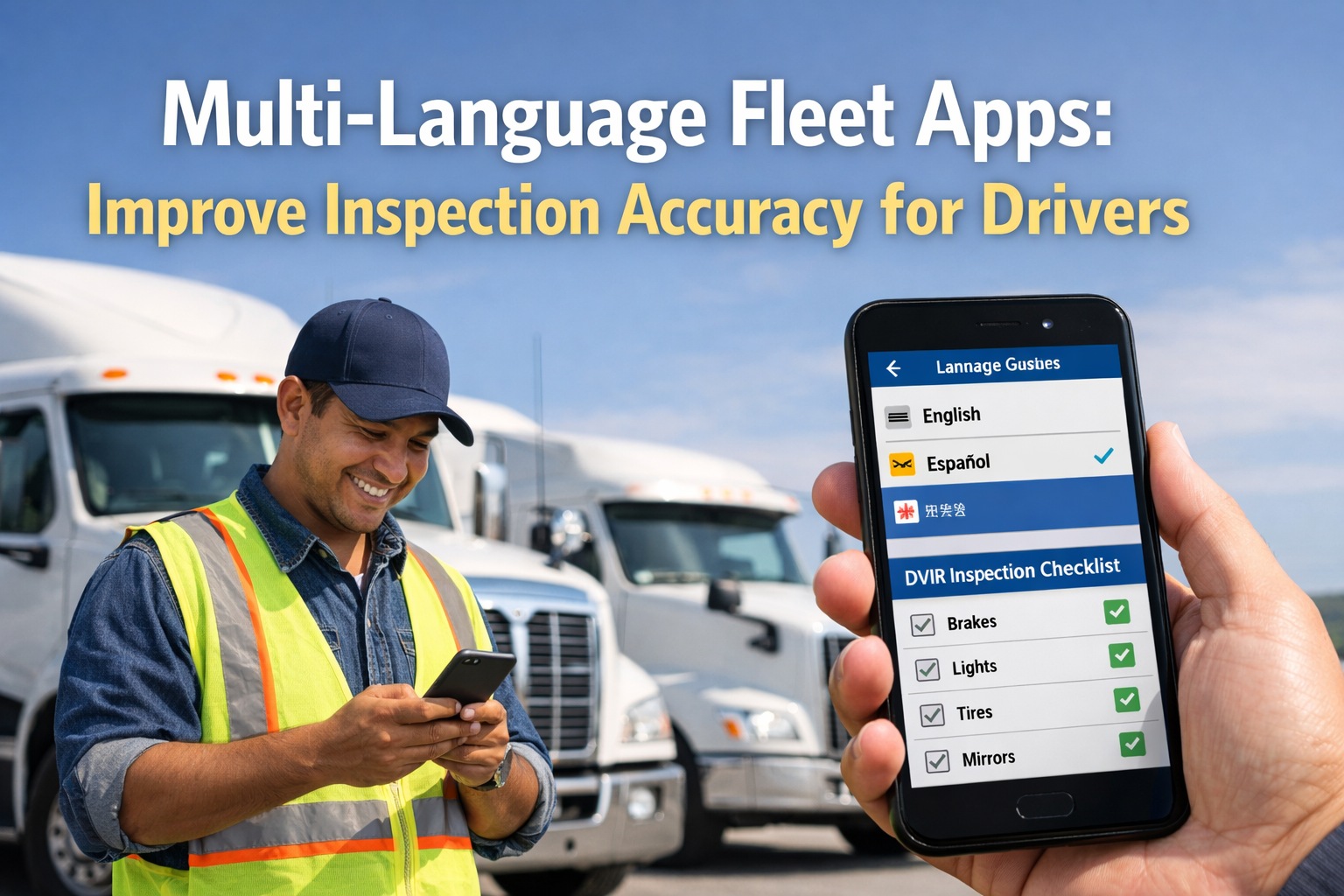
A driver stands next to a Class 8 tractor at 5:30 AM, opens an inspection app, and reads "Check fifth-wheel coupling mechanism for excessive play, wear, or damage." The problem is not the vehicle. The problem is that the driver's primary language is Spanish, Punjabi, or Polish — and the app is English-only. What follows is predictable: the driver taps "pass" on items they did not fully understand, skips components they could not identify by name, and produces a DVIR that technically exists but does not verify what the regulation requires. Multiply this across a 200-driver fleet where 30–40% of drivers are non-native English speakers, and the scale of undetected inspection failure becomes clear. Language barriers are not a minor UX issue — they are a direct threat to inspection accuracy, compliance documentation, and fleet safety. Multi-language fleet apps close this gap by presenting every inspection item, defect description, and instruction in each driver's primary language — while maintaining a single, standardized compliance record in English for FMCSA, OSHA, and audit purposes. HVI's multi-language inspection platform delivers this capability natively — built for the actual driver workforce that runs American heavy vehicle fleets in 2026.
The Hidden Scale of the Language Barrier
The commercial driver workforce is one of the most linguistically diverse in the US economy — a fact that fleet software has historically ignored. Here is what the demographics actually look like.
30–40%
Non-Native English Speakers
Estimated share of the US commercial driver workforce whose primary language is not English. In some fleets operating in border states or major ports, this percentage exceeds 60%.
600+
Drivers Pulled Off the Road
California alone pulled over 600 truckers off the road in January 2026 for English proficiency failures during FMCSA inspections — the beginning of stricter enforcement nationwide.
8,200+
Federal Inspections Targeting English
FMCSA roadside inspections now explicitly test English proficiency and sign recognition. Drivers who cannot communicate inspection findings in English face out-of-service orders.
5
Primary Languages in US Trucking
English, Spanish, Punjabi, Russian, and Polish account for the majority of non-English driver primary languages. Fleet apps must support all of them to match the actual workforce.
Where English-Only Inspection Apps Break Down
The failure mode of English-only inspection apps is not that drivers refuse to use them — it is that they use them incorrectly. Here are the five specific failure points where language barriers degrade inspection accuracy.
Technical Terminology Confusion
"Fifth-wheel coupling," "king pin," "slack adjuster," "air governor cut-out pressure" — these are not translatable with a dictionary. Drivers who do not recognize the component name cannot inspect it properly, regardless of how well they know the vehicle.
Defect Description Errors
When drivers find a real defect, they struggle to describe it accurately in English — "brake thing is leaking oil" instead of "rear brake chamber diaphragm showing hydraulic fluid seepage." Maintenance teams get vague reports that delay repairs and create documentation gaps.
Checklist Skipping
When a driver encounters an item they do not understand, they default to "pass" to avoid acknowledging confusion. The inspection completes, the record looks clean, but the actual verification never happened. This is pencil whipping driven by language, not laziness.
Time-Pressure Amplification
English inspections take drivers 3–5x longer when they are reading in a second language. Under dispatch time pressure, comprehension drops further — drivers rush through items to hit their departure window, producing inspections that are technically complete but functionally incomplete.
Training Reinforcement Loss
Orientation and safety training often happen in English regardless of driver demographics. Drivers retain a fraction of what they are taught in a second language. Inspection apps that repeat English terminology reinforce the original training gap instead of closing it.
How Multi-Language Inspection Apps Actually Work
A multi-language fleet app is not just a translated interface — it is a parallel-content system that maintains inspection accuracy in the driver's language while producing compliance-ready documentation in English. Here is what that looks like in practice. Start free with HVI and see multi-language support on your own fleet.
What the Driver Sees
"Inspect the fifth-wheel coupling — check for excessive play, visible wear, or damage to the locking mechanism." — displayed in Spanish, Punjabi, Russian, or Polish based on the driver's profile setting.
What the Compliance Record Shows
"Fifth-wheel coupling inspected — [pass/fail] — [defect description if any]" — stored in English with the driver's digital signature, GPS stamp, timestamp, and language indicator for audit purposes.
What the Driver Sees
Defect reporting interface with translated severity levels, photo capture prompts in the driver's language, and voice-to-text in their native language for defect descriptions.
What Maintenance Receives
Work order in English with translated defect description, photos, GPS location, and standardized component codes that map to parts inventory and repair procedures.
What the Driver Sees
Training content, safety reminders, and in-app coaching tips in the driver's primary language — reinforcing correct inspection technique with every walk-around.
What Managers See
Uniform English dashboard showing inspection completion, defect trends, and compliance metrics across all drivers — regardless of the language each driver used to complete the inspection.
The Accuracy Impact: Before and After Multi-Language
When drivers can inspect in their primary language, every measurable inspection accuracy metric improves — often dramatically. Here is what the data shows.
Defect Detection Rate
+28 pts
Inspection Time (Non-Native)
−70%
"Pass" Selections Without Verification
Eliminated
Defect Description Quality
Maintenance-ready
Driver Adoption Rate
+37 pts
Training Retention
Complete comprehension
What HVI's Multi-Language Platform Delivers
HVI was built to support the actual workforce that operates American heavy vehicle fleets — not an English-only workforce that exists in software documentation but not on loading docks, truck yards, and construction sites. Book a demo to see how HVI supports your specific driver language mix.
Multi-Language Inspection Templates
Every vehicle-specific inspection template (37+ items for Class 8 tractors, 70 for cranes, etc.) available in multiple languages including Spanish, Punjabi, Russian, Polish, and more. Technical terminology professionally translated — not machine-generated.
Driver-Level Language Preference
Each driver sets their preferred language in their profile. Every inspection, alert, notification, and in-app coaching content automatically displays in their language — while compliance records maintain standardized English for audit consistency.
Translated Defect Descriptions
When drivers report defects in their native language, HVI translates the description into standardized English for maintenance work orders — preserving the specificity and accuracy that gets lost in second-language descriptions.
Voice-to-Text in Multiple Languages
Drivers can speak defect descriptions in their primary language — HVI transcribes and translates automatically. Eliminates typing barriers for drivers who are comfortable speaking but less comfortable writing in English or any language.
In-App Training & Safety Content
Orientation content, safety reminders, inspection technique tips, and regulatory updates delivered in each driver's primary language. Training retention improves when content is delivered in the language drivers think in, not just the language they work in.
Unified English Reporting
Fleet managers, safety directors, and auditors see uniform English dashboards and reports regardless of the language each driver used. No fragmented data, no translation gaps in compliance records — one standardized view across the entire fleet.
The App Should Match the Workforce
You cannot improve inspection accuracy by giving drivers better English. You can only improve it by meeting drivers in the language they actually think and work in — while maintaining the standardized compliance documentation that FMCSA, OSHA, and your CSA scores require. Multi-language fleet apps are not a concession to non-native English speakers — they are a recognition that inspection accuracy depends on comprehension, and comprehension depends on language. HVI delivers multi-language inspection natively — with professionally translated technical terminology, voice-to-text in multiple languages, translated defect descriptions, and unified English reporting that keeps every audit-ready record consistent. The fleets achieving the highest inspection accuracy, cleanest CSA scores, and most engaged driver workforces are not running English-only software against a non-English-only workforce — they are running platforms built for the drivers who actually operate their vehicles. Sign up free and give your drivers inspection tools that speak their language.
Improve Inspection Accuracy with Multi-Language Support
Translated inspection templates. Driver-level language preferences. Voice-to-text in multiple languages. Unified English reporting. All on one platform — trusted by 25,000+ users worldwide.
Frequently Asked Questions
Q: What languages does HVI support?
HVI supports multiple languages common in the US commercial driver workforce, including Spanish, Punjabi, Russian, Polish, and English. The inspection templates, in-app navigation, alerts, and training content are all available in each language. Compliance records are maintained in standardized English regardless of the driver's language selection.
Book a demo to confirm your specific language requirements.
Q: Does multi-language support affect FMCSA compliance?
No — it improves it. HVI maintains all compliance records in standardized English for FMCSA, OSHA, and CSA purposes while presenting inspection content to drivers in their preferred language. This dual-layer approach produces better inspection accuracy (drivers understand what they are checking) while maintaining audit-ready documentation. The 2026 CSA "Driver Observed" scoring category specifically rewards fleets whose drivers actually perform thorough inspections — which is exactly what multi-language support enables.
Q: How does HVI handle English proficiency requirements for drivers?
FMCSA requires commercial drivers to speak and read English sufficiently to respond to roadside inspections and traffic signs. Multi-language inspection apps do not change this requirement — they address a different problem: the accuracy of daily inspections performed at depots and yards before roadside encounters. HVI helps drivers complete more accurate inspections during their work while encouraging English proficiency development through side-by-side content options.
Start free.
Q: How accurate are the translations?
HVI's translations are professionally developed for technical fleet terminology — not machine-generated word-for-word conversions. Industry terms like "fifth-wheel coupling," "slack adjuster," and "air governor" are translated using standardized commercial vehicle terminology in each language, not generic translations that would confuse drivers even in their native language.
Q: Can drivers switch languages mid-inspection?
Yes. Drivers can toggle between their primary language and English at any point during an inspection — useful for drivers actively developing English proficiency who want to see technical terms in both languages. Every inspection record tags which language was used, giving fleet managers visibility into adoption patterns and training needs.