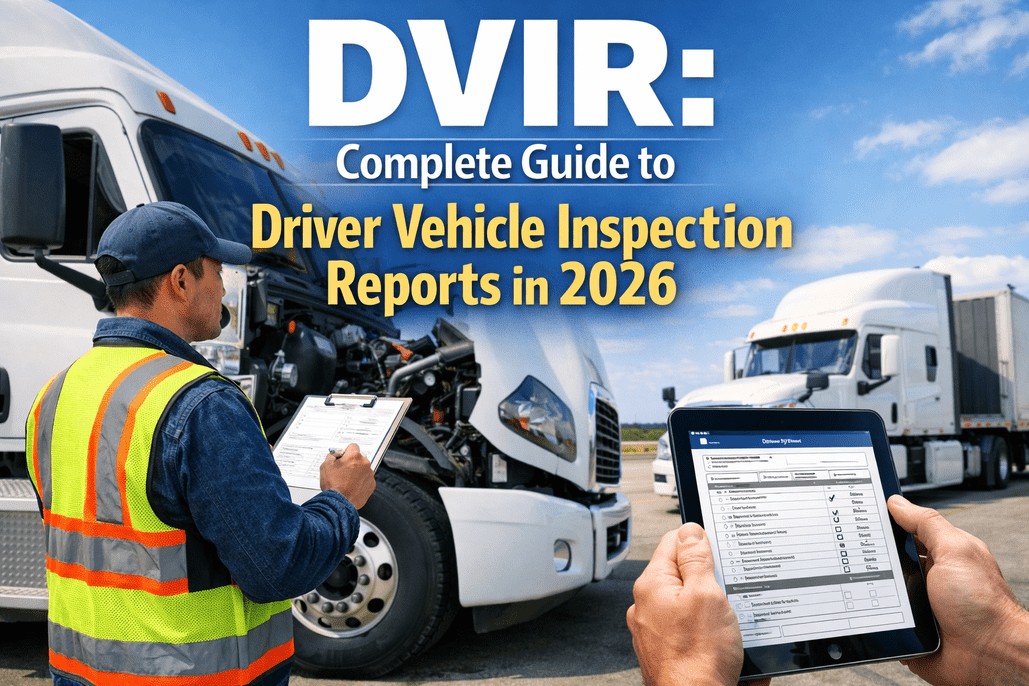
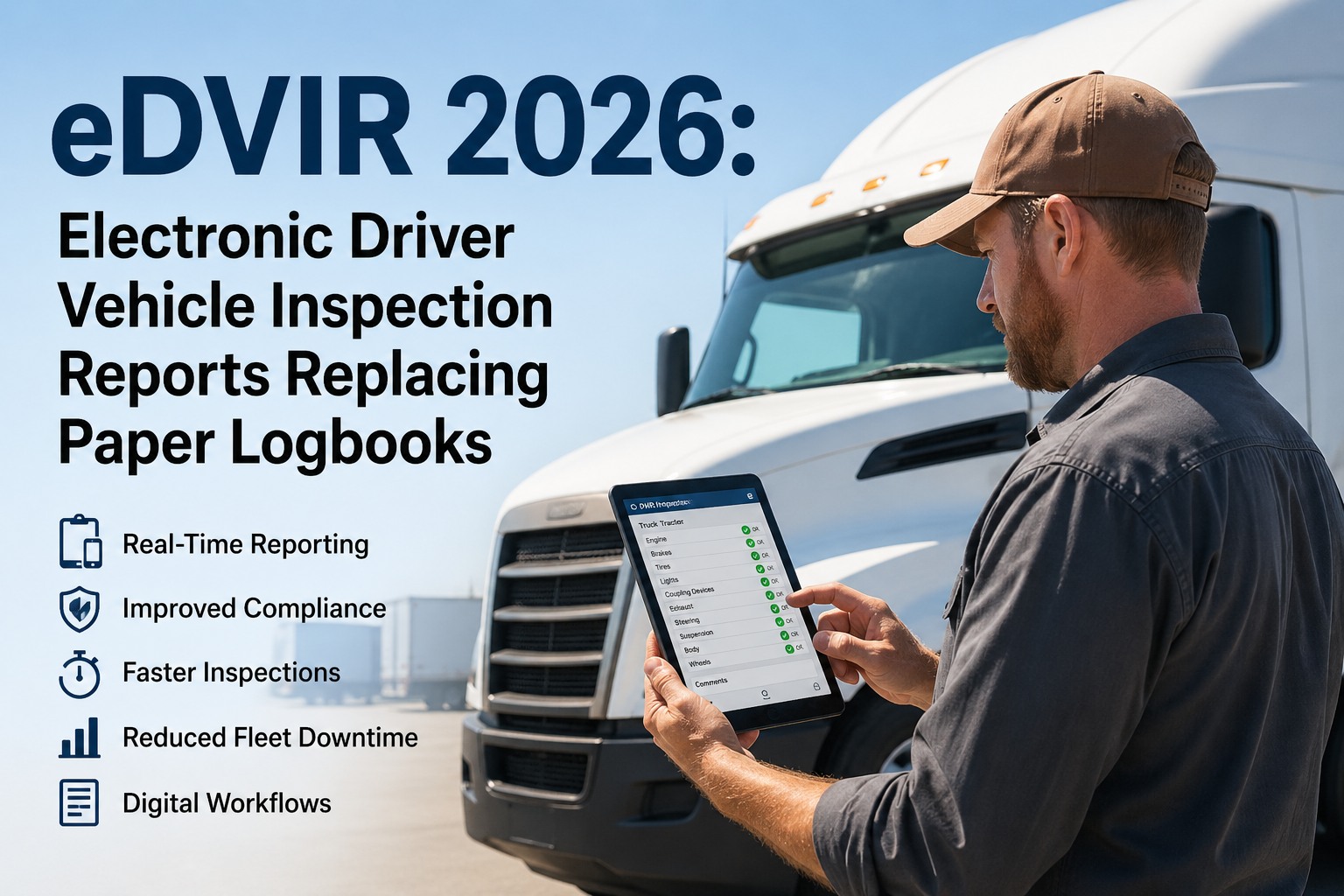
A Driver Vehicle Inspection Report — DVIR — is the single most important compliance document in commercial trucking, and one of the most misunderstood. FMCSA estimates that proper DVIRs prevent approximately 14,000 accidents every year through early defect identification. Yet DVIR violations remain among the most frequent citations during DOT audits, and only 7% of motor carriers pass a focused compliance review without a single violation. The confusion is understandable: the rules around when a DVIR is required, what it must contain, and who must sign it have changed multiple times — most recently with FMCSA's May 2025 proposed rulemaking to explicitly authorize electronic DVIRs. This guide covers everything drivers and fleet managers need to know about DVIRs in 2026: the regulatory requirements, the inspection components, the compliance mistakes that trigger fines, and the digital tools that are replacing paper forms across the industry.
What Is a DVIR and Why It Matters
A DVIR is a formal written report that a CDL driver prepares to document the condition of a commercial motor vehicle. It serves as the official record that an inspection was performed, what defects were found (if any), and that those defects were addressed before the vehicle operated again. The DVIR creates a chain of accountability between the driver who finds a defect, the carrier who repairs it, and the next driver who confirms the repair — a documentation chain that FMCSA auditors and plaintiff attorneys examine closely.
Anatomy of a DVIR: The 5 Required Elements
01
Vehicle Identity
Unit number, VIN, license plate, or other unique identifier for each vehicle operated during the workday
02
Inspection Findings
List of defects or deficiencies affecting safe operation or likely to cause breakdown — or a statement that none were found
03
Driver Signature
Driver who prepared the report must sign (physical or electronic signature under 49 CFR 390.32)
04
Repair Certification
Carrier official or mechanic certifies defects repaired or repair deemed unnecessary — signed before next dispatch
05
Next Driver Acknowledgment
Next driver reviews DVIR, confirms repair status, and signs before operating — completing the chain of custody
14,000
accidents prevented annually by proper DVIRs (FMCSA)
$1,270
per day fine for missing a required DVIR
22.6%
vehicle OOS rate at 2025 CVSA Roadcheck
93%
of carriers have violations during DOT audits
FMCSA DVIR Requirements: 49 CFR 396.11 and 396.13
Two federal regulations govern DVIRs — one for the report itself and one for the pre-trip review cycle. Understanding the distinction between these two sections prevents the most common compliance gaps. In May 2025, FMCSA published NPRM docket FMCSA-2025-0115 proposing explicit language authorizing electronic DVIRs in both sections — a clarification that formalizes what many carriers already practice.
§396.11
Driver Vehicle Inspection Report
When is it required?
At the completion of each day's work, for each vehicle operated during the day
Is a no-defect report required?
No — since 2014 for property-carrying CMVs, 2020 for passenger-carrying. DVIR only required when defects are found. But many carriers require daily DVIRs as company policy.
What must it contain?
Vehicle identification, condition of components (see 11-item checklist), defects affecting safety or likely to cause breakdown, driver signature, date
Can it be electronic?
Yes — electronic records and signatures authorized under 49 CFR 390.32 since 2018. FMCSA's 2025 NPRM adds explicit eDVIR language.
How long must it be retained?
Carrier must retain the original DVIR and repair certification for 3 months from the report date
§396.13
Driver Inspection (Pre-Trip Review)
What does this section require?
Before operating a CMV, the driver must be satisfied it is in safe operating condition — and must review the most recent DVIR if one exists
What if the previous DVIR had defects?
The current driver must sign the previous DVIR to acknowledge they reviewed the report and that repairs were completed or deemed unnecessary
What if there was no previous DVIR?
If no DVIR was filed (because no defects were found), the driver still must perform a pre-trip inspection under §392.7 but has no DVIR to review or sign
What creates the "chain of custody"?
Driver A files DVIR with defect → Carrier repairs and certifies → Driver B signs acknowledging review → drives. Breaking any link = audit citation.
What if repairs were not completed?
Vehicle cannot be dispatched until the carrier certifies that defects are repaired or repair is unnecessary. Dispatching unrepaired = up to $15,420 fine.
Who Is Exempt from DVIR Requirements?
✓ Private motor carriers of passengers (non-business)
✓ Driveaway-towaway operations
✓ Motor carriers operating only one CMV
✓ Intermodal equipment providers (separate rules under §396.11(b))
Pre-Trip vs. Post-Trip DVIR: The Timing That Matters
The most common DVIR confusion is timing. Many drivers and even fleet managers believe the DVIR is the pre-trip inspection form — it isn't. The DVIR is a post-trip document. The pre-trip requirement (§392.7) is a separate regulation that requires the physical act of inspecting but doesn't require written documentation. Here's how they actually work together in a driver's day.
Start of Shift
Review Previous DVIR
§396.13
If previous DVIR exists with defects noted, review it. Sign to acknowledge repairs were made. If no previous DVIR exists (no defects found), proceed to inspection.
Before Driving
Pre-Trip Inspection
§392.7
Physically inspect vehicle. Must be "satisfied" it's safe. No written report required by federal law — but most carriers require documentation as company policy.
During Operation
Drive & Monitor
Ongoing
Note any issues that develop during operation. If safety-critical defect occurs, stop immediately and notify carrier. Do not continue driving with known safety defects.
End of Shift
Post-Trip Inspection + DVIR
§396.11
Inspect vehicle again. If defects found: complete and submit DVIR. If no defects: no DVIR required (property-carrying). Carrier must repair before next dispatch.
Both inspections — pre-trip and post-trip DVIR — in one seamless digital workflow.
Start your free HVI trial — guided checklists, photo documentation, and automatic repair routing. Or
book a demo to see the complete DVIR workflow.
Paper vs. Electronic DVIR (eDVIR)
The shift from paper DVIRs to electronic DVIRs is accelerating. FMCSA's May 2025 NPRM (docket FMCSA-2025-0115) proposes adding explicit eDVIR authorization language to §396.11 and §396.13 — making it unambiguous that electronic creation, maintenance, and signature of DVIRs is fully compliant. While electronic records have been permissible under 49 CFR 390.32 since 2018, this clarification removes the last hesitation for carriers still clinging to paper. Here's why the switch matters.
Paper DVIR
Completion Time
20-30 minutes per vehicle
Defect Detection
70-80% accuracy — items skipped, details vague
Defect-to-Repair
24-72+ hours — paper sits in cab, mailbox, or desk
Falsification Risk
High — "pencil-whipping" undetectable
Audit Retrieval
Hours searching filing cabinets
Storage Cost
$15,000+/year for physical filing
Litigation Value
Checkmark on paper — weak defense in court
Fleet Analytics
None — data locked in paper
Electronic DVIR (eDVIR)
Completion Time
5-10 minutes — 40-67% faster
Defect Detection
95-99% accuracy — required fields, photo gates
Defect-to-Repair
Instant — auto work order + maintenance alert
Falsification Risk
Near zero — GPS, timestamps, required photos
Audit Retrieval
Seconds — search by vehicle, driver, date range
Storage Cost
Cloud included — 99.9% retention guaranteed
Litigation Value
Timestamped GPS + photos = nuclear verdict defense
Fleet Analytics
Defect trends, driver patterns, predictive insights
The eDVIR ROI Math (50-Truck Fleet)
Time Saved
15 min/day × 250 days × 50 trucks = 3,125 hours/year
~$93,750 in driver labor
Repair Cost Reduction
35% decrease from earlier defect detection
~$8,500/truck/year = $425,000
Violation Prevention
35-42 pt CSA improvement → 15% insurance reduction
~$2,400/truck/year = $120,000
Storage Elimination
No filing cabinets, no physical retention costs
~$15,000/year
DVIR Checklist: Components You Must Inspect
49 CFR 396.11 specifies the minimum components that must be covered in every DVIR. These are the same 11 items listed for both the pre-trip inspection (§392.7) and the post-trip DVIR, harmonized by FMCSA in the 2014 rulemaking. Your DVIR form — whether paper or digital — must at minimum address each of these areas, and any defects affecting safe operation must be documented.
▩
Service Brakes
Including trailer brake connections. Check air pressure, hoses, chambers, pads, drums, slack adjusters, ABS.
Critical — #1 OOS Source
▩
Parking Brake
Hand brake must hold vehicle stationary on grade. Test independently from service brakes.
Critical
▩
Steering Mechanism
Linkage, power steering fluid, free play (max 2" on 20" wheel). No loose or damaged components.
High Priority
▩
Lighting & Reflectors
Headlights, tails, brakes, turns, clearance markers, reflective tape. All must function and be correct color.
High — Gateway Violation
▩
Tires
Tread depth (4/32" steer, 2/32" others), inflation (≥50% rated), condition (no cuts, bulges, exposed cord).
Critical — 53.5% of Breakdowns
▩
Horn
Must function and be audible from minimum 200 feet.
Standard
▩
Windshield Wipers
Both wipers functional. Blades not cracked or torn. Windshield not cracked in driver's line of sight.
Standard
▩
Rear-View Mirrors
Both side mirrors present, securely mounted, properly adjusted. No cracks obstructing view.
Standard
▩
Coupling Devices
Fifth wheel locked, kingpin engaged (tug test), glad hands sealed, electrical connected, safety chains attached.
Critical
▩
Wheels & Rims
No cracks, missing lugs, or damaged rims. Duals properly spaced. Hub seals not leaking.
High Priority
▩
Emergency Equipment
Fire extinguisher (charged, minimum 5 B:C), 3 reflective triangles, spare fuses (if applicable).
Standard
+
Company-Specific Items
Many carriers add: fluid levels, exhaust system, frame condition, cargo securement, cab safety items, documentation checks.
Company Policy
Common DVIR Compliance Mistakes
These are the DVIR-related citations that FMCSA auditors find most frequently. Each mistake has a specific fix — and most are eliminated by switching from paper to digital DVIR processes.
What happens: Driver checks "OK" on every item without actually performing the inspection. Often done from the cab before moving the truck, especially under schedule pressure.
Why it's dangerous: 10% of driver OOS violations at 2025 CVSA Roadcheck involved false logs. Juries in nuclear verdict cases specifically look for patterns of rubber-stamped inspections as evidence of carrier negligence.
Fix: Digital DVIRs with GPS verification (proves driver was at the vehicle), required photos for key components, and quality scoring that flags suspiciously fast or uniform inspections.
Start free with HVI.
What happens: Driver A files DVIR with defect. Carrier repairs but doesn't sign certification. Driver B operates vehicle without reviewing or signing the DVIR. Any break in this 3-step chain is a violation.
Why it's dangerous: This is the #1 DVIR-specific audit citation. FMCSA auditors pull a random sample of DVIRs and check every signature. One missing signature = one violation.
Fix: Digital DVIR platforms enforce the chain automatically — repair can't be marked complete without mechanic signature, and the next driver must acknowledge before their pre-trip can begin.
What happens: DVIR reports a defect but the vehicle is dispatched the next day before the carrier certifies the repair is complete (or unnecessary). Common when paper DVIRs sit unprocessed overnight.
Why it's dangerous: Carries the steepest DVIR-related penalty. Creates massive litigation exposure if a crash occurs with a known, unrepaired defect documented on a DVIR.
Fix: eDVIR platforms route defects instantly to maintenance with priority flags. Vehicle dispatch is blocked until the repair certification is completed and signed digitally.
What happens: Paper DVIRs get lost, damaged, or accidentally discarded before the 3-month retention period expires. Illegible handwriting makes some retained DVIRs useless for audit purposes.
Why it's dangerous: Missing DVIRs during an audit are treated as if the inspection never occurred. The carrier cannot prove compliance. For roadside inspection reports with OOS violations, retention extends to 12 months.
Fix: Cloud-based eDVIR storage with automatic retention policies. Records never get lost, are always legible, and are retrievable in seconds for any audit timeframe.
What happens: Driver completes a "DVIR" at the start of the day and nothing at the end. Or takes a photo of their pre-trip log and calls it their DVIR. These are different requirements with different timing.
Why it's dangerous: The pre-trip is the physical inspection before driving (§392.7). The DVIR is the written report at end of day (§396.11). Confusing them creates gaps in both compliance areas.
Fix: Use a digital platform that guides drivers through both workflows separately — pre-trip checklist at shift start, DVIR submission at shift end — with clear labels and separate documentation.
Book a demo to see how HVI handles both.
What happens: DVIR says "brake issue" or "light out" without specifying which brake, which light, the severity, or the location. Maintenance can't act on vague reports without additional diagnosis time.
Why it's dangerous: Vague descriptions delay repairs, waste technician time, and may result in the wrong component being serviced. During litigation, vague DVIRs suggest the inspection wasn't thorough.
Fix: eDVIR apps with photo capture, drop-down defect categories, severity ratings, and location-specific fields eliminate ambiguity. A photo with a pin drop is worth 1,000 words on a paper form.
Best DVIR Apps and Software in 2026
The DVIR software market has matured significantly. When evaluating eDVIR platforms, these are the capabilities that separate compliance tools from compliance-plus-operations tools — and the criteria fleet managers should use to make the right choice.
DVIR Software Evaluation Criteria
Must-Have
FMCSA-Compliant Workflow
Enforces §396.11 and §396.13 chain of custody: driver report → carrier repair cert → next-driver acknowledgment. Non-negotiable.
Must-Have
Electronic Signatures
Compliant with 49 CFR 390.32. All three signatures (driver, mechanic, next driver) captured and retained with timestamps.
Must-Have
Photo Documentation
Camera integration for defect evidence. Geotagged and timestamped photos prove inspection occurred and defect severity.
Must-Have
3-Month+ Cloud Retention
Automatic retention that exceeds the federal minimum. Instant audit retrieval by date range, vehicle, or driver.
High Value
Automatic Work Order Generation
When a driver reports a defect, the system auto-creates a maintenance work order and routes it to the right technician. Closes the defect loop instantly.
High Value
GPS + Timestamp Verification
Proves the driver was physically at the vehicle when the inspection was submitted. Eliminates pencil-whipping and provides court-grade evidence.
High Value
Defect Analytics Dashboard
Fleet-wide defect trends by component, vehicle, driver, and time period. Identifies recurring issues before they become roadside failures.
Differentiator
Pre-Trip + DVIR in One Platform
Handles both §392.7 pre-trip checklists and §396.11 DVIRs in a single app. Reduces driver confusion and eliminates duplicate tools.
Differentiator
Inspection Quality Scoring
Rates each inspection based on time, completeness, photo quality, and consistency. Flags suspicious patterns for manager review.
HVI: Built for DVIR Compliance and Fleet Operations
HVI's digital inspection platform was purpose-built for heavy vehicle inspection compliance. It delivers every Must-Have, High Value, and Differentiator capability listed above in a single mobile app — plus fleet-wide dashboards, CSA score tracking, and maintenance integration. Whether you run 5 trucks or 500, HVI transforms your DVIR process from a paper headache into a competitive advantage.
The DVIR: Your Fleet's Most Valuable 5 Minutes
A properly executed DVIR takes 5-10 minutes with digital tools — and those minutes create the documentation chain that protects your drivers, your DOT compliance, your CSA scores, your insurance premiums, and your defense in litigation. With FMCSA's 2025 eDVIR rulemaking formalizing electronic records and the CSA overhaul making "Driver Observed" violations a separate scoring category, the quality and consistency of your DVIR program has never been more visible or more consequential. Make it digital. Make it thorough. Make it every day.
Frequently Asked Questions
Q: Is a DVIR required every day?
For property-carrying CMVs, a DVIR is required only when defects are found (since 2014 rule change). For passenger-carrying CMVs, the same rule applies since 2020. However, most carriers require daily DVIRs regardless of defect status as company policy — this is a strong best practice for audit defense and proactive maintenance.
Q: Can I complete a DVIR electronically?
Yes. Electronic DVIRs have been permissible under 49 CFR 390.32 since 2018. FMCSA's May 2025 NPRM (docket FMCSA-2025-0115) proposes adding explicit eDVIR authorization to §396.11 and §396.13. Electronic signatures, cloud storage, and mobile submission are all compliant.
Start free with HVI's eDVIR platform.
Q: Is a DVIR the same as a pre-trip inspection?
No. A pre-trip inspection (§392.7) is the physical act of checking the vehicle before driving — no written report required by federal law. A DVIR (§396.11) is the written report submitted at end of day documenting defects found. Pre-trip is the inspection. DVIR is the documentation. They serve different regulatory purposes at different times of day.
Q: Who must sign a DVIR?
Up to three signatures are required: (1) the driver who prepared the report, (2) the carrier official or mechanic who certifies repairs are complete (or unnecessary), and (3) the next driver who reviews the DVIR and acknowledges the repair status before operating the vehicle. All three can be electronic signatures.
Q: How long must DVIRs be retained?
Carriers must retain the original DVIR, repair certification, and driver review acknowledgment for 3 months from the report date. For roadside inspection reports showing out-of-service violations, retention extends to 12 months. Digital storage makes retention automatic and retrieval instant for audits.
Q: What are the penalties for DVIR violations?
Civil penalties include up to $1,270/day for failing to complete a required DVIR, up to $12,700 for falsifying records, and up to $15,420 for failing to repair documented defects. Beyond direct fines, violations impact CSA BASIC scores, trigger additional audits, increase insurance premiums, and create significant litigation exposure.
Q: Are single-vehicle carriers exempt from DVIRs?
Yes. Companies operating only one CMV are exempt from the DVIR requirement under §396.11. Other exemptions include private motor carriers of passengers (non-business), driveaway-towaway operations, and intermodal equipment (which has separate rules under §396.11(b)). Even exempt carriers should consider voluntary DVIRs for liability protection.