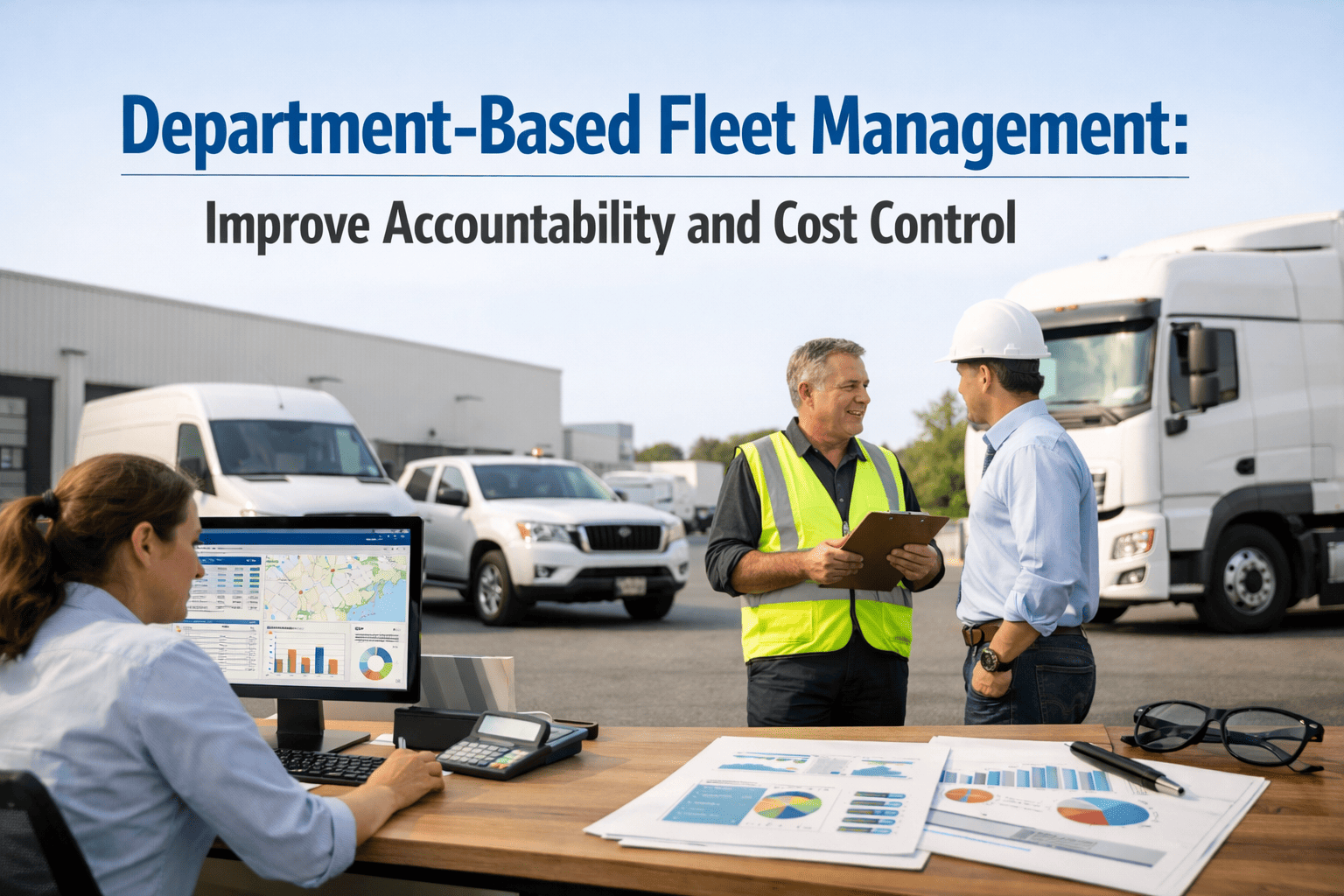
When every vehicle, driver, maintenance cost, and compliance record lives in one undifferentiated pool, nobody owns anything — and nobody is accountable for the costs they create. A 200-vehicle fleet spread across operations, construction, field service, and logistics departments looks like one fleet on the balance sheet but operates as four completely different businesses with different vehicles, different usage patterns, different cost profiles, and different compliance requirements. Department-based fleet management separates this single pool into distinct operational units — each with its own vehicles, drivers, budgets, KPIs, and accountability — while maintaining centralized visibility for leadership. The result is precise cost tracking where every dollar traces back to the department that spent it, clear accountability where every missed inspection or overdue PM has a name attached, and budget control where each department manages its allocation instead of fighting over a shared number. HVI's inspection and maintenance platform supports department-based fleet structures natively — assigning vehicles, drivers, inspections, work orders, and costs to specific departments while giving fleet directors a single dashboard view across the entire organization.
The Cost of Undifferentiated Fleet Management
Before understanding department-based management, you need to see what happens when fleets operate as a single undifferentiated pool. These five problems compound silently until a budget review or audit reveals the damage.
Invisible Cost Allocation
Maintenance, fuel, and repair costs are tracked per vehicle — but not per department. When leadership asks "why did fleet costs increase 18%?", no one can identify which team drove the increase. Hidden costs account for 15–25% of total fleet expenses in undifferentiated structures.
Diffused Accountability
When a DVIR is missed, a PM is overdue, or a vehicle operates with an open defect — who is responsible? In a pooled fleet, the fleet manager carries all accountability while department heads who control driver behavior have none. Problems identified but never owned do not get fixed.
Budget Black Hole
Departments share one fleet budget — creating a tragedy-of-the-commons dynamic. No department has incentive to reduce its own costs because savings are absorbed into the shared pool. Over 60% of multi-department fleets report using three or more disconnected systems, creating data silos that make cost attribution impossible.
Unequal Compliance Exposure
Different departments face different regulations — FMCSA for CDL vehicles, OSHA for equipment, ASME B30 for cranes. A single fleet-wide compliance score hides which department is creating audit risk. One non-compliant department drags the entire fleet's CSA scores down.
How Department-Based Structure Works
Department-based fleet management divides your fleet into logical operational units — each functioning as an accountable entity with its own performance metrics — while keeping everything visible on one centralized platform.
Fleet Director Dashboard
Single-pane view across all departments: total fleet availability, aggregate cost-per-mile, organization-wide compliance score, and cross-department benchmarking
Operations Dept
18 Class 8 tractors, 22 trailers. FMCSA DVIRs + annual DOT inspections. Mileage-based PM. 12 CDL drivers. Department budget: tracked independently.
Construction Dept
8 cranes, 14 excavators, 6 loaders. OSHA + ASME B30 inspections. Hours-based PM. 20 operators. Separate cost center with job-level allocation.
Field Service Dept
30 service vans, 10 utility trucks. Calendar-based PM. 35 technicians. Vehicle utilization and fuel efficiency tracked per team.
What Changes When You Organize by Department
The shift from pooled to department-based fleet management produces measurable improvements across every operational dimension. Start free with HVI and see these improvements on your own fleet within the first month.
Cost Visibility
Pooled Fleet
"Fleet maintenance was $420K last quarter" — no one knows which department caused the 22% increase
Department-Based
"Construction spent $186K (up 34%), Operations $148K (flat), Field Service $86K (down 8%)" — cause identified, action targeted
Accountability
Pooled Fleet
Fleet manager responsible for 200 vehicles across 4 departments with no authority over department driver behavior
Department-Based
Each department head owns their DVIR completion rate, PM compliance, defect response time, and cost-per-mile — with their own dashboard view
Budget Control
Pooled Fleet
Shared budget with no incentive for individual departments to reduce costs — savings absorbed into the common pool
Department-Based
Each department manages its own fleet budget allocation. Cost savings stay within the department — creating incentive to maintain vehicles properly and reduce waste
Compliance
Pooled Fleet
Fleet-wide compliance score hides that Construction is at 72% DVIR completion while Operations is at 96%
Department-Based
Per-department compliance dashboards show exactly where gaps exist. Targeted training for the specific team that needs it — not fleet-wide retraining
Benchmarking
Pooled Fleet
No internal comparison possible — all vehicles averaged together regardless of type, usage, or department
Department-Based
Cross-department benchmarking reveals best practices. When Field Service achieves 97% PM compliance, that becomes the target for Construction and Operations
HVI's platform supports department-based fleet structures natively — assigning vehicles, drivers, inspections, work orders, and costs to specific departments while giving fleet directors organization-wide visibility.
Book a demo to see it configured for your structure. Or
start free.
How HVI Powers Department-Based Fleet Management
HVI is not a generic fleet tool with a department filter added — it is an inspection and maintenance platform built to support multi-department, multi-vehicle-type, multi-regulation operations from the ground up. Sign up free and configure your department structure in the first session.
Vehicle Assignment by Department
Every vehicle is assigned to a specific department. Inspections, work orders, parts costs, and maintenance history are tracked at the department level. When a vehicle transfers between departments, its cost history follows it — maintaining accurate per-department reporting.
Department-Specific Inspection Templates
Operations gets FMCSA DVIR checklists for Class 8 tractors. Construction gets OSHA and ASME B30 crane templates. Field Service gets vehicle-appropriate light/medium-duty checklists. Each department's drivers see only the templates relevant to their equipment — not a one-size-fits-all form.
Per-Department Compliance Dashboards
Each department head sees their own DVIR completion rate, PM compliance percentage, open defects, and inspection thoroughness score. The fleet director sees all departments on one screen — with drill-down into any team's metrics. Compliance gaps are visible at the department level, not hidden in fleet-wide averages.
Cost Allocation & Budget Tracking
Every work order, parts purchase, and maintenance activity is tagged to a department and — optionally — a project or cost center. Fleet directors see cost-per-mile by department, cost trends over time, and cross-department benchmarks. Finance teams get export-ready reports for budget reviews and audits.
Role-Based Access Control
Department managers see their own vehicles and data. Fleet directors see everything. Drivers see their assigned vehicles and personal scorecards. Finance sees cost data without operational details. Every role gets the right view — no more, no less — protecting data integrity while maintaining transparency.
Cross-Department Benchmarking
Compare PM compliance, inspection quality, defect response time, and cost-per-mile across departments on one dashboard. Internal benchmarking identifies which teams are performing well and which need support — with data, not assumptions. Best practices from top-performing departments become targets for the rest.
Accountability Starts with Structure
You cannot improve what you cannot measure — and you cannot measure what you have not structured. Department-based fleet management creates the organizational framework that makes cost tracking precise, accountability clear, compliance visible, and improvement measurable. HVI provides this structure purpose-built for heavy vehicle operations — with multi-vehicle-type templates, multi-regulation compliance, per-department dashboards, and the inspection-to-maintenance chain that makes every department responsible for the vehicles it operates. The fleets achieving declining cost-per-mile, 95%+ compliance rates, and clean DOT audits are not managing one giant pool — they are managing accountable departments, each with clear KPIs, within a centralized platform. Start free and give your departments the visibility and accountability they need.
Structure Your Fleet for Accountability
Department-based management. Per-team cost tracking. Role-based dashboards. Cross-department benchmarking. All on one platform — trusted by 25,000+ users worldwide.
Frequently Asked Questions
Q: What is department-based fleet management?
It is an organizational structure where vehicles, drivers, inspections, work orders, and costs are assigned to specific departments within your organization — rather than managed as one undifferentiated fleet pool. Each department operates as an accountable unit with its own KPIs, budgets, and compliance metrics, while centralized leadership maintains visibility across the entire organization through a single dashboard.
Q: How does HVI support multi-department fleets?
HVI assigns vehicles, drivers, and inspection templates to specific departments natively. Each department gets its own compliance dashboard, cost tracking, and KPIs. Department heads see only their team's data; fleet directors see everything with cross-department benchmarking. Vehicle-specific templates ensure each department gets the correct checklists for its equipment type.
Book a demo to see your department structure configured in HVI.
Q: Can different departments have different inspection requirements?
Yes — HVI provides vehicle-type-specific templates by department. Your operations team running Class 8 tractors gets FMCSA DVIR checklists (37+ items). Your construction team gets OSHA and ASME B30 crane templates (70 items). Your field service team gets light/medium-duty checklists. Each department's drivers see only the templates relevant to their assigned vehicles.
Try it free.
Q: How does department-based management improve cost control?
When every maintenance cost, parts purchase, and repair is tagged to a specific department, you can identify exactly which team drives cost increases — and target corrective action precisely. Departments with their own budget allocations have incentive to maintain vehicles properly because savings stay within their department, not absorbed into a shared pool.
Q: How quickly can I set up department-based structure in HVI?
Most organizations configure their department structure during the initial HVI setup — typically in the first 1–2 days. Vehicle and driver assignments to departments happen during data import. Department-specific templates and compliance dashboards activate immediately. Per-department cost tracking begins from the first inspection and work order.