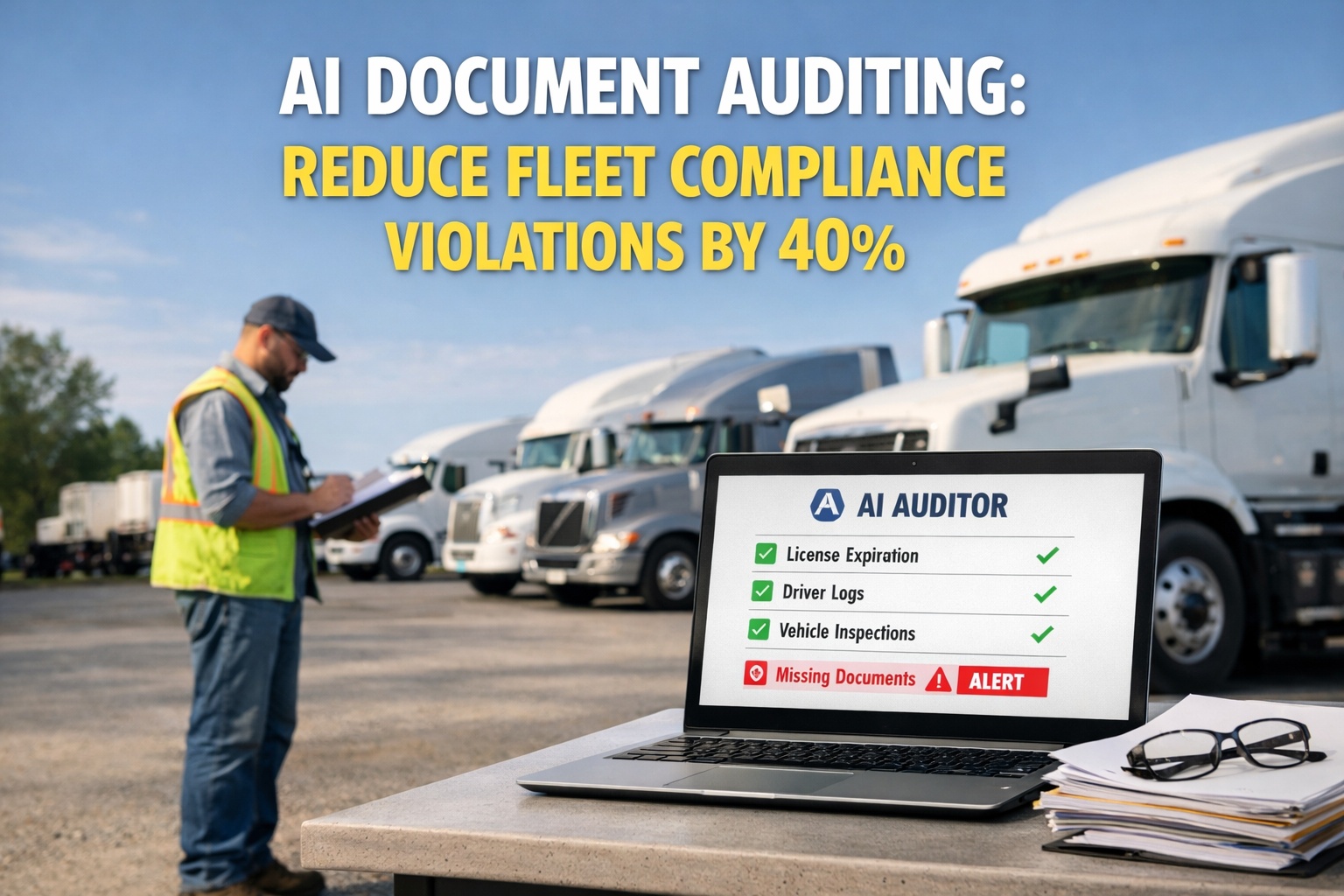
93% of carriers audited in 2025 received at least one violation. The average audit uncovers 6 violations per case, with penalties averaging $7,155 and severe cases exceeding $125,000. The most common finding is not dramatic safety failures — it is paperwork: expired medical certificates (35% of all violations), missing DVIR records, incomplete driver qualification files, and maintenance documentation gaps that a properly maintained system would have caught weeks before the auditor arrived. Manual document tracking cannot keep pace with modern compliance complexity — FMCSA's Safety Measurement System now updates monthly with data published just 10 days after capture, and 2026 regulatory changes (CSA scoring overhaul, eDVIR authorization, stricter Clearinghouse rules) have made the pace of change faster than any spreadsheet can follow. AI document auditing changes this entire equation: it scans every record continuously, flags expirations before they happen, identifies inconsistencies humans miss, and generates audit-ready compliance packages on demand. Fleets using AI-powered compliance automation report up to 40% reduction in violations — and more importantly, join the 7% of carriers that pass DOT audits without a single finding. HVI's AI document auditing brings this capability to your inspection, maintenance, and compliance workflows on one integrated platform.
The Compliance Reality That Most Fleets Ignore
Before AI auditing can reduce your violations, you need to see where those violations actually come from. The pattern is remarkably consistent across fleets — and remarkably preventable.
93%
Carriers Audited Found at Least One Violation
Industry data from FMCSA 2025 investigations
6
Average Violations Per Audit
Most are paperwork failures — not safety issues
$7,155
Average Penalty Per Audited Carrier
Severe cases exceed $125,000
35%
Violations Are Expired Medical Certificates
100% preventable with automated alerts
Why Manual Document Auditing Fails at Scale
Fleet document compliance involves tracking hundreds of time-sensitive records per driver, per vehicle, and per regulation — with different retention periods, different expiration cycles, and different audit requirements. Here is what that complexity actually looks like.
Driver Qualification Files
CDL, MVR, medical cert, road test, previous employment, drug/alcohol records
3 years post-termination
Medical Certificates
DOT physical certificates, expiration dates, renewal tracking
1 year + 6 months
DVIRs
Daily inspection reports, defect documentation, 3-signature chain
3 months minimum
Annual DOT Inspections
Vehicle inspection reports, inspector qualifications, sticker tracking
14 months
HOS Records
ELD logs, supporting documents, duty status changes
6 months
Maintenance Records
PM history, repair records, parts used, technician sign-off
Vehicle service life + 6 months
Clearinghouse Queries
Pre-employment full queries, annual limited queries, 24-hour reporting
3 years
Accident Register
DOT-reportable crashes, investigation records, resolution documentation
3 years
For a 50-driver fleet, that means over 400 active documents with rolling expirations — and that is before counting the vehicle-specific records. At 200 drivers, it is 1,600 documents. Manual tracking systems do not fail because people are careless. They fail because the math exceeds human capacity.
How AI Document Auditing Works
AI document auditing is not a single technology — it is four capabilities working together to deliver continuous compliance verification. Each capability addresses a specific failure point in manual document management. Start free with HVI to see AI auditing on your own fleet's documents.
01
Automated Expiration Monitoring
AI tracks every time-sensitive document continuously — medical certificates, CDLs, MVRs, annual inspections, Clearinghouse queries, registration renewals. Alerts fire at 60, 30, and 7 days before expiration. Escalation to supervisors if action is not taken. Zero expired documents at roadside — the most common and most preventable audit finding eliminated entirely.
02
Document Content Analysis
AI analyzes uploaded documents in real time — identifying missing information, incorrect dates, inconsistent data across forms, and potential DOT and FCRA compliance issues. When a driver uploads a medical certificate, the AI verifies the expiration date, examiner credentials, and restriction codes — flagging problems immediately instead of at the next audit.
03
Cross-Reference Verification
AI cross-checks data across documents to catch inconsistencies that destroy audit defensibility. Does the ELD duty status match the fuel receipt timing? Does the DVIR sign-off time match the GPS location? Does the maintenance record match the vehicle history? When records do not align, the AI flags them before a DOT auditor finds the gap.
04
Instant Audit Package Generation
When an audit notice arrives, AI generates complete compliance packages on demand — DQ files, HOS records, DVIRs, maintenance logs, drug testing records, and Clearinghouse documentation — organized exactly as FMCSA auditors expect. Pre-audit gap analysis identifies missing documents before the auditor arrives, giving you time to correct issues that would otherwise become violations.
The 40% Violation Reduction: Where It Comes From
The 40% reduction in compliance violations is not a marketing number — it comes from eliminating specific categories of failures that cause most audit findings. Here is where the reduction actually happens.
Expired Credentials
35% of all audit violations
0% with automated expiration tracking
DVIR Documentation Gaps
22% of maintenance-related findings
Eliminated by 3-signature chain enforcement
Missed Clearinghouse Queries
Common DQ file finding
Auto-scheduled with 30-day lookahead alerts
HOS-ELD Data Inconsistencies
62% of citations from HOS/ELD category
AI cross-references ELD with supporting docs
Missing Maintenance Records
Common 49 CFR 396.3 violation
Auto-generated from inspection-to-work-order chain
Incomplete DQ Files
Frequent new-hire compliance gap
AI verifies completeness at upload time
What Changes When AI Handles Document Auditing
The shift from manual to AI-powered document auditing produces measurable changes across every dimension of fleet compliance operations.
40%
Violation Reduction
Fleets using AI document auditing report up to 40% fewer compliance violations in their first year — with continued improvement as historical data builds the AI's fleet-specific accuracy.
75%
Faster Audit Preparation
What took days of scrambling through filing cabinets now takes minutes. AI generates complete audit packages on demand — organized exactly as FMCSA expects.
90%
Reduction in Compliance Gaps
AI identifies expiring credentials, missing documents, and data inconsistencies before they become audit findings. Gaps that would surface during a DOT review are closed weeks in advance.
12+ hrs
Admin Time Saved Weekly
The average fleet manager spends 12+ hours per week on compliance paperwork. AI automation reduces this to minutes of review time — freeing managers to focus on operational improvement.
3x
Faster DOT Audit Pass Rate
Fleets using digital document systems with AI verification pass DOT audits 3x faster than paper-based operations — with significantly higher clean-pass rates.
7%
Join the Clean-Audit Club
Only 7% of carriers pass DOT audits without a single violation. Fleets using AI document auditing consistently join this top tier — with measurable CSA score improvements and insurance premium reductions.
Compliance Becomes Continuous, Not Reactive
The fleets that get destroyed by DOT audits are not the ones running unsafe operations — they are the ones whose documentation cannot keep pace with their actual compliance. Expired certificates, missed queries, incomplete files, and inconsistent records add up to five-figure penalties that better paperwork would have prevented. AI document auditing eliminates this gap by making compliance continuous instead of reactive: every record monitored constantly, every expiration flagged in advance, every inconsistency caught before it appears on an inspection report, and every audit package ready on demand. HVI brings this capability to heavy vehicle fleets — integrated with inspections, maintenance, and driver records on one platform that keeps your fleet audit-ready every day of the year. Sign up free and see how AI auditing changes your compliance position within the first month.
Reduce Compliance Violations with AI Document Auditing
Continuous document monitoring. Automated expiration alerts. Cross-reference verification. Instant audit packages. All on one platform — trusted by 25,000+ users worldwide.
Frequently Asked Questions
Q: What is AI document auditing?
AI document auditing uses artificial intelligence to continuously monitor fleet compliance records — driver qualification files, medical certificates, DVIRs, maintenance logs, HOS records, and Clearinghouse queries. The AI scans documents in real time, flags expirations before they happen, identifies inconsistencies across records, and generates audit-ready packages on demand. It replaces the reactive "find problems during audits" model with continuous verification that catches issues before they become violations.
Q: How does AI auditing actually reduce violations by 40%?
Most compliance violations come from preventable failures: expired credentials (35% of findings), documentation gaps (22%), missed Clearinghouse queries, and data inconsistencies. AI eliminates each category through automated expiration tracking, 3-signature DVIR chain enforcement, auto-scheduled queries with lookahead alerts, and cross-reference verification. The 40% reduction compounds across all these categories — with measurable results within 90 days.
Try HVI free.
Q: How is this different from standard document management software?
Standard document management stores files. AI auditing analyzes them. Standard systems send date-based reminders. AI systems verify content, cross-reference data across documents, identify inconsistencies, and generate audit packages on demand. The difference is between a filing cabinet with a calendar and an active compliance verification system that catches problems before they become audit findings.
Q: What documents does HVI's AI auditor cover?
HVI covers the full FMCSA compliance document set: DVIRs with 3-signature chains, annual DOT inspections, maintenance records per 49 CFR 396.3, driver qualification files, medical certificates, CDLs, MVRs, Clearinghouse queries, drug/alcohol testing records, and accident registers. For heavy equipment operations, it adds OSHA inspection records and ASME B30 crane certifications.
Book a demo to see document coverage for your fleet type.
Q: How quickly do fleets see results from AI document auditing?
Most fleets see immediate improvements: zero expired credentials within the first 30 days as the AI catches and flags every upcoming expiration. Complete audit readiness within 60 days as the full document set is digitized and verified. Measurable violation reduction within 90 days as inspection patterns improve. Full 40% reduction typically achieved within the first year as historical data builds fleet-specific AI accuracy.